

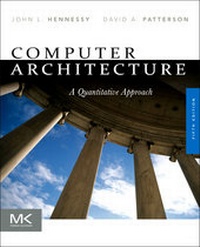
Computer Architecture
A Quantitative Approach
5th Edition
Published on 25. October 2011
Book
Paperback/Softback
856 pages
978-0-12-383872-8 (ISBN)
Description
Computer Architecture: A Quantitative Approach, Fifth Edition, explores the ways that software and technology in the cloud are accessed by digital media, such as cell phones, computers, tablets, and other mobile devices. The book, which became a part of Intel's 2012 recommended reading list for developers, covers the revolution of mobile computing. It also highlights the two most important factors in architecture today: parallelism and memory hierarchy.
This fully updated edition is comprised of six chapters that follow a consistent framework: explanation of the ideas in each chapter; a crosscutting issues section, which presents how the concepts covered in one chapter connect with those given in other chapters; a putting it all together section that links these concepts by discussing how they are applied in real machine; and detailed examples of misunderstandings and architectural traps commonly encountered by developers and architects. Formulas for energy, static and dynamic power, integrated circuit costs, reliability, and availability are included. The book also covers virtual machines, SRAM and DRAM technologies, and new material on Flash memory. Other topics include the exploitation of instruction-level parallelism in high-performance processors, superscalar execution, dynamic scheduling and multithreading, vector architectures, multicore processors, and warehouse-scale computers (WSCs). There are updated case studies and completely new exercises. Additional reference appendices are available online.
This book will be a valuable reference for computer architects, programmers, application developers, compiler and system software developers, computer system designers and application developers.
This fully updated edition is comprised of six chapters that follow a consistent framework: explanation of the ideas in each chapter; a crosscutting issues section, which presents how the concepts covered in one chapter connect with those given in other chapters; a putting it all together section that links these concepts by discussing how they are applied in real machine; and detailed examples of misunderstandings and architectural traps commonly encountered by developers and architects. Formulas for energy, static and dynamic power, integrated circuit costs, reliability, and availability are included. The book also covers virtual machines, SRAM and DRAM technologies, and new material on Flash memory. Other topics include the exploitation of instruction-level parallelism in high-performance processors, superscalar execution, dynamic scheduling and multithreading, vector architectures, multicore processors, and warehouse-scale computers (WSCs). There are updated case studies and completely new exercises. Additional reference appendices are available online.
This book will be a valuable reference for computer architects, programmers, application developers, compiler and system software developers, computer system designers and application developers.
Reviews / Votes
"What has made this book an enduring classic is that each edition is not an update, but an extensive revision that presents the most current information and unparalleled insight into this fascinating and fast changing field. For me, after over twenty years in this profession, it is also another opportunity to experience that student-grade admiration for two remarkable teachers." --From the Foreword by Luiz Andre Barroso, Google, Inc."This is an academic textbook that is also suitable for a far broader readership. Each chapter is organised in the same structure, with the main content supported by case studies and exercises... Having read this book I now have a far better understanding of why processors from all the different designers and manufacturers are so different. Memory hierarchies, multicore architectures and compiler optimisation are all covered in great detail. I was particularly interested in their discussion of graphical processing units and how they are suitable for far more than just graphical workloads... What is great about this book is that it moves with the times. There is a lot of content on processors for mobile computing, and power usage is a pervasive theme. At the other extreme there is an excellent chapter on warehouse scale computers, which offers tremendous insight into the cloud computing infrastructure provided by Google, Amazon and others. If your job has anything to do with IT infrastructure then I recommend this book as a must-read. As an academic text book it has both depth and breadth. And if you're just interested in the topic you'll gain a huge amount of insight into the fundamentals of computer architecture." --The Chartered Institute for IT
More details
Series
Edition
5th edition
Language
English
Place of publication
San Francisco
United States
Publishing group
Elsevier Science & Technology
Target group
Professional and scholarly
Computer Architects, Computer System Designers, Compiler and System Software Developers, Programmers, Application Developers
Illustrations
45 illustrations
Dimensions
Height: 235 mm
Width: 191 mm
Weight
1700 gr
ISBN-13
978-0-12-383872-8 (9780123838728)
Copyright in bibliographic data and cover images is held by Nielsen Book Services Limited or by the publishers or by their respective licensors: all rights reserved.
Schweitzer Classification
Other editions
New editions
John L. Hennessy | David A. Patterson | Christos Kozyrakis
Computer Architecture
A Quantitative Approach
Book
11/2025
7th Edition
Morgan Kaufmann
€104.50
Available immediately
Book
12/2017
6th Edition
Morgan Kaufmann
€106.45
Article exhausted; check for reprint

John L. Hennessy | David A. Patterson
Computer Architecture
A Quantitative Approach: Fifth Multimedia Edition
Book
02/2016
5th Edition
Morgan Kaufmann
€87.35
No shipping information available
Previous edition
Book
11/2006
4th Edition
Morgan Kaufmann
€54.46
Article exhausted; check for reprint
Persons
ACM named John L. Hennessy a recipient of the 2017 ACM A.M. Turing Award for pioneering a systematic, quantitative approach to the design and evaluation of computer architectures with enduring impact on the microprocessor industry. John L. Hennessy is a Professor of Electrical Engineering and Computer Science at Stanford University, where he has been a member of the faculty since 1977 and was, from 2000 to 2016, its tenth President. Prof. Hennessy is a Fellow of the IEEE and ACM; a member of the National Academy of Engineering, the National Academy of Science, and the American Philosophical Society; and a Fellow of the American Academy of Arts and Sciences. Among his many awards are the 2001 Eckert-Mauchly Award for his contributions to RISC technology, the 2001 Seymour Cray Computer Engineering Award, and the 2000 John von Neumann Award, which he shared with David Patterson. He has also received seven honorary doctorates. David Patterson is the Pardee Professor of Computer Science, Emeritus at the University of California at Berkeley, which he joined after graduating from UCLA in 1977.His teaching has been honored by the Distinguished Teaching Award from the University of California, the Karlstrom Award from ACM, and the Mulligan Education Medal and Undergraduate Teaching Award from IEEE. Prof. Patterson received the IEEE Technical Achievement Award and the ACM Eckert-Mauchly Award for contributions to RISC, and he shared the IEEE Johnson Information Storage Award for contributions to RAID. He also shared the IEEE John von Neumann Medal and the C & C Prize with John Hennessy. Like his co-author, Prof. Patterson is a Fellow of the American Academy of Arts and Sciences, the Computer History Museum, ACM, and IEEE, and he was elected to the National Academy of Engineering, the National Academy of Sciences, and the Silicon Valley Engineering Hall of Fame. He served on the Information Technology Advisory Committee to the U.S. President, as chair of the CS division in the Berkeley EECS department, as chair of the Computing Research Association, and as President of ACM. This record led to Distinguished Service Awards from ACM, CRA, and SIGARCH.
Content
Printed TextChap 1: Fundamentals of Quantitative Design and AnalysisChap 2: Memory Hierarchy DesignChap 3: Instruction-Level Parallelism and Its ExploitationChap 4: Data-Level Parallelism in Vector, SIMD, and GPU ArchitecturesChap 5: Multiprocessors and Thread-Level ParallelismChap 6: The Warehouse-Scale ComputerApp A: Instruction Set PrinciplesApp B: Review of Memory HierarchyApp C: Pipelining: Basic and Intermediate Concepts
OnlineApp D: Storage SystemsApp E: Embedded SystemsApp F: Interconnection NetworksApp G: Vector ProcessorsApp H: Hardware and Software for VLIW and EPICApp I: Large-Scale Multiprocessors and Scientific ApplicationsApp J: Computer Arithmetic App K: Survey of Instruction Set ArchitecturesApp L: Historical Perspectives
OnlineApp D: Storage SystemsApp E: Embedded SystemsApp F: Interconnection NetworksApp G: Vector ProcessorsApp H: Hardware and Software for VLIW and EPICApp I: Large-Scale Multiprocessors and Scientific ApplicationsApp J: Computer Arithmetic App K: Survey of Instruction Set ArchitecturesApp L: Historical Perspectives