

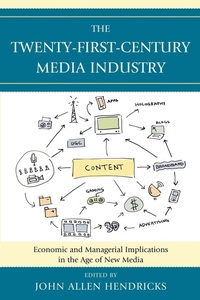
The Twenty-First-Century Media Industry
Economic and Managerial Implications in the Age of New Media
Published on 15. July 2011
Book
Paperback/Softback
312 pages
978-0-7391-4004-8 (ISBN)
Description
The Twenty-First-Century Media Industry: Economic and Managerial Implications in the Age of New Media examines the role that new media technologies are having on the traditional media industry from a media management perspective. Consumer behaviors and consumer expectations are being shaped by new media technologies. They now expect information on-demand and on-the-go as well as at their finger-tips via the Internet. In order to stay relevant, traditional media managers and practitioners are adapting to these consumer demands and expectations by developing new business models and new business philosophies to stay competitive. The contributors to this volume explore the business strategies being implemented by some media industries such as newspapers and the recording industry who are struggling to not only remain competitive and profitable, but also to survive. The Twenty-First-Century Media Industry provides an intriguing examination of how traditional media industries are adapting to new media technologies and evolving in the twenty-first century.
Reviews / Votes
The 21st Century Media Industry is well worth reading not only for its broad scope, but for the timeliness of the chapters. Readers of this book will come away with a clear conceptual map of the changing media landscape as well as a detailed understanding of the challenges of the years ahead in forging a new business model, or set of business models, for media operating in the digital age. -- John V. Pavlik, Rutgers University Predicting the future of the media industry at this juncture may sound audacious, yet this volume does so, and the future it presents is auspicious. The 13 chapters-all by US academicians and media scholars with impressive credentials-address possible approaches to media management, new technologies and innovations, and the implications of various media: recorded music, print, journalism, cable and broadcasting (including radio), cinema, the Internet, mobile telephones. Media have saturated modern society for the past 50 years. The opening essay, coauthored by Hendricks (Stephen F. Austin State Univ.) and Susan Smith, notes that "the latter half of the twentieth century saw an explosion in the communication industry [with] personal computers, satellites, cable television, cell phones, digital and high definition television, DVDs and the World Wide Web." But, the essay goes on to observe, the change is not in the media per se but rather in the "delivery systems." That the book does not offer an exact definition of the term "new media" is only right, given that in the 1450s the printing press was a "new medium." Summing Up: Highly recommended. Upper-division undergraduates through faculty. * Choice Reviews *More details
Series
Language
English
Place of publication
United States
Publishing group
Bloomsbury Publishing Plc
Target group
Professional and scholarly
Dimensions
Height: 229 mm
Width: 152 mm
Thickness: 18 mm
Weight
509 gr
ISBN-13
978-0-7391-4004-8 (9780739140048)
Copyright in bibliographic data and cover images is held by Nielsen Book Services Limited or by the publishers or by their respective licensors: all rights reserved.
Schweitzer Classification
Other editions
Additional editions
The Twenty-First-Century Media Industry
Economic and Managerial Implications in the Age of New Media
E-Book
06/2010
1st Edition
Lexington Books
€48.99
Available for download
The Twenty-First-Century Media Industry
Economic and Managerial Implications in the Age of New Media
E-Book
06/2010
1st Edition
Lexington Books
€48.99
Available for download
Persons
John Allen Hendricks is the director of the division of communication and contemporary culture and professor of communication at Stephen F. Austin State University.
Content
Dedication
List of Tables
List of Figures
Foreword
Acknowledgments: Change: Technology, Economic Implications, and Consumer Behaviors
1: New Media: New Technology, New Ideas or New Headaches
2: Media Management: The Changing Media Industry and Adaptability
3: DVRs and the Empowered Audience: A Transformative New Media Technology Takes Off
4: The Obstinate Audience Revisited: The Decline of Network Advertising
5: Going Viral: Mass Media Meets Innovation
6: The First Domino: The Recorded Music Industry and New Technology
7: Changes and Challenges in the Print Industry: The New Landscape of the Print Media
8: Challenges and Opportunities, New Models and the Emergence of the Next Newsroom
9: Broadcast and Cable on the Third Screen: Moving Television Content to Mobile Devices
10: How to Reach the Masses: Broadcasters' Uses of the Internet and Cell Phones
11: Making Money with Mobile
12: Cinema in the Age of RWX Culture
13: Local Market Radio: Programming and Operations in a New Media World
About the Editor
About the Contributors
Bibliography
Index
List of Tables
List of Figures
Foreword
Acknowledgments: Change: Technology, Economic Implications, and Consumer Behaviors
1: New Media: New Technology, New Ideas or New Headaches
2: Media Management: The Changing Media Industry and Adaptability
3: DVRs and the Empowered Audience: A Transformative New Media Technology Takes Off
4: The Obstinate Audience Revisited: The Decline of Network Advertising
5: Going Viral: Mass Media Meets Innovation
6: The First Domino: The Recorded Music Industry and New Technology
7: Changes and Challenges in the Print Industry: The New Landscape of the Print Media
8: Challenges and Opportunities, New Models and the Emergence of the Next Newsroom
9: Broadcast and Cable on the Third Screen: Moving Television Content to Mobile Devices
10: How to Reach the Masses: Broadcasters' Uses of the Internet and Cell Phones
11: Making Money with Mobile
12: Cinema in the Age of RWX Culture
13: Local Market Radio: Programming and Operations in a New Media World
About the Editor
About the Contributors
Bibliography
Index