

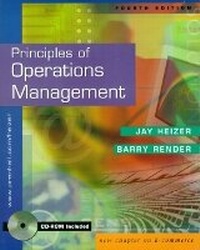
Operations Management
International Edition
7th Edition
Published on 18. March 2003
Book
Mixed media product
848 pages
978-0-13-120974-9 (ISBN)
Description
For the introductory Operations Management course, at both the undergraduate and graduate level. This text provides students with a state-of-the-art overview of operations management. This text is available in two versions: Operations Management, Seventh Edition, which is hardcover, and Principles of Operations Management, Fifth Edition, a paperback.
More details
Edition
7th edition
Language
English
Place of publication
United States
Publishing group
Pearson Education (US)
Target group
Professional and scholarly
Dimensions
Height: 275 mm
Width: 215 mm
Thickness: 32 mm
Weight
1728 gr
ISBN-13
978-0-13-120974-9 (9780131209749)
Copyright in bibliographic data and cover images is held by Nielsen Book Services Limited or by the publishers or by their respective licensors: all rights reserved.
Schweitzer Classification
Other editions
New editions

Jay Heizer | Barry Render
Operations Management & Student CD Package
Book
08/2005
8th Edition
Pearson
€62.04
Article exhausted; check for reprint
Previous edition
Book
12/2002
6th Edition
Pearson
€49.64
Article exhausted; check for reprint
Content
(NOTE: Both books include the identical core chapters 1-17. However, Operations Management, Seventh Edition, also includes six quantitative modules in Part IV (See table of contents for details). Five CD-ROM Bonus Chapters are on the Student CD that accompanies both texts.)Operations Management, 7/e I. INTRODUCTION TO OPERATIONS MANAGEMENT. 1. Operations and Productivity. 2. Operations Strategy in a Global Environment. 3. Project Management. 4. Forecasting. II. DESIGNING OPERATIONS. 5. Design of Goods and Services. 6. Managing Quality. 6S. Statistical Process Control. 7. Process Strategy. 7S. Capacity Planning. 8. Location Strategies. 9. Layout Strategy. 10. Human Resources and Job Design. 10S. Work Measurement. III. MANAGING OPERATIONS. 11. Supply Chain Management. 11S. E-Commerce and Operations Management. 12. Inventory Management. 13. Aggregate Planning. 14. Material Requirement Planning and ERP. 15. Short-Term Scheduling. 16. Just-In-Time and Lean Systems. 17. Maintenance and Reliability. IV. QUANTITATIVE MODULES. A. Decision Making Tools. B. Linear Programming. C. Transportation Models. D. Waiting Line Models. E. Learning Curves. F. Simulation. Principles of Operations Management, 5/e I. INTRODUCTION TO OPERATIONS MANAGEMENT. 1. Operations and Productivity. 2. Operations Strategy in a Global Environment. 3. Project Management. 4. Forecasting. II. DESIGNING OPERATIONS. 5. Design of Goods and Services. 6. Managing Quality. 6S. Statistical Process Control. 7. Process Strategy. 7S. Capacity Planning. 8. Location Strategies. 9. Layout Strategy. 10. Human Resources and Job Design. 10S. Work Measurement. III. MANAGING OPERATIONS. 11. Supply Chain Management. 11S. E-Commerce and Operations Management. 12. Inventory Management. 13. Aggregate Planning. 14. Material Requirement Planning and ERP. 15. Short-Term Scheduling. 16. Just-In-Time and Lean Systems. 17. Maintenance and Reliability. CD-ROM Bonus Chapters 1. Statistical Tools for Managers. 2. Acceptance Sampling. 3. The Simplex Method of LP. 4. The MODI and VAM Methods. 5. Vehicle Scheduling and Routing.