

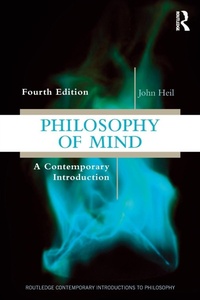
Philosophy of Mind
A Contemporary Introduction
4th Edition
Published on 6. September 2019
Book
Paperback/Softback
264 pages
978-1-138-58101-2 (ISBN)
Description
The book is intended as a reader-friendly introduction to issues in the philosophy of mind, including mental-physical causal interaction, computational models of thought, the relation minds bear to brains, and assorted -isms: behaviorism, dualism, eliminativism, emergentism, functionalism, materialism, neutral monism, and panpsychism. The Fourth Edition reintroduces a chapter on Donald Davidson and a discussion of 'Non-Cartesian Dualism', along with a wholly new chapter on emergence and panpsychism. A concluding chapter draws together material in earlier chapters and offers what the author regards as a plausible account of the mind's place in nature. Suggested readings at the conclusion of each chapter have been updated, with a focus on accessible, non-technical material.
Key Features of the Fourth Edition
Includes a new chapter, 'Emergence and Panpsychism' (Chapter 13), reflecting growing interest in these areas
Reintroduces and updates a chapter on Donald Davidson, 'Radical Interpretation' (Chapter 8), which was excised from the previous edition
Updates 'Descartes' Legacy' (Chapter 3) to include a discussion of E. J. Lowe's arresting 'Non-Cartesian Dualism', also removed from the previous edition
Includes a highly revised final chapter, which draws together much of the previous material and sketches a plausible account of the mind's place in nature
Updated 'Suggested Reading' lists at the end of each chapter
Key Features of the Fourth Edition
Includes a new chapter, 'Emergence and Panpsychism' (Chapter 13), reflecting growing interest in these areas
Reintroduces and updates a chapter on Donald Davidson, 'Radical Interpretation' (Chapter 8), which was excised from the previous edition
Updates 'Descartes' Legacy' (Chapter 3) to include a discussion of E. J. Lowe's arresting 'Non-Cartesian Dualism', also removed from the previous edition
Includes a highly revised final chapter, which draws together much of the previous material and sketches a plausible account of the mind's place in nature
Updated 'Suggested Reading' lists at the end of each chapter
Reviews / Votes
"This is an excellent introduction to the philosophy of mind. The book is admirably wide ranging, exemplifying Heil's vast knowledge of the field. It is also impressively accessible, without ever sacrificing faithfulness to the difficult issues it discusses. Furthermore, thanks to Heil's characteristic stylistic flair and unpretentiousness, it's consistently fun to read. The new edition contains many welcome additions. It features an important new chapter on emergence and panpsychism, in which Heil manages to capture the core of these popular positions without becoming bogged down in the notorious technicalities that affect these areas. The volume also contains the most accessible introduction to Davidson's views on radical interpretation that I have ever read, carefully placing all the pieces in place one by one in a reader-friendly manner. I was also especially pleased to see the reintroduction of a discussion of Non-Cartesian Substance Dualism. This volume will serve as a great introduction for advanced undergraduates, graduate students, and professionals in the field, especially for those who approach philosophy of mind through the lens of metaphysics." - Henry Taylor, University of Birmingham, UK"Heil's book is a super reader-friendly introduction to a notoriously difficult subject that still manages to be challenging and wide-ranging enough to interest the advanced reader. I particularly like that it is not merely an attempt to impartially survey the full range of issues and arguments in contemporary philosophy of mind. Heil also engages with them with a sense of urgency and excitement that is contagious." - R.D. Ingthorsson, Lund University, Sweden
"This is the kind of textbook that gives philosophy a good name. Lucid, comprehensive, and impeccably fair, it conveys the excitement of philosophical questions about the mind while at the same time providing a very broad survey of the field. Students will appreciate the perspicacious explanations and lively examples, and teachers will welcome the directness and lack of obscurantism. Moreover, it can be used either as a stand-alone text or in conjunction with journal articles and other primary sources, many of which are mentioned in the "Suggested Reading" sections that follow each chapter." - Muhammad Ali Khalidi, York University, Canada
More details
Series
Edition
4th edition
Language
English
Place of publication
London
United Kingdom
Publishing group
Taylor & Francis Ltd
Target group
College/higher education
Illustrations
41 s/w Zeichnungen, 41 s/w Abbildungen
41 Line drawings, black and white; 41 Illustrations, black and white
Dimensions
Height: 229 mm
Width: 152 mm
Thickness: 16 mm
Weight
424 gr
ISBN-13
978-1-138-58101-2 (9781138581012)
Copyright in bibliographic data and cover images is held by Nielsen Book Services Limited or by the publishers or by their respective licensors: all rights reserved.
Schweitzer Classification
Other editions
New editions
Book
approx. 01/2026
5th Edition
Routledge
€65.40
Not yet published
Additional editions

Book
09/2019
4th Edition
Routledge
€183.50
Shipment within 10-20 days
Previous edition
Book
12/2012
3rd Edition
Routledge
€62.15
Article exhausted; check for reprint
Person
John Heil is Professor of Philosophy at Washington University in St. Louis and Durham University, and an Honorary Research Associate at Monash University. His recent publications include Appearance in Reality (forthcoming), The Universe As We Find It (2012), and From an Ontological Point of View (2003).
Content
1. Introduction
2. Cartesian Dualism
3. Descartes's Legacy
4. Mind and Behavior
5. The Identity Theory
6. Functionalism
7. The Representational Theory of Mind
8. Radical Interpretation
9. The Intentional Stance
10. Eliminativism
11. Non-Reductive Physicalism
12. Consciousness
13. Emergency and Panpsychism
14. The Mind's Place in Nature
2. Cartesian Dualism
3. Descartes's Legacy
4. Mind and Behavior
5. The Identity Theory
6. Functionalism
7. The Representational Theory of Mind
8. Radical Interpretation
9. The Intentional Stance
10. Eliminativism
11. Non-Reductive Physicalism
12. Consciousness
13. Emergency and Panpsychism
14. The Mind's Place in Nature