

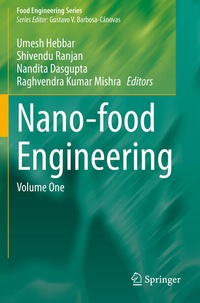
Nano-food Engineering
Volume One
Published on 8. August 2021
Book
Paperback/Softback
X, 389 pages
978-3-030-44554-6 (ISBN)
Description
This extensive and singular work focuses on current applications of nanotechnology in food systems. The functionality and applicability of food-related nanotechnology is covered in depth, presenting a view on the food processing, packaging,storage and safety assessment of nanotechnology in the food industry. Multiple nanostructures are covered, each with their specific ingredient choice, production strategy, functionality and application in food engineering. Individual chapters focus on current processing methods and applications of nanotechnology in foods. Nano-food Engineering Volume One brings together panels of highly accomplished experts in the field of composites, nanotechnology and chemical engineering and food technology. The work encompasses basic studies and addresses novel issues, covering all engineering aspects, opportunities and challenges and solutions of nano-foods.
More details
Series
Edition
2020 ed.
Language
English
Place of publication
Cham
Switzerland
Publishing group
Springer International Publishing
Target group
Professional and scholarly
Illustrations
104 farbige Abbildungen, 50 s/w Abbildungen
X, 389 p. 154 illus., 104 illus. in color.
Dimensions
Height: 235 mm
Width: 155 mm
Thickness: 22 mm
Weight
604 gr
ISBN-13
978-3-030-44554-6 (9783030445546)
DOI
10.1007/978-3-030-44552-2
Schweitzer Classification
Other editions
Additional editions
Book
08/2020
Springer
€181.89
Shipment within 7-9 days
Persons
Umesh Hebbar is a
Senior Principal Scientist & Head of the Department of Technology Scale-up, CSIR-CFTRI, in Mysuru, India.
Shivendu Ranjan is a Research-Fellow at VIT University, Vellore in Tamil Nadu, India.
Nandita Dasgupta is a Research Associate at VIT University, Vellore in Tamil Nadu, India.
Raghvendra Kumar Mishra is a Research Fellow at Mahatma Gandhi University in Kottayam, Kerala, India.
Content
Introduction to Nanofood.- Supercritical Fluid Techniques to fabricate efficient nanoencapsulated food-grade materials.- Preparation methods and advantages of nano-sorbents for food contaminants determination.- Inclusion Complexation and Coacervation to fabricate Nanoencapsulated foods.- Principles and Potential Applications of Cavitation Technology for Nano-Foods.- Microfluidization Technique in Nano-Food Engineering.- Biopolymer Nanocomposite based food packaging.- Nanotechnology applications to improve solubility of bioactive constituents of foods for health-promoting purposes.- Emerging Sustainable Nanostructured Materials Facilitated by Herbal Bioactive Agents for Edible Food Packaging.- Nano-films for food packaging.- Spray drying as for food-grade nanomaterial.- Nanosensors for foods.- Index.