

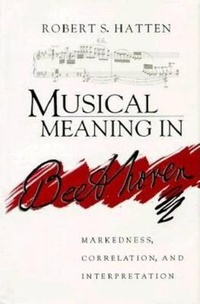
Musical Meaning in Beethoven
Markedness, Correlation and Interpretation
Published on 1. July 1994
Book
Hardback
372 pages
978-0-253-32742-0 (ISBN)
Description
"Musical Meaning in Beethoven" offers a fresh approach to the problem of expressive meaning in music. Beginning with a provocative analysis of the slow movement of the Hammerklavier piano sonata, Robert S. Hatten examines the roles of markedness, Classical topics, expressive genres, and musical tropes in fostering expressive interpretation at all levels of structure. Close readings of movements from Beethoven's late piano sonatas and string quartets highlight less-obvious expressive meanings and explain how more-familiar general meanings are consistently cued from one work to the next. Hatten's model of musical meaning is grounded in the semiotic principles of Charles Sanders Pierce, Umberto Eco, and Michael Shapiro, and in the theoretical and historical contributions of Leonard B. Meyer, Charles Rosen, and Leonard Ratner. Radically departing from the nineteenth-century Formalist aesthetics of Eduard Hanslick and Formalist theories underlying twentieth-century tonal analysis, the author argues that expressive meaning is not extramusical but fundamental to the reconstruction of compositional practice and stylistic understanding, even for the "absolute" works of Beethoven.
More details
Series
Language
English
Place of publication
Bloomington, IN
United States
Target group
Professional and scholarly
Illustrations
34figs.76mus.exs.
Dimensions
Height: 235 mm
Width: 156 mm
Weight
500 gr
ISBN-13
978-0-253-32742-0 (9780253327420)
Copyright in bibliographic data and cover images is held by Nielsen Book Services Limited or by the publishers or by their respective licensors: all rights reserved.
Schweitzer Classification
Other editions
New editions
Book
10/2004
Indiana University Press
€27.27
Shipment within 10-20 days
Content
Foreword by David Lidov Preface Introduction Part I. Interpretation and Theory I. A Case Study for Interpretation The Third Movement of Op. 106 (Hammerklavier) II. Correlation, Interpretation, and the Markedness of Oppositions III. From Topic to Expressive Genre IV. The Pastoral Expressive Genre The Four Movements of Op. 101 V. The Thematic Level and the Markedness of Classical Material VI. Thematic Markedness The First Movements of Op. 130 and Op. 131 VII. Beyond the Hierarchies of Correlation Troping, Irony, Levels of Discourse, and Intertextuality VIII. Analysis and Synthesis The Cavatina from Op. 130 IX. From the Aesthetic to me Semiotic X. Further Perspectives on Musical Meaning and Cognition Conclusion Appendix: Abnegation and the New Genre Glossary Notes Bibliography Index of Concepts Index of Names and Works