

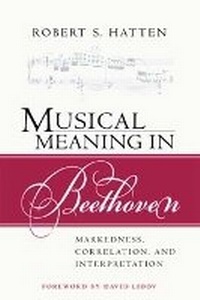
Musical Meaning in Beethoven
Markedness, Correlation, and Interpretation
Published on 20. October 2004
Book
Paperback/Softback
368 pages
978-0-253-21711-0 (ISBN)
Description
"Hatten's interpretations are at times surprisingly poetic in their expression. . . . In his book he effectively creates an interaction between aspects of music theory, analysis, aesthetics and semiotics. His work yields some novel insights that deserve careful consideration from anyone in these fields." -The Semiotic Review of Books
Musical Meaning in Beethoven offers a fresh approach to the problem of expressive meaning in music. Beginning with a provocative analysis of the slow movement of the Hammerklavier piano sonata, Robert S. Hatten examines the roles of markedness, Classical topics, expressive genres, and musical tropes in fostering expressive interpretation at all levels of structure. Close readings of movements from Beethoven's late piano sonatas and string quartets highlight less obvious expressive meanings and explain how more familiar stylistic meanings are consistently cued from one work to the next. Co-recipient of the 1997 Wallace Berry Publication Award from the Society for Music Theory.
Musical Meaning and Interpretation-Robert S. Hatten, editor
Musical Meaning in Beethoven offers a fresh approach to the problem of expressive meaning in music. Beginning with a provocative analysis of the slow movement of the Hammerklavier piano sonata, Robert S. Hatten examines the roles of markedness, Classical topics, expressive genres, and musical tropes in fostering expressive interpretation at all levels of structure. Close readings of movements from Beethoven's late piano sonatas and string quartets highlight less obvious expressive meanings and explain how more familiar stylistic meanings are consistently cued from one work to the next. Co-recipient of the 1997 Wallace Berry Publication Award from the Society for Music Theory.
Musical Meaning and Interpretation-Robert S. Hatten, editor
Reviews / Votes
"This remarkable book should be seized upon by everyone looking to brush up their Ludwig. . . . Written so well, and with so little resort to classical music jargon, that it can be read in short amusing stretchesor long, engrossing sections. Read a few pages and you, too, can be humming him now."-huffingtonpost.comMore details
Series
Language
English
Place of publication
Bloomington, IN
United States
Target group
Professional and scholarly
Product notice
Paperback (trade)
Dimensions
Height: 229 mm
Width: 152 mm
Weight
531 gr
ISBN-13
978-0-253-21711-0 (9780253217110)
Copyright in bibliographic data and cover images is held by Nielsen Book Services Limited or by the publishers or by their respective licensors: all rights reserved.
Schweitzer Classification
Other editions
Previous edition
Book
07/1994
Indiana University Press
€32.13
Article exhausted; check for reprint
Person
Robert S. Hatten is Professor of Music Theory in the Indiana University School of Music. He is editor of the series Musical Meaning and Interpretation.
Content
Foreword by David Lidov
Preface
Introduction
Part I. Interpretation and Theory
I. A Case Study for Interpretation
The Third Movement of Op. 106 (Hammerklavier)
II. Correlation, Interpretation, and the Markedness of Oppositions
III. From Topic to Expressive Genre
IV. The Pastoral Expressive Genre
The Four Movements of Op. 101
V. The Thematic Level and the Markedness of Classical Material
VI. Thematic Markedness
The First Movements of Op. 130 and Op. 131
VII. Beyond the Hierarchies of Correlation
Troping, Irony, Levels of Discourse, and Intertextuality
VIII. Analysis and Synthesis
The Cavatina from Op. 130
IX. From the Aesthetic to me Semiotic
X. Further Perspectives on Musical Meaning and Cognition
Conclusion
Appendix: Abnegation and the New Genre
Glossary
Notes
Bibliography
Index of Concepts
Index of Names and Works
Preface
Introduction
Part I. Interpretation and Theory
I. A Case Study for Interpretation
The Third Movement of Op. 106 (Hammerklavier)
II. Correlation, Interpretation, and the Markedness of Oppositions
III. From Topic to Expressive Genre
IV. The Pastoral Expressive Genre
The Four Movements of Op. 101
V. The Thematic Level and the Markedness of Classical Material
VI. Thematic Markedness
The First Movements of Op. 130 and Op. 131
VII. Beyond the Hierarchies of Correlation
Troping, Irony, Levels of Discourse, and Intertextuality
VIII. Analysis and Synthesis
The Cavatina from Op. 130
IX. From the Aesthetic to me Semiotic
X. Further Perspectives on Musical Meaning and Cognition
Conclusion
Appendix: Abnegation and the New Genre
Glossary
Notes
Bibliography
Index of Concepts
Index of Names and Works