

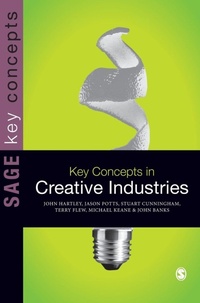
Key Concepts in Creative Industries
1st Edition
Published on 22. October 2012
Book
Hardback
200 pages
978-1-4462-0288-3 (ISBN)
Description
This guide to the emerging language of creative industries field is a valuable resource for researchers and students alike. Concise, extensively referenced, and accessible, this this is an exceptionally useful reference work.
- Gauti Sigthorsson, Greenwich University
"There could be no better guides to the conceptual map of the creative industries than John Hartley and his colleagues, pioneers in the field. This book is a clear, comprehensive and accessible tool-kit of ideas, concepts, questions and discussions which will be invaluable to students and practitioners alike. Key Concepts in Creative Industries is set to become the corner stone of an expanding and exciting field of study"
- Chris Barker, University of Wollongong
Creativity is an attribute of individual people, but also a feature of organizations like firms, cultural institutions and social networks. In the knowledge economy of today, creativity is of increasing value, for developing, emergent and advanced countries, and for competing cities. This book is the first to present an organized study of the key concepts that underlie and motivate the field of creative industries. Written by a world-leading team of experts, it presents readers with compact accounts of the history of terms, the debates and tensions associated with their usage, and examples of how they apply to the creative industries around the world.
Crisp and relevant, this is an invaluable text for students of the creative industries across a range of disciplines, especially media, communication, economics, sociology, creative and performing arts and regional studies.
- Gauti Sigthorsson, Greenwich University
"There could be no better guides to the conceptual map of the creative industries than John Hartley and his colleagues, pioneers in the field. This book is a clear, comprehensive and accessible tool-kit of ideas, concepts, questions and discussions which will be invaluable to students and practitioners alike. Key Concepts in Creative Industries is set to become the corner stone of an expanding and exciting field of study"
- Chris Barker, University of Wollongong
Creativity is an attribute of individual people, but also a feature of organizations like firms, cultural institutions and social networks. In the knowledge economy of today, creativity is of increasing value, for developing, emergent and advanced countries, and for competing cities. This book is the first to present an organized study of the key concepts that underlie and motivate the field of creative industries. Written by a world-leading team of experts, it presents readers with compact accounts of the history of terms, the debates and tensions associated with their usage, and examples of how they apply to the creative industries around the world.
Crisp and relevant, this is an invaluable text for students of the creative industries across a range of disciplines, especially media, communication, economics, sociology, creative and performing arts and regional studies.
Reviews / Votes
This is an authoritative overview of a rapidly developing area of study and research. The book offers much to both those familiar with work on the creative industries and those for whom the concept is an entirely new object of study. -- John Storey There could be no better guides to the conceptual map of the creative industries than John Hartley and his colleagues, pioneers in the field. This book is a clear, comprehensive and accessible tool-kit of ideas, concepts, questions and discussions which will be invaluable to students and practitioners alike. Key Concepts in Creative Industries is set to become the corner stone of an expanding and exciting field of study. -- Chris BarkerMore details
Series
Language
English
Place of publication
London
United Kingdom
Target group
College/higher education
Dimensions
Height: 250 mm
Width: 175 mm
Thickness: 15 mm
Weight
534 gr
ISBN-13
978-1-4462-0288-3 (9781446202883)
Copyright in bibliographic data and cover images is held by Nielsen Book Services Limited or by the publishers or by their respective licensors: all rights reserved.
Schweitzer Classification
Other editions
Additional editions
John Hartley | Jason Potts | Stuart Cunningham
Key Concepts in Creative Industries
Book
10/2012
1st Edition
SAGE Publications Ltd
€81.50
Shipment within 15-20 days
John Hartley | Jason Potts | Stuart Cunningham
Key Concepts in Creative Industries
E-Book
10/2012
1st Edition
SAGE Publications Ltd
€63.89
Available for download
John Hartley | Jason Potts | Stuart Cunningham
Key Concepts in Creative Industries
E-Book
10/2012
1st Edition
SAGE Publications Ltd
from
€63.89
Available for download
Persons
John Hartley, AM (Order of Australia), is John Curtin Distinguished Professor at Curtin University Australia, and Professor of Journalism, Media and Cultural Studies at Cardiff University Wales.
Recent books include: Cultural Science: A Natural History of Stories, Demes, Knowledge and Innovation (with Jason Potts, Bloomsbury, 2014); Key Concepts in Creative Industries (co-authored, SAGE, 2013); A Companion to New Media Dynamics (co-edited, Wiley-Blackwell, 2013); and Digital Futures for Cultural and Media Studies (Wiley-Blackwell, 2012).
He is editor of the International Journal of Cultural Studies (SAGE) and publisher of Cultural Science Journal (online). He is a Fellow of the Australian Academy of Humanities and the International Communication Association, Honorary Professor of Zhejiang University of Media and Communications (Hangzhou), and Guest Researcher, Institute for Cultural Industries, Shenzhen University, China. Jason Potts is Professor of Economics at RMIT University, Australia. Stuart Cunningham is Distinguished Professor in the Faculty of Creative Industries at Queensland University of Technology, Australia. Terry Flew is Professor of Media and Communications in the Creative Industries Faculty at the Queensland University of Technology, Brisbane, Australia. He has been seconded from QUT to act as a Commissioner of the Australian Law Reform Commission from May 2011 to February 2012, chairing the Inquiry into the National Classification Scheme in Australia. Professor Michael Keane is Professor of Chinese Media and Cultural Studies at Curtin University, Perth. John Banks is Associate Professor of the Creative Industries Faculty at Queensland University of Technology, Australia.
Recent books include: Cultural Science: A Natural History of Stories, Demes, Knowledge and Innovation (with Jason Potts, Bloomsbury, 2014); Key Concepts in Creative Industries (co-authored, SAGE, 2013); A Companion to New Media Dynamics (co-edited, Wiley-Blackwell, 2013); and Digital Futures for Cultural and Media Studies (Wiley-Blackwell, 2012).
He is editor of the International Journal of Cultural Studies (SAGE) and publisher of Cultural Science Journal (online). He is a Fellow of the Australian Academy of Humanities and the International Communication Association, Honorary Professor of Zhejiang University of Media and Communications (Hangzhou), and Guest Researcher, Institute for Cultural Industries, Shenzhen University, China. Jason Potts is Professor of Economics at RMIT University, Australia. Stuart Cunningham is Distinguished Professor in the Faculty of Creative Industries at Queensland University of Technology, Australia. Terry Flew is Professor of Media and Communications in the Creative Industries Faculty at the Queensland University of Technology, Brisbane, Australia. He has been seconded from QUT to act as a Commissioner of the Australian Law Reform Commission from May 2011 to February 2012, chairing the Inquiry into the National Classification Scheme in Australia. Professor Michael Keane is Professor of Chinese Media and Cultural Studies at Curtin University, Perth. John Banks is Associate Professor of the Creative Industries Faculty at Queensland University of Technology, Australia.
Content
Introduction
The Concepts:
Aesthetics, Art
Agent/Agency
Attention
Audience
Cluster
Co-Creation (User-Created Content; User-Generated Content)
Competition
Complex Systems
Consumer
Convergence
Creative Arts
Creative Cities
Creative Class
Creative Destruction
Creative Economy
Creative Industries
Creative Labour
Creativity
Cultural Policy
Culture (History of Concept)
Culture Industry/Cultural Industries
Design
Digital Literacy
Entertainment
Entrepreneur/ship
Evolution
Expert
Globalization
Information Economy
Innovation
Institution
Intellectual Property
Internationalization (of Creative Industries)
Knowledge (Growth of)
Markets
Media
Networks
Power
Productivity
Public Culture
Representation
Technology
References
Index
The Concepts:
Aesthetics, Art
Agent/Agency
Attention
Audience
Cluster
Co-Creation (User-Created Content; User-Generated Content)
Competition
Complex Systems
Consumer
Convergence
Creative Arts
Creative Cities
Creative Class
Creative Destruction
Creative Economy
Creative Industries
Creative Labour
Creativity
Cultural Policy
Culture (History of Concept)
Culture Industry/Cultural Industries
Design
Digital Literacy
Entertainment
Entrepreneur/ship
Evolution
Expert
Globalization
Information Economy
Innovation
Institution
Intellectual Property
Internationalization (of Creative Industries)
Knowledge (Growth of)
Markets
Media
Networks
Power
Productivity
Public Culture
Representation
Technology
References
Index