


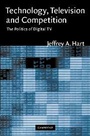
Technology, Television, and Competition
The Politics of Digital TV
Published on 1. February 2007
Book
Paperback/Softback
264 pages
978-0-521-03355-8 (ISBN)
Description
In the late 1980s and 1990s, the advanced industrial countries considered replacing the existing analogue television infrastructure with a new digital one. A key common feature to the debates over digital TV (DTV) in the United States, Western Europe and Japan was the eventual victory of the ideas of digitalism (the superiority of everything digital over everything analogue) and of digital convergence (the merging of computing, telecommunications and broadcasting infrastructures made possible by digitalization) in public debates over standards. Jeffrey Hart's book shows how nationalism and regionalism combined with digitalism to produce three different and incompatible DTV standards in the three regions, an outcome which has led to missed opportunities in developing the new technologies. Hart's book contributes to our understanding of relations between business and government, and of competition between the world's great economic powers.
Reviews / Votes
'... the book is an excellent review of what has been a ground breaking period for the industry ...' Multimedia Communications '... the discussion of the broader meaning of the case of digitalization for the present and future of the political economy is well developed and contributes to our understanding.' Journal of Common Market Studies '... the book is an excellent review of what has been a ground breaking period for the industry as it moved into the digital age.' The IEE 'Technology, Television and Competition is well written and has clear historical value.' Journalism Studies 'It has a dry, academic writing style, with jargon and data that go beyond basic textbook (or newspaper-based) understanding of the core issues. One hopes that the information collected here can inform future volumes that are more accessible to non expert readers.' Megan Mullen, Department of Communication, University of WisconsinMore details
Language
English
Place of publication
Cambridge
United Kingdom
Target group
Professional and scholarly
Product notice
Paperback (trade)
Illustrations
Worked examples or Exercises
Dimensions
Height: 229 mm
Width: 152 mm
Thickness: 16 mm
Weight
434 gr
ISBN-13
978-0-521-03355-8 (9780521033558)
Copyright in bibliographic data and cover images is held by Nielsen Book Services Limited or by the publishers or by their respective licensors: all rights reserved.
Schweitzer Classification
Other editions
Additional editions
E-Book
12/2004
1st Edition
Cambridge University Press
€27.99
Available for download
Person
Jeffrey Hart is Professor of Political Science at Indiana University, Bloomington, where he has taught international politics and international political economy since 1981. His first teaching position was at Princeton University from 1973 to 1980. He was a professional staff member of the President's Commission for a National Agenda for the Eighties from 1980 to 1981. Hart worked as an internal contractor at the Office of Technology Assessment of the US Congress from 1985 to 1986 and helped to write their report, 'International Competition in Services' (1987). His books include The New International Economic Order (1983), Interdependence in the Post Multilateral Era (1985), Rival Capitalists (1992), Globalization and Governance (1999), Managing New Industry Creation (2001), Technology, Television, and Competition (2004), The Politics of International Economic Relations, 7th edition (2010) and he has published scholarly articles in World Politics, International Organization, the British Journal of Political Science, New Political Economy and the Journal of Conflict Resolution.
Content
Preface; Acknowledgments; List of acronyms; 1. Introduction; 2. The institutional setting for advanced TV; 3. Digital convergence: consumer electronics; 4. HDTV in Japan; 5. HDTV in the United States; 6. HDTV in Europe; 7. Digital television in the United States; 8. Digital television in Europe and Japan; 9. Examples of global standards; 10. Conclusions; Index.