

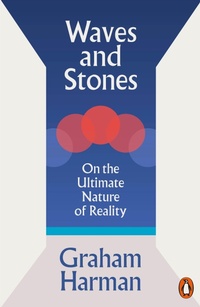
Waves and Stones
On the Ultimate Nature of Reality
Will be published approx. on 5. November 2026
Book
Paperback/Softback
416 pages
978-0-14-199051-4 (ISBN)
Description
A new exploration of our conception of reality, by one of the world's most influential philosophers
How do we understand the world and our place in it? Do our lives consist of a small number of dramatic turning points, or is there nothing but a series of gradual changes from infancy to old age? Are political elections genuinely transformational, or merely arbitrary points along a shifting cultural timeline? And in physics, how can the continuities of general relativity coexist with the discontinuities of quantum theory?
In Waves and Stones, Graham Harman shows that this paradoxical interaction - the question of whether reality is made up of sudden jumps, or is laid out along a gentle gradient with no clear divisions between the various things in the world - permeates every area of human life. What's more, this paradox is as old as human thought itself. In exploring how the continuous and discrete relate to each other, he takes us on a kaleidoscopic journey from the philosophers of ancient Greece, through the writings of the great Arab historian Ibn Khaldun, through architectural and evolutionary theory, the compatibility of religion with science, and the wave-particle duality of matter.
To explore the relationship between the continuous and the discrete, Harman shows, is to consider the very fabric of reality. With this dazzling new book, he proposes a new way of thinking about this ancient problem, with profound implications for our understanding of ourselves and the bewilderingly complex world in which we live.
How do we understand the world and our place in it? Do our lives consist of a small number of dramatic turning points, or is there nothing but a series of gradual changes from infancy to old age? Are political elections genuinely transformational, or merely arbitrary points along a shifting cultural timeline? And in physics, how can the continuities of general relativity coexist with the discontinuities of quantum theory?
In Waves and Stones, Graham Harman shows that this paradoxical interaction - the question of whether reality is made up of sudden jumps, or is laid out along a gentle gradient with no clear divisions between the various things in the world - permeates every area of human life. What's more, this paradox is as old as human thought itself. In exploring how the continuous and discrete relate to each other, he takes us on a kaleidoscopic journey from the philosophers of ancient Greece, through the writings of the great Arab historian Ibn Khaldun, through architectural and evolutionary theory, the compatibility of religion with science, and the wave-particle duality of matter.
To explore the relationship between the continuous and the discrete, Harman shows, is to consider the very fabric of reality. With this dazzling new book, he proposes a new way of thinking about this ancient problem, with profound implications for our understanding of ourselves and the bewilderingly complex world in which we live.
More details
Language
English
Place of publication
London
United Kingdom
Target group
Professional and scholarly
College/higher education
Product notice
Paperback (UK-B)
Dimensions
Height: 198 mm
Width: 129 mm
Thickness: 35 mm
Weight
500 gr
ISBN-13
978-0-14-199051-4 (9780141990514)
Copyright in bibliographic data and cover images is held by Nielsen Book Services Limited or by the publishers or by their respective licensors: all rights reserved.
Schweitzer Classification
Other editions
Additional editions
E-Book
11/2025
Penguin Books Ltd
€14.99
Available for download
Book
11/2025
Allen Lane
€37.50
Available immediately
Person
Graham Harman is Distinguished Professor of Philosophy at SCI-Arc, Los Angeles. A key figure in the contemporary speculative realism movement in philosophy and known for his development of object-oriented ontology, he was named by Art Review magazine as one of the 100 most influential figures in international art. His previous books include Object-Oriented Ontology: A New Theory of Everything (Penguin, 2018).