

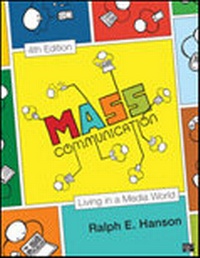
Mass Communication
Living in a Media World
4th Edition
Published on 9. April 2013
Book
Paperback/Softback
456 pages
978-1-4522-0299-0 (ISBN)
Description
View the interactive ebook here here
That the media world is changing at a dizzying pace is a statement of the obvious. Yet, some things do remain constant. There are principles of media literacy, which once students have mastered, arm them with the tools and critical thinking they need to be savvy and self-aware consumers of the media. Ralph Hanson does this in every page of his book.
Oh, but there is so much more.
The fourth edition of Mass Communication is now a full-color Media Edition which means, at no extra cost to your students, they now have access to an interactive ebook when they buy a new print copy. Through a series of icons, students link to a wealth of multimedia assets-including audio, video, data, articles, reference, and policy backgrounders from CQ Researcher-right where it matters most: on the exact page where a topic is discussed. Students can immediately dive deeper and explore an important concept or idea while reading. There is also an important assessment piece. For each "Test Your Media Literacy" box, students can answer critical thinking questions, as well as take a chapter quiz making sure they master chapter objectives. All answers and quiz results feed an instructor gradebook so you can efficiently track participation and comprehension. It's an enhanced, enriching, and interactive learning experience.
And for those who used Hanson for the past three editions, we know you appreciate the book's smart approach and value price. The good news is that there is one more tool to get students engaged and reading: a good read, an affordable price, and now, full-color design. The addition of color clearly enhances photos, but also improves the book's pedagogic muscle, with colored text that highlights the Seven Truths principles, with global icons signifying comparative examples and international content, and with a new "Test Your Visual Media Literacy" box that helps students really think about the reactions they have to media images they see everyday.
Reminders of the book's media literacy principles are Hanson's Seven Truths "they" don't want you to know about the media:
1. The media are essential components of our lives.
2. There are no mainstream media (MSM).
3. Everything from the margin moves to the center.
4. Nothing's new-everything that happened in the past will happen again.
5. New media are always scary.
6. Activism and analysis is not the same thing.
7. There is no "they."
The fourth edition delivers comprehensive yet compact coverage, incisive analysis, and fun, conversational writing. While Hanson delves into critical theory, and will take a critical stance on the media, he does not believe the media are something to be feared or demonized, but rather are an essential part of the way we live.
That the media world is changing at a dizzying pace is a statement of the obvious. Yet, some things do remain constant. There are principles of media literacy, which once students have mastered, arm them with the tools and critical thinking they need to be savvy and self-aware consumers of the media. Ralph Hanson does this in every page of his book.
Oh, but there is so much more.
The fourth edition of Mass Communication is now a full-color Media Edition which means, at no extra cost to your students, they now have access to an interactive ebook when they buy a new print copy. Through a series of icons, students link to a wealth of multimedia assets-including audio, video, data, articles, reference, and policy backgrounders from CQ Researcher-right where it matters most: on the exact page where a topic is discussed. Students can immediately dive deeper and explore an important concept or idea while reading. There is also an important assessment piece. For each "Test Your Media Literacy" box, students can answer critical thinking questions, as well as take a chapter quiz making sure they master chapter objectives. All answers and quiz results feed an instructor gradebook so you can efficiently track participation and comprehension. It's an enhanced, enriching, and interactive learning experience.
And for those who used Hanson for the past three editions, we know you appreciate the book's smart approach and value price. The good news is that there is one more tool to get students engaged and reading: a good read, an affordable price, and now, full-color design. The addition of color clearly enhances photos, but also improves the book's pedagogic muscle, with colored text that highlights the Seven Truths principles, with global icons signifying comparative examples and international content, and with a new "Test Your Visual Media Literacy" box that helps students really think about the reactions they have to media images they see everyday.
Reminders of the book's media literacy principles are Hanson's Seven Truths "they" don't want you to know about the media:
1. The media are essential components of our lives.
2. There are no mainstream media (MSM).
3. Everything from the margin moves to the center.
4. Nothing's new-everything that happened in the past will happen again.
5. New media are always scary.
6. Activism and analysis is not the same thing.
7. There is no "they."
The fourth edition delivers comprehensive yet compact coverage, incisive analysis, and fun, conversational writing. While Hanson delves into critical theory, and will take a critical stance on the media, he does not believe the media are something to be feared or demonized, but rather are an essential part of the way we live.
More details
Edition
4th Revised edition
Language
English
Place of publication
Washington
United States
Publishing group
SAGE Publications Inc
Target group
College/higher education
Edition type
Revised edition
Dimensions
Height: 279 mm
Width: 216 mm
Weight
821 gr
ISBN-13
978-1-4522-0299-0 (9781452202990)
Copyright in bibliographic data and cover images is held by Nielsen Book Services Limited or by the publishers or by their respective licensors: all rights reserved.
Schweitzer Classification
Other editions
New editions
Book
03/2015
5th Edition
SAGE Publications Inc
€120.34
Article exhausted; check for reprint
Previous edition
Book
03/2010
3rd Edition
CQ Press
€84.38
Article exhausted; check for reprint
Person
Ralph E. Hanson is a professor in the communication department at the University of Nebraska at Kearney, where he teaches courses in writing, blogging, reporting, and mass communication. Previously, he was on the faculty at West Virginia University and Northern Arizona University. He has been teaching introduction to mass communication for more than twenty-five years, and he has worked extensively on developing online courses and degree programs. Hanson has a bachelor's degree in journalism and anthropology from Iowa State University, a master's degree in journalism from Iowa State, and a doctorate in sociology from Arizona State University. He recently completed a book chapter on the long-standing connections between the Martin Luther King Jr. holiday and the NFL's Super Bowl. When Ralph is not out on his motorcycle riding to places a long way from Nebraska, he is blogging on mass communication issues at http://ralphehanson.com. He tweets as @ralphehanson.
Content
I. INTRODUCTION TO THE MEDIA
1. Living in a Media World
2. Mass Communication Effects: How Society and Media Interact
3. The Media Business: Consolidation, Globalization, and the Long Tail
II. PRINT MEDIA
4. Books: The Birth of the Mass Media
5. Magazines: The Power of Words and Images
6. Newspapers & the News: Reflection of a Democratic Society
III. ELECTRONIC MEDIA
7. Audio: Music and Talk Across Media
8. Movies: Mass Producing Entertainment
9. Television: Broadcast and Beyond
10. The Internet: Mass Communication Gets Personal
IV. STRATEGIC COMMUNICATION
11. Advertising: Selling a Message
12. Public Relations: Interactions, Relationships, and the News
V. REGULATION AND CONTROL OF THE MEDIA
13. Media Law: Free Speech and Fairness
14. Media Ethics: Truthfulness, Fairness, and Standards of Decency
15. Global Media: Communication Around the World
1. Living in a Media World
2. Mass Communication Effects: How Society and Media Interact
3. The Media Business: Consolidation, Globalization, and the Long Tail
II. PRINT MEDIA
4. Books: The Birth of the Mass Media
5. Magazines: The Power of Words and Images
6. Newspapers & the News: Reflection of a Democratic Society
III. ELECTRONIC MEDIA
7. Audio: Music and Talk Across Media
8. Movies: Mass Producing Entertainment
9. Television: Broadcast and Beyond
10. The Internet: Mass Communication Gets Personal
IV. STRATEGIC COMMUNICATION
11. Advertising: Selling a Message
12. Public Relations: Interactions, Relationships, and the News
V. REGULATION AND CONTROL OF THE MEDIA
13. Media Law: Free Speech and Fairness
14. Media Ethics: Truthfulness, Fairness, and Standards of Decency
15. Global Media: Communication Around the World