

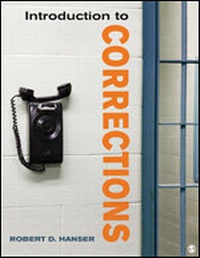
Introduction to Corrections
1st Edition
Published on 27. November 2012
Book
Paperback/Softback
600 pages
978-1-4129-7566-7 (ISBN)
Description
Introduction to Corrections provides students with an understanding of basic concepts in the field of corrections. The book offers comprehensive coverage of both institutional and community corrections, with particular emphasis on the perspective of the practitioner.
Students taking corrections classes often have wild misconceptions about prison work and the corrections environment - misconceptions typically derived from movies and the news, and even current textbooks. In this new text, Robert Hanser uses his own on-the-ground experience to colorfully explain how the corrections system actually works, and what's it's like to be a part of it.
A practioner, scholar, and experienced teacher whose research has focused on gangs, domestic violence, and corrections, Hanser introduces students to the correctional worker's complex world of sub-cultural norms, the impact of prisoner classification and assessment, and both the theory and legal elements affecting corrections systems today.
Students taking corrections classes often have wild misconceptions about prison work and the corrections environment - misconceptions typically derived from movies and the news, and even current textbooks. In this new text, Robert Hanser uses his own on-the-ground experience to colorfully explain how the corrections system actually works, and what's it's like to be a part of it.
A practioner, scholar, and experienced teacher whose research has focused on gangs, domestic violence, and corrections, Hanser introduces students to the correctional worker's complex world of sub-cultural norms, the impact of prisoner classification and assessment, and both the theory and legal elements affecting corrections systems today.
Reviews / Votes
"What I most like about it is that it conveys the author's experiences in corrections. It comes across that author worked corrections and cares about the topic. It is (therefore) not as dry as the typical textbook. At the same time, it is not simply a memoir or personal experience. The author relies enough on current literature and data that it is an authoritative textbook." Robert Hormant, U. of Detroit -- Robert Hormant "I liked what I read and would be interested in seeing a copy of the completed text. It is very comprehensive in its coverage and should provide a wealth of information for those students who are genuinely interested in corrections. The pedagogical features are well-done and truly add some value to the topics. I can't imagine any further embellishments on these. Also, the chapter organization is one of the best I have seen." Michael Montgomery, Tennessee State University -- Michael Montgomery "I think the text is great! I would seriously consider adopting the text for my course. It is very thorough, covers the right topics, and is well-written. I am excited to see the finished product!" Kristie Blevins, Eastern Kentucky University -- Kristie Blevins "Overall, I found the text to be well written and well organized. Also, the majority of aspects that I read were up do date. I particularly liked the applied exercises and I believe I would use them regularly in in-class discussions. Further, the cross-national components were great. That is something that you don't regularly get much detail on and the students will really enjoy learning about corrections abroad." Danielle McDonald, Northern Kentucky University -- Danielle McDonald Great book! This is the kind of book I was waiting for. The full correctional experience that covers the clients-offenders-inmates and staff working in the field. -- Gabriel KovnatorMore details
Language
English
Place of publication
Thousand Oaks
United States
Target group
College/higher education
Dimensions
Height: 279 mm
Width: 216 mm
Weight
1191 gr
ISBN-13
978-1-4129-7566-7 (9781412975667)
Copyright in bibliographic data and cover images is held by Nielsen Book Services Limited or by the publishers or by their respective licensors: all rights reserved.
Schweitzer Classification
Other editions
New editions
Robert D. Hanser
Introduction to Corrections
Book
03/2016
2nd Edition
SAGE Publications Inc
€141.32
Article is exhausted; no reprint
Person
Robert D. Hanser is a past professor of criminal justice and the coordinator of the Criminal Justice program at the University of Louisiana at Monroe. He is now a professor of Marriage and Family Therapy at the University of Louisiana at Monroe. Dr. Hanser has a PhD in marriage and family therapy and a PhD in criminal justice. He is a national certified counselor, a licensed professional counselor in the states of Louisiana and Texas, a licensed addiction counselor, a certified hypnotherapist, and a certified anger management therapist. He is the President Elect for the Louisiana Marriage and Family Counselor chapter of the Louisiana Counseling Association. He is also the Board President for the Arkansas Association for the Treatment and Prevention of Sexual Abuse (AR-ATSA). He holds a gubernatorial appointment on the Reentry Advisory Council of Louisiana, serves on the Board of Directors of the Louisiana Coalition Against Domestic Violence (LCADV), a member of the Louisiana Domestic Abuse Fatality Review (LADAFR) board. has been appointed to the Professional Educational Counsel with the American Correctional Association (ACA), and is an Executive Counselor for the Corrections section for the Academy of Criminal Justice Sciences (ACJS). He is a past member of the 4th Judicial District's Youth Services Planning Board, a past therapeutic director of the 4th Judicial District Drug Court, and is the director of the Northeast Louisiana Batterer's Intervention Program. For fourteen years, he was the Clinical Director for New Day Recovery with facilities in West Monroe and Shreveport. In addition, for 13 years, he was the program director at Richwood Correctional Center (RCC), Madison Parish Correctional Center (MPCC), and the Louisiana Transitional Center for Women (LTCW). He has written Introduction to Corrections (3rd ed.), Community Corrections (2nd ed.), Correctional Counseling, Multiculturalism in the Criminal Justice System, Special Needs Offenders, and over 65 other textbooks, anthologies, and peer-reviewed articles.
Content
Chapter 1: Early History and Evolution of Punishment and Corrections
Chapter 2: The Development of Prisons in the United States
Chapter 3: Ideological and Theoretical Underpinnings to Corrections
Chapter 4: Correctional Law and Legal Liabilities
Chapter 5: Jail and Detention Facilities
Chapter 6: Probation
Chapter 7: Intermediate Sanctions
Chapter 8: Correctional Facilities
Chapter 9: Classification and Custody Levels
Chapter 10: Prison Subculture and Prison Gang Influence
Chapter 11: Female Offenders in Correctional Systems
Chapter 12: Specialized Inmate Populations
Chapter 13: Juvenile Correctional Systems
Chapter 14: Correctional Administration
Chapter 15: Prison Education, Work & Basic Services and Programming
Chapter 16: Therapeutic, Recreational, & Religious Programming
Chapter 17: Parole and Reintegration
Chapter 18: The Death Penalty
Chapter 19: Program Evaluation, Evidence Based Practices, and Future Trends in Corrections
Chapter 2: The Development of Prisons in the United States
Chapter 3: Ideological and Theoretical Underpinnings to Corrections
Chapter 4: Correctional Law and Legal Liabilities
Chapter 5: Jail and Detention Facilities
Chapter 6: Probation
Chapter 7: Intermediate Sanctions
Chapter 8: Correctional Facilities
Chapter 9: Classification and Custody Levels
Chapter 10: Prison Subculture and Prison Gang Influence
Chapter 11: Female Offenders in Correctional Systems
Chapter 12: Specialized Inmate Populations
Chapter 13: Juvenile Correctional Systems
Chapter 14: Correctional Administration
Chapter 15: Prison Education, Work & Basic Services and Programming
Chapter 16: Therapeutic, Recreational, & Religious Programming
Chapter 17: Parole and Reintegration
Chapter 18: The Death Penalty
Chapter 19: Program Evaluation, Evidence Based Practices, and Future Trends in Corrections