

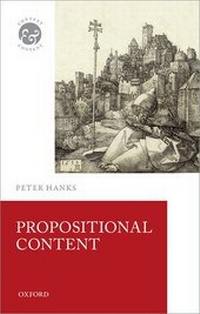
Propositional Content
Published on 4. June 2015
Book
Hardback
238 pages
978-0-19-968489-2 (ISBN)
Description
Peter Hanks defends a new theory about the nature of propositional content. According to this theory, the basic bearers of representational properties are particular mental or spoken actions. Propositions are types of these actions, which we use to classify and individuate our attitudes and speech acts. Hanks abandons several key features of the traditional Fregean conception of propositional content, including the idea that propositions are the primary bearers of truth-conditions, the distinction between content and force, and the concept of entertainment. The main difficulty for this traditional conception is the problem of the unity of the proposition, the problem of explaining how propositions have truth conditions and other representational properties. The new theory developed here, in its place,explains the unity of propositions and provides new solutions to a long list of puzzles and problems in philosophy of language.
More details
Series
Language
English
Place of publication
Oxford
United Kingdom
Target group
College/higher education
Dimensions
Height: 219 mm
Width: 143 mm
Thickness: 20 mm
Weight
416 gr
ISBN-13
978-0-19-968489-2 (9780199684892)
Copyright in bibliographic data and cover images is held by Nielsen Book Services Limited or by the publishers or by their respective licensors: all rights reserved.
Schweitzer Classification
Other editions
Additional editions
Peter Hanks
Propositional Content
Book
08/2019
Oxford University Press
€42.30
Shipment within 15-20 days
Person
Peter Hanks is an associate professor in the Department of Philosophy at the University of Minnesota. His research is in philosophy of language and the history of analytic philosophy.
Content
Acknowledgements ; Introduction ; 1. Three pictures of content ; 2. The problem of the unity of the proposition ; 3. Predication and unity ; 4. Cancellation and the content-force distinction ; 5. Proper names and types of reference acts ; 6. Empty names ; 7. Propositional attitude reports ; 8. First-person propositions ; 9. Asking and ordering ; Conclusion ; References ; Index