

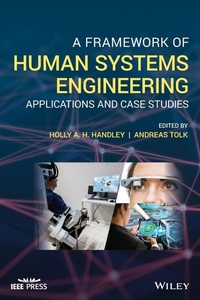
A Framework of Human System Engineering
Applications and Case Studies
Published on 5. January 2021
Book
Hardback
304 pages
978-1-119-69875-3 (ISBN)
Description
This book presents a series of Human System Engineering (HSE) applications on a range of topics, such as interface design, training requirements, personnel capabilities and limitations, and human task allocation. Each chapter represents a case study of the application of HSE from different dimensions of socio-technical systems. The examples are organized using a socio-technical system framework to reference the applications across multiple system types and domains. These case studies serve to illustrate the value of applying HSE to the broader engineering community and provide real world examples. The book provides reference examples in a variety of domains and applications to educate engineers; the integration of the human user is listed as one of the enablers of System Engineering (SE) in the System Engineering Body of Knowledge (SEBoK).
More details
Other editions
Additional editions
Holly A. H. Handley | Andreas Tolk
A Framework of Human Systems Engineering
Applications and Case Studies
E-Book
12/2020
1st Edition
Wiley
€108.99
Available for download
Holly A. H. Handley | Andreas Tolk
A Framework of Human Systems Engineering
Applications and Case Studies
E-Book
12/2020
1st Edition
Wiley
€112.99
Available for download
Persons
Content
Editor Bios
Author Short Bios
Contributors list
Foreword
Preface
Section 1: Socio - Technical System Types
1. Introduction to the Human System Engineering Framework
Holly A. H. Handley
2. Human Interface Considerations for Situational Awareness
Christian G.W. Schnedler and Michael Joy
3. Utilizing Artificial Intelligence to Make Systems Engineering More Human
Philip Barry and Steve Doskey
4. Life-Learning of Smart Autonomous Systems for Meaningful Human-Autonomy Teaming
Kate J. Yaxley, Keith F. Joiner, Jean Bogais and Hussein A. Abbass
Section 2: Domain Deep Dives
5. Modeling the Evolution of Organizational Systems for the Digital Transformation of Heavy Rail
Grace Kennedy, William Scott, Farid Shirvani and Peter Campbell
6. Human System Integration in the Space Exploration Systems Engineering Lifecycle
George Salazar and Maria Natalia Russi-Vigoya
7. Aerospace Human System Integration - Evolution over the Last 40 Years
Guy Andre Boy
Section 3: Focus on Training and Skill Sets
8. Building a Socio-Cognitive Evaluation Framework to Develop Enhanced Aviation Training Concepts for Gen Y and Gen Z Pilot Trainees
Alliya Anderson, Samuel Feng, Fabrizio Interlandi, Michael Melkonian, Vladimir Parezanovic, Mary-Lynn Woolsey, Claudine Habak and Nelson King
9. Improving Enterprise Resilience by Evaluating Training System Architecture: Method Selection for Australian Defence
Victoria Jnitova, Mahmoud Efatmaneshnik, Keith Joiner and Elizabeth Chang
10. Integrating New Technology into the Complex System of Air Combat Training
Sarah M. Sherwood, Kelly J. Neville, Angus L. M. Thom McLean, III, Melissa Walwanis and Amy Bolton
Section 4: Considering Human Characteristics
11. Engineering a Trustworthy Private Blockchain for Operational Risk Management - A Rapid Human Data Engineering Approach based on Human System Engineering
Marius Becherer, Michael Zipperle, Stuart Green, Florian Gottwalt, T. Bui-Nguyen and Elizabeth Chang
12. Lights Properties and Power in Facilitating Organizational Change
Pravir Malik
Section 5: From the Field
13. Observations of Real-Time Control Room Simulation
Hugh David with an editor introduction by Holly Handley
14. A Research Agenda for Human Systems Engineering
Andreas Tolk
Index Terms
Author Short Bios
Contributors list
Foreword
Preface
Section 1: Socio - Technical System Types
1. Introduction to the Human System Engineering Framework
Holly A. H. Handley
2. Human Interface Considerations for Situational Awareness
Christian G.W. Schnedler and Michael Joy
3. Utilizing Artificial Intelligence to Make Systems Engineering More Human
Philip Barry and Steve Doskey
4. Life-Learning of Smart Autonomous Systems for Meaningful Human-Autonomy Teaming
Kate J. Yaxley, Keith F. Joiner, Jean Bogais and Hussein A. Abbass
Section 2: Domain Deep Dives
5. Modeling the Evolution of Organizational Systems for the Digital Transformation of Heavy Rail
Grace Kennedy, William Scott, Farid Shirvani and Peter Campbell
6. Human System Integration in the Space Exploration Systems Engineering Lifecycle
George Salazar and Maria Natalia Russi-Vigoya
7. Aerospace Human System Integration - Evolution over the Last 40 Years
Guy Andre Boy
Section 3: Focus on Training and Skill Sets
8. Building a Socio-Cognitive Evaluation Framework to Develop Enhanced Aviation Training Concepts for Gen Y and Gen Z Pilot Trainees
Alliya Anderson, Samuel Feng, Fabrizio Interlandi, Michael Melkonian, Vladimir Parezanovic, Mary-Lynn Woolsey, Claudine Habak and Nelson King
9. Improving Enterprise Resilience by Evaluating Training System Architecture: Method Selection for Australian Defence
Victoria Jnitova, Mahmoud Efatmaneshnik, Keith Joiner and Elizabeth Chang
10. Integrating New Technology into the Complex System of Air Combat Training
Sarah M. Sherwood, Kelly J. Neville, Angus L. M. Thom McLean, III, Melissa Walwanis and Amy Bolton
Section 4: Considering Human Characteristics
11. Engineering a Trustworthy Private Blockchain for Operational Risk Management - A Rapid Human Data Engineering Approach based on Human System Engineering
Marius Becherer, Michael Zipperle, Stuart Green, Florian Gottwalt, T. Bui-Nguyen and Elizabeth Chang
12. Lights Properties and Power in Facilitating Organizational Change
Pravir Malik
Section 5: From the Field
13. Observations of Real-Time Control Room Simulation
Hugh David with an editor introduction by Holly Handley
14. A Research Agenda for Human Systems Engineering
Andreas Tolk
Index Terms