

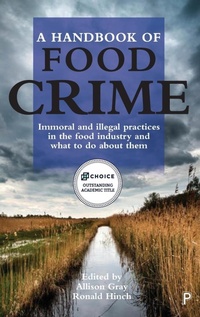
A Handbook of Food Crime
Immoral and Illegal Practices in the Food Industry and What to Do About Them
Policy Press
1st Edition
Published on 9. May 2018
Book
Hardback
458 pages
978-1-4473-3601-3 (ISBN)
Description
Food today is over-corporatized and under-regulated. It is involved in many immoral, harmful, and illegal practices along production, distribution, and consumption systems. These problematic conditions have significant consequences on public health and well-being, nonhuman animals, and the environment, often simultaneously.
In this insightful book, Gray and Hinch explore the phenomenon of food crime. Through discussions of food safety, food fraud, food insecurity, agricultural labour, livestock welfare, genetically modified foods, food sustainability, food waste, food policy, and food democracy, they problematize current food systems and criticize their underlying ideologies.
Bringing together the best contemporary research in this area, they argue for the importance of thinking criminologically about food and propose radical solutions to the realities of unjust food systems.
In this insightful book, Gray and Hinch explore the phenomenon of food crime. Through discussions of food safety, food fraud, food insecurity, agricultural labour, livestock welfare, genetically modified foods, food sustainability, food waste, food policy, and food democracy, they problematize current food systems and criticize their underlying ideologies.
Bringing together the best contemporary research in this area, they argue for the importance of thinking criminologically about food and propose radical solutions to the realities of unjust food systems.
Reviews / Votes
"An excellent wide-ranging contribution to the field of criminology and green criminology in particular." Tanya Wyatt, University of NorthumbriaMore details
Edition
First Edition
Language
English
Place of publication
Bristol
United Kingdom
Publishing group
Bristol University Press
Target group
Professional and scholarly
Illustrations
Not illustrated
Dimensions
Height: 240 mm
Width: 161 mm
Thickness: 29 mm
Weight
845 gr
ISBN-13
978-1-4473-3601-3 (9781447336013)
Copyright in bibliographic data and cover images is held by Nielsen Book Services Limited or by the publishers or by their respective licensors: all rights reserved.
Schweitzer Classification
Other editions
Additional editions
A Handbook of Food Crime
Immoral and Illegal Practices in the Food Industry and What to Do About Them
Book
10/2019
1st Edition
Policy Press
€46.30
Shipment within 15-20 days
A Handbook of Food Crime
Immoral and Illegal Practices in the Food Industry and What to Do About Them
E-Book
05/2018
1st Edition
Policy Press
€278.99
Available for download
A Handbook of Food Crime
Immoral and Illegal Practices in the Food Industry and What to Do About Them
E-Book
05/2018
1st Edition
Policy Press
€51.49
Available for download
Persons
Allison Gray is a PhD Candidate at the University of Windsor. She pursues a diverse range of research interests across the areas of food studies, green criminology, theoretical sociology, and the intersection of humanity, nonhuman animals, and the environment. She is especially keen on studying the sociology of food choice.
Ronald Hinch, PhD, is Professor Emeritus at the University of Ontario Institute of Technology. His research interests and publications include food crime, green criminology, critical criminology, criminological theory and violent crime with a special interest in serial homicide.
Ronald Hinch, PhD, is Professor Emeritus at the University of Ontario Institute of Technology. His research interests and publications include food crime, green criminology, critical criminology, criminological theory and violent crime with a special interest in serial homicide.
Contributions
University of Saskatchewan
University of Victoria, BC
Toulouse Business School, Department of Marketing and International Business
INRA-SAD/UMR Innovation
Flinders University, School of Health Sciences
Flinders University
University of Calgary
Universidade de Londrina
University of Southern Florida
Northumbria University
Content
Introduction;
Section I: Thinking about food crime;
A food crime perspective ~ Allison Gray;
Food crime without criminals: Agri-good-safety governance as a protection racket for dominant political and economic interest ~ Martha McMahon,
Kora Liegh Glatt;
The social construction of illegality within local food systems ~ Marcello de Rosa, Ferro Trabalzi, Tiziana Pagnani;
Section II: Farming and food production;
Ethical challenges facing farm managers ~ Harvey S. James Jr.;
Chocolate, slavery, forced labour, child labour, and the state ~ Ronald Hinch;
Impact of hazards and pesticides on farmers and farming communities ~ Jinky Leilanie del Prado-Lu;
Section III: Processing, marketing, and accessing food;
Agency and responsibility: The case of the food industry and obesity ~ Judith Schrempf-Stirling, Robert Phillips;
The value of product sampling in mitigating food adulteration ~ Louise Manning, Jan Mei Soon;
Prohibitive property practices: The impact of restrictive covenants on the built food environment ~ Sugandi del Canto, Rachel Engler-Stringer;
Section IV: Corporate food and food safety;
Regulating food fraud: Public and private law responses in the EU, Italy and the Netherlands ~ Antonia Corini, Bernd van der Meulen;
Mass salmonella poisoning by the Peanut Corporation of America: Lessons in state-corporate food crime ~ Paul Leighton;
Food crime in the context of cheap capitalism ~ Joseph Yaw Asomah, Hongming Cheng;
Section V: Food trade and movement;
Crime versus harm in the transportation of animals: A closer look at Ontario's 'pig trial' ~ Amy Fitzgerald, Wesley Tourangeau;
Coming together to combat food fraud: Regulatory networks in the EU ~ Richard Hyde, Ashley Savage;
Fair trade laws, labels, and ethics ~ Will Low, Eileen Davenport;
Section VI: Technologies and food;
Food, genetics and knowledge politics ~ Reece Walters;
Technology, novel foods and crime ~ Juanjuan Sun, Xiaocen Liu;
Food crimes, harms, and carnist technologies ~ Linnea Laestadius, Jan Deckers, Stephanie Baran;
Section VII: Green food;
Farming and climate change ~ Rob White, Jasmine Yeates;
Food waste (non)regulation ~ Michael A. Long, Michael J. Lynch;
Responding to neoliberal diets: School meal programs in Brazil and Canada ~ Estevan Leopoldo de Freitas Coca, Ricardo Cesar Barbosa Junior;
Section VIII: Questioning and consuming food;
Counter crimes and food democracy: Suspects and citizens remaking the food system ~ Sue Booth, John Coveney, Dominique Paturel;
Consumer reactions to food safety scandals: A research model and moderating effects ~ Camilla Barbarossa;
Resisting food crime and the problem of the 'food police' ~ Allison Gray.
Section I: Thinking about food crime;
A food crime perspective ~ Allison Gray;
Food crime without criminals: Agri-good-safety governance as a protection racket for dominant political and economic interest ~ Martha McMahon,
Kora Liegh Glatt;
The social construction of illegality within local food systems ~ Marcello de Rosa, Ferro Trabalzi, Tiziana Pagnani;
Section II: Farming and food production;
Ethical challenges facing farm managers ~ Harvey S. James Jr.;
Chocolate, slavery, forced labour, child labour, and the state ~ Ronald Hinch;
Impact of hazards and pesticides on farmers and farming communities ~ Jinky Leilanie del Prado-Lu;
Section III: Processing, marketing, and accessing food;
Agency and responsibility: The case of the food industry and obesity ~ Judith Schrempf-Stirling, Robert Phillips;
The value of product sampling in mitigating food adulteration ~ Louise Manning, Jan Mei Soon;
Prohibitive property practices: The impact of restrictive covenants on the built food environment ~ Sugandi del Canto, Rachel Engler-Stringer;
Section IV: Corporate food and food safety;
Regulating food fraud: Public and private law responses in the EU, Italy and the Netherlands ~ Antonia Corini, Bernd van der Meulen;
Mass salmonella poisoning by the Peanut Corporation of America: Lessons in state-corporate food crime ~ Paul Leighton;
Food crime in the context of cheap capitalism ~ Joseph Yaw Asomah, Hongming Cheng;
Section V: Food trade and movement;
Crime versus harm in the transportation of animals: A closer look at Ontario's 'pig trial' ~ Amy Fitzgerald, Wesley Tourangeau;
Coming together to combat food fraud: Regulatory networks in the EU ~ Richard Hyde, Ashley Savage;
Fair trade laws, labels, and ethics ~ Will Low, Eileen Davenport;
Section VI: Technologies and food;
Food, genetics and knowledge politics ~ Reece Walters;
Technology, novel foods and crime ~ Juanjuan Sun, Xiaocen Liu;
Food crimes, harms, and carnist technologies ~ Linnea Laestadius, Jan Deckers, Stephanie Baran;
Section VII: Green food;
Farming and climate change ~ Rob White, Jasmine Yeates;
Food waste (non)regulation ~ Michael A. Long, Michael J. Lynch;
Responding to neoliberal diets: School meal programs in Brazil and Canada ~ Estevan Leopoldo de Freitas Coca, Ricardo Cesar Barbosa Junior;
Section VIII: Questioning and consuming food;
Counter crimes and food democracy: Suspects and citizens remaking the food system ~ Sue Booth, John Coveney, Dominique Paturel;
Consumer reactions to food safety scandals: A research model and moderating effects ~ Camilla Barbarossa;
Resisting food crime and the problem of the 'food police' ~ Allison Gray.