

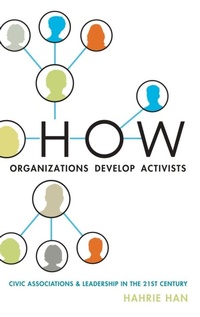
How Organizations Develop Activists
Civic Associations and Leadership in the 21st Century
Published on 21. August 2014
Book
Hardback
250 pages
978-0-19-933676-0 (ISBN)
Description
Why are some civic associations better than others at getting--and keeping--people involved in activism? From MoveOn.org to the National Rifle Association, Health Care for America Now to the Sierra Club, membership-based civic associations constantly seek to engage people in civic and political action. What makes some more effective than others?
Using in-person observations, surveys, and field experiments, this book compares organizations with strong records of engaging people in health and environmental politics to those with weaker records. To build power, civic associations need quality and quantity (or depth and breadth) of activism. They need lots of people to take action and also a cadre of leaders to develop and execute that activity. Yet, models for how to develop activists and leaders are not necessarily transparent. This book provides these models to help associations build the power they want and support a healthy democracy. In particular, the book examines organizing, mobilizing, and lone wolf models of engagement and shows how highly active associations blend mobilizing and organizing to transform their members' motivations and capacities for involvement.
This is not a simple story about the power of offline versus online organizing. Instead, it is a story about how associations can blend both online and offline strategies to build their activist base. In this compelling book, Hahrie Han explains how civic associations can invest in their members and build the capacity they need to inspire action.
Using in-person observations, surveys, and field experiments, this book compares organizations with strong records of engaging people in health and environmental politics to those with weaker records. To build power, civic associations need quality and quantity (or depth and breadth) of activism. They need lots of people to take action and also a cadre of leaders to develop and execute that activity. Yet, models for how to develop activists and leaders are not necessarily transparent. This book provides these models to help associations build the power they want and support a healthy democracy. In particular, the book examines organizing, mobilizing, and lone wolf models of engagement and shows how highly active associations blend mobilizing and organizing to transform their members' motivations and capacities for involvement.
This is not a simple story about the power of offline versus online organizing. Instead, it is a story about how associations can blend both online and offline strategies to build their activist base. In this compelling book, Hahrie Han explains how civic associations can invest in their members and build the capacity they need to inspire action.
Reviews / Votes
For all the scholarship on social movements and civic associations, surprisingly little research has focused on the issue of organizational effectiveness. Han's book should go a long way toward filling this gap. Using a mix of comparative case analysis and field experiments, the author offers an empirically rich, analytically compelling account of why some associations succeed in mobilizing effective collective action, while so many others fail- often spectacularly - to do so. This book deserves the widest possible audience in political science, sociology and, most importantly, among those who aspire to successful grass roots activism. * Doug McAdam, author of Freedom Summer * As organizers, we know that winning real change begins with real people, but it's not always easy to know what strategies are most effective for engaging people in ways that build power. How Organizations Develop Activists fills that gap, and is a must-read for any organizer or organization looking to build people power. * Ai-jen Poo, Director of the National Domestic Workers Alliance and co-director of Caring Across Generations * Effective citizens' movements need to do much more than raise money and recruit the right individual adherents. Helping members become fully engaged and developing good volunteer leaders are the keys to having a real impact -and Hahrie Han's pathbreaking research shows exactly how these challenges can be met with well-designed organizational strategies. Her book is a must-read for all who care about making American democracy more vibrant and powerful. * Theda Skocpol, Victor S. Thomas Professor of Government and Sociology, Harvard University, and Director, Scholars Strategy Network *More details
Language
English
Place of publication
New York
United States
Target group
Professional and scholarly
Dimensions
Height: 240 mm
Width: 161 mm
Thickness: 18 mm
Weight
540 gr
ISBN-13
978-0-19-933676-0 (9780199336760)
Copyright in bibliographic data and cover images is held by Nielsen Book Services Limited or by the publishers or by their respective licensors: all rights reserved.
Schweitzer Classification
Other editions
Additional editions
E-Book
07/2014
1st Edition
OUP eBook
€27.49
Available for download
E-Book
07/2014
1st Edition
OUP USA
€27.49
Available for download
Person
Hahrie Han is Associate Professor of Political Science at Wellesley College.
Content
List of Tables and Figures ; Acknowledgements ; Chapter 1 Introduction ; Chapter 2 Setting Up the Comparative Case Studies ; Chapter 3 Choosing Strategies for Building Power ; Chapter 4 Prospecting for Activists ; Chapter 5 Developing Leaders ; Chapter 6 Conclusion ; Appendix A: Methods ; Works Cited ; Notes ; Index