

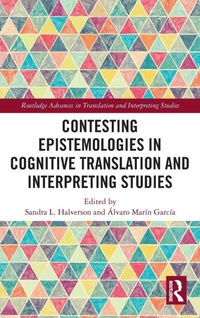
Contesting Epistemologies in Cognitive Translation and Interpreting Studies
1st Edition
Published on 31. December 2021
Book
Hardback
244 pages
978-0-367-64679-0 (ISBN)
Description
This dynamic collection synthesizes and critically reflects on epistemological challenges and developments within Cognitive Translation and Interpreting Studies, problematizing a range of issues. These critical essays provide a means of encouraging further development by grounding new theories, stances, and best practices.
The volume is a clear marker of a maturing discipline, as decades of empirical study and methodological innovation provide the backdrop for critique and debate. The volume exemplifies tendencies toward convergence and difference, while at the same time pushing against disciplinary boundaries and structures. Constructs such as expertise and process are explored, and different theories of cognition are brought to the table. A number of chapters consider what it might mean for translation to be a form of situated, or 4EA cognition, while others query interdisciplinary relationships of foundational importance to the field. Issues of methodology are also addressed in terms of their underlying philosophical assumptions and implications.
This book will be of interest to scholars working at the intersection of translation and cognition, in such fields as translation studies, cognitive science, psycholinguistics, semiotics, and philosophy of science.
The volume is a clear marker of a maturing discipline, as decades of empirical study and methodological innovation provide the backdrop for critique and debate. The volume exemplifies tendencies toward convergence and difference, while at the same time pushing against disciplinary boundaries and structures. Constructs such as expertise and process are explored, and different theories of cognition are brought to the table. A number of chapters consider what it might mean for translation to be a form of situated, or 4EA cognition, while others query interdisciplinary relationships of foundational importance to the field. Issues of methodology are also addressed in terms of their underlying philosophical assumptions and implications.
This book will be of interest to scholars working at the intersection of translation and cognition, in such fields as translation studies, cognitive science, psycholinguistics, semiotics, and philosophy of science.
More details
Series
Language
English
Place of publication
London
United Kingdom
Publishing group
Taylor & Francis Ltd
Target group
College/higher education
Illustrations
13 s/w Abbildungen, 3 s/w Photographien bzw. Rasterbilder, 10 s/w Zeichnungen, 4 s/w Tabellen
4 Tables, black and white; 10 Line drawings, black and white; 3 Halftones, black and white; 13 Illustrations, black and white
Dimensions
Height: 235 mm
Width: 157 mm
Thickness: 19 mm
Weight
532 gr
ISBN-13
978-0-367-64679-0 (9780367646790)
Copyright in bibliographic data and cover images is held by Nielsen Book Services Limited or by the publishers or by their respective licensors: all rights reserved.
Schweitzer Classification
Other editions
Additional editions
Sandra L. Halverson | Alvaro Marin Garcia
Contesting Epistemologies in Cognitive Translation and Interpreting Studies
Book
01/2024
1st Edition
Routledge
€63.20
Shipment within 15-20 days
Sandra L. Halverson | Alvaro Marin Garcia
Contesting Epistemologies in Cognitive Translation and Interpreting Studies
E-Book
12/2021
1st Edition
Routledge
€55.49
Available for download
Sandra L. Halverson | Alvaro Marin Garcia
Contesting Epistemologies in Cognitive Translation and Interpreting Studies
E-Book
12/2021
1st Edition
Routledge
€55.49
Available for download
Persons
Sandra L. Halverson is a professor of translation and professional communication at the University of Agder. Her research has centered on questions related to various areas of translation and interpreting studies and cognitive linguistics, and she has published both empirical and theoretical/conceptual work. Other long-term research interests are the epistemology of translation studies and research methodology. Professor Halverson is a member of the Translation Research, Empiricism and Cognition network (TREC) and INTERACT. She served as co-editor of Target for a period of eight years and currently serves on the editorial boards of several TIS journals. She was appointed CETRA Chair Professor for 2018.
Alvaro Marin Garcia is an assistant professor at the School of Translation and Interpreting at the University of Valladolid (Spain). Previously, he has worked as a translaiton lecturer at the University of Essex (UK).He has also taught translation theory and practice at Kent State University (USA), where he completed his PhD in translation studies. His research interests are in cultural and intellectual history and its relation to translation practices, cognitve translation studies, and the epistemology of translation studies. He is currently investigating translation expertise from an emic perspective as well as new forms of theory development from a pluralistic methodology as applied to cognitive translation studies and translation history.
Alvaro Marin Garcia is an assistant professor at the School of Translation and Interpreting at the University of Valladolid (Spain). Previously, he has worked as a translaiton lecturer at the University of Essex (UK).He has also taught translation theory and practice at Kent State University (USA), where he completed his PhD in translation studies. His research interests are in cultural and intellectual history and its relation to translation practices, cognitve translation studies, and the epistemology of translation studies. He is currently investigating translation expertise from an emic perspective as well as new forms of theory development from a pluralistic methodology as applied to cognitive translation studies and translation history.
Content
Introduction: Scientific maturity and epistemological reflection in cognitive Translation and Interpreting Studies
Alvaro Marin Garcia & Sandra L. Halverson
Part I Challenging epistemologies
Epistemologies of translation expertise: Notions in research and praxis
Hanna Risku & Daniela Schlager
Processualizing process in Cognitive Translation and Interpreting Studies
Piotr Blumczynski
Sociocognitive constructs in Translation and Interpreting Studies (TIS): Do we really need concepts like norms and risk when we have a comprehensive usage-based theory of language?
Sandra L. Halverson & Haidee Kotze
"Tackling stillness through movement"; or constraining the extended mind. Cognitive-semiotic insights into Translation
Kobus Marais & Jani Marais
Latent variables in Translation and Interpreting Studies: Ontology, epistemology, and methodology
Christopher D. Mellinger & Thomas A. Hanson
Part II Converging epistemologies
Translation product and process data: A happy marriage or worlds apart?
Tatiana Serbina & Stella Neumann
Looking back to move forward: Towards a situated, distributed, and extended account of expertise
Fabio Alves, Igor A. Lourenco da Silva
An enactivist-posthumanist perspective on the translation process
Michael Carl
Part III Pluralist epistemologies
Where does it hurt? Learning from the parallels between medicine and Cognitive Translation and Interpreting Studies
Ricardo Munoz & Christian Olalla Soler
Towards a pluralist approach to translation theory development
Alvaro Marin Garcia
Alvaro Marin Garcia & Sandra L. Halverson
Part I Challenging epistemologies
Epistemologies of translation expertise: Notions in research and praxis
Hanna Risku & Daniela Schlager
Processualizing process in Cognitive Translation and Interpreting Studies
Piotr Blumczynski
Sociocognitive constructs in Translation and Interpreting Studies (TIS): Do we really need concepts like norms and risk when we have a comprehensive usage-based theory of language?
Sandra L. Halverson & Haidee Kotze
"Tackling stillness through movement"; or constraining the extended mind. Cognitive-semiotic insights into Translation
Kobus Marais & Jani Marais
Latent variables in Translation and Interpreting Studies: Ontology, epistemology, and methodology
Christopher D. Mellinger & Thomas A. Hanson
Part II Converging epistemologies
Translation product and process data: A happy marriage or worlds apart?
Tatiana Serbina & Stella Neumann
Looking back to move forward: Towards a situated, distributed, and extended account of expertise
Fabio Alves, Igor A. Lourenco da Silva
An enactivist-posthumanist perspective on the translation process
Michael Carl
Part III Pluralist epistemologies
Where does it hurt? Learning from the parallels between medicine and Cognitive Translation and Interpreting Studies
Ricardo Munoz & Christian Olalla Soler
Towards a pluralist approach to translation theory development
Alvaro Marin Garcia