

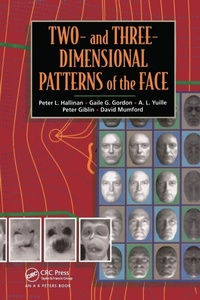
Two- and Three-Dimensional Patterns of the Face
1st Edition
Published on 2. December 2019
Book
Paperback/Softback
272 pages
978-0-367-44758-8 (ISBN)
Description
The human face is perhaps the most familiar and easily recognized object in the world, yet both its three-dimensional shape and its two-dimensional images are complex and hard to characterize. This book develops the vocabulary of ridges and parabolic curves, of illumination eigenfaces and elastic warpings for describing the perceptually salient features of a face and its images. The book also explores the underlying mathematics and applies these mathematical techniques to the computer vision problem of face recognition, using both optical and range images.
More details
Language
English
Place of publication
London
United Kingdom
Publishing group
Taylor & Francis Ltd
Target group
Professional and scholarly
Professional Practice & Development
Dimensions
Height: 229 mm
Width: 152 mm
Thickness: 15 mm
Weight
399 gr
ISBN-13
978-0-367-44758-8 (9780367447588)
Copyright in bibliographic data and cover images is held by Nielsen Book Services Limited or by the publishers or by their respective licensors: all rights reserved.
Schweitzer Classification
Other editions
Additional editions
Peter W. Hallinan | Gaile Gordon | A. L. Yuille
Two- and Three-Dimensional Patterns of the Face
Book
06/1999
1st Edition
A K Peters
€121.50
Shipment within 3-4 weeks
Peter W. Hallinan | Gaile Gordon | A. L. Yuille
Two- and Three-Dimensional Patterns of the Face
E-Book
06/1999
1st Edition
CRC Press
€65.99
Available for download
Peter W. Hallinan | Gaile Gordon | A. L. Yuille
Two- and Three-Dimensional Patterns of the Face
E-Book
06/1999
CRC Press
€65.99
Available for download
Persons
Hallinan, Peter W.; Gordon, Gaile; Yuille, A. L.; Giblin, Peter; Mumford, David
Content
1. Faces from a Pattern-Theoretic Perspective 2. Overview of Approaches to Face Recognition 3. Modeling Variations in Illumination 4. Modeling Variations in Geometry 5. Recognition from Image Data 6. Parabolic Curves and Ridges on Surfaces 7. Sculpting a Surface 8. Finding Facial Features from Range Data 9. Recognition from Range Data 10. What's Next?