

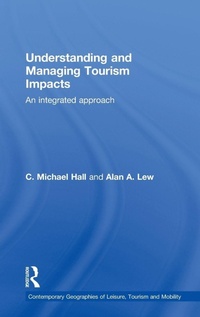
Understanding and Managing Tourism Impacts
An Integrated Approach
1st Edition
Published on 14. July 2009
Book
Hardback
388 pages
978-0-415-77132-0 (ISBN)
Description
As one of the world's largest industries, tourism carries with it significant social, environmental, economic and political impacts. Although tourism can provide significant economic benefits for some destinations, the image of tourism as a benign and environmentally friendly industry has often been challenged. There is a clear and growing body of evidence that suggests that the effects of tourism development are far more complex than policy-makers usually suggest and that the impacts of tourism occur not just at the destination but at all stages of a tourist's trip. Furthermore, tourism does not exist in a vacuum. Broader social and environmental changes also shape the form, growth and experience of tourism development.
This text provides a clear, accessible and up-to-date synthesis of tourism's role in our contemporary world, both as an agent of change, and as a response to it. Tourism-related change is approached from a framework that illustrates the changing environments in which they occur, including the spatial scale of such impacts and the effects of these impacts over time. This framework is then applied to the economic, socio-cultural and physical dimensions of tourism. After examining the different forms of tourism-related impacts, the book then discusses the role of planning as part of an integrated approach to the mitigation of undesirable impacts and the maximization of the desirable benefits of tourism development. Case studies and illustrations from a variety of locations from around the world are used throughout the book to exemplify key themes and issues; additionally figures and tables serve to elucidate statistical data.
Understanding and Managing Tourism Impacts illustrates that when well managed tourism can make a positive contribution to destinations. The books use of issues of scale, time and form to illustrate the effects of tourism provide an accessible and significant reminder that tourism's impacts vary over time and space, affects both the visitor and the host community, and can be unpredictable in its consequences. Chapter objectives, recommended readings, and links to web-based material help students, practitioners and researchers to grasp the broader implications of tourism development in today's world. With tourism increasingly being implicated as a factor in climate and environmental change, and with the benefits and costs of tourism as a form of economic development being examined more closely than ever, this book provides a timely contribution to help clarify the potentials and pitfalls of contemporary tourism.
This text provides a clear, accessible and up-to-date synthesis of tourism's role in our contemporary world, both as an agent of change, and as a response to it. Tourism-related change is approached from a framework that illustrates the changing environments in which they occur, including the spatial scale of such impacts and the effects of these impacts over time. This framework is then applied to the economic, socio-cultural and physical dimensions of tourism. After examining the different forms of tourism-related impacts, the book then discusses the role of planning as part of an integrated approach to the mitigation of undesirable impacts and the maximization of the desirable benefits of tourism development. Case studies and illustrations from a variety of locations from around the world are used throughout the book to exemplify key themes and issues; additionally figures and tables serve to elucidate statistical data.
Understanding and Managing Tourism Impacts illustrates that when well managed tourism can make a positive contribution to destinations. The books use of issues of scale, time and form to illustrate the effects of tourism provide an accessible and significant reminder that tourism's impacts vary over time and space, affects both the visitor and the host community, and can be unpredictable in its consequences. Chapter objectives, recommended readings, and links to web-based material help students, practitioners and researchers to grasp the broader implications of tourism development in today's world. With tourism increasingly being implicated as a factor in climate and environmental change, and with the benefits and costs of tourism as a form of economic development being examined more closely than ever, this book provides a timely contribution to help clarify the potentials and pitfalls of contemporary tourism.
Reviews / Votes
"In providing a coherent framework for managing tourism impacts as part of a holistic planning approach, it serves as a valuable resource not only for teaching students of tourism management but also for the development of professionals already engaged in the tourism industry." - Dr Angela Kalisch, University of Gloucestershire, UK"This book is an important addition to the field and to the resources of tourism educators and policymakers. Its examination of the complexities of tourism's impacts, the broader contexts and the elements involved result in a key text at the forefront of the study of tourism impacts." - Dr Mark Ewen, University of Hertfordshire, UK
More details
Series
Language
English
Place of publication
London
United Kingdom
Publishing group
Taylor & Francis Ltd
Target group
College/higher education
Product notice
Paper over boards
Illustrations
67 s/w Abbildungen, 38 s/w Photographien bzw. Rasterbilder, 29 s/w Zeichnungen, 32 s/w Tabellen
32 Tables, black and white; 29 Line drawings, black and white; 38 Halftones, black and white; 67 Illustrations, black and white
Dimensions
Height: 240 mm
Width: 161 mm
Thickness: 26 mm
Weight
752 gr
ISBN-13
978-0-415-77132-0 (9780415771320)
Copyright in bibliographic data and cover images is held by Nielsen Book Services Limited or by the publishers or by their respective licensors: all rights reserved.
Schweitzer Classification
Other editions
Additional editions
E-Book
09/2009
1st Edition
Routledge
€72.49
Available for download
E-Book
09/2009
1st Edition
Routledge
€72.49
Available for download
Book
07/2009
1st Edition
Routledge
€94.70
Shipment within 15-20 days
Persons
Michael Hall is Professor at University of Canterbury, Christchurch where he teaches social and services marketing and tourism, and Docent in the Department of Geography, University of Oulu. Co-editor of Current Issues in Tourism his research focuses on tourism, regional development, environmental history and gastronomy.
Alan A. Lew is Professor in the Department of Geography, Planning, and Recreation at Northern Arizona University where he teaches geography, urban planning and tourism development. His research focuses on tourism in China and Southeast Asia, and he is editor-in-chief of the journal, Tourism Geographies.
Alan A. Lew is Professor in the Department of Geography, Planning, and Recreation at Northern Arizona University where he teaches geography, urban planning and tourism development. His research focuses on tourism in China and Southeast Asia, and he is editor-in-chief of the journal, Tourism Geographies.
Content
1. Introduction: Conceptualising Tourism 2. Understanding Impacts 3. Economic Impacts 4. Socio-Cultural Impacts 5. Physical Impacts 6. Integrated Approaches to Tourism Impacts: The Role of Planning 7. The Future of Tourism