

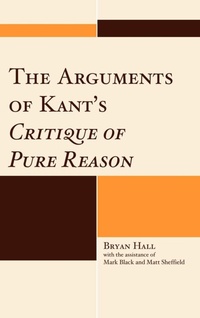
The Arguments of Kant's Critique of Pure Reason
Published on 27. December 2010
Book
Hardback
242 pages
978-0-7391-4165-6 (ISBN)
Description
The importance of Immanuel Kant's Critique of Pure Reason in the history of philosophy is matched only by its difficulty. In particular, readers are often frustrated by how difficult it is to extract Kant's arguments from his dense prose. This book reconstructs, using the tools of propositional logic, the central arguments of the Critique. In all, the book reconstructs thirty-six of Kant's arguments spanning the Transcendental Aesthetic, Transcendental Analytic, and Transcendental Dialectic. For each argument, they begin with a quote from Kant's text followed by a synopsis that explains the argument informally. Finally, each synopsis is followed by a formal reconstruction of the argument. The synopses offer examples, metaphors, historical background, and objections/responses to aid the reader in appreciating Kant's arguments. Even though many readers who approach Kant for the first time have a good philosophical vocabulary, few will understand Kant's unique lexicon. In addition to formally reconstructing Kant's arguments, the book also includes a glossary that defines the technical terms that Kant uses in his arguments. Finally, since this book is directed largely at students, Bryan Hall enlisted two of his own students to ensure that the book is maximally student friendly. In contrast to most pedagogical philosophical literature, the content of this book has been tailored by students for students.
Reviews / Votes
There are now several first-rate secondary texts on Kant's first Critique available, including Gardner's Kant and the Critique of Pure Reason and Altman's Companion to Kant's Critique of Pure Reason. But Bryan Hall's The Arguments of Kant's Critique of Pure Reason is not only every bit as excellent as these other texts, it is unique. It is a secondary text that carefully, critically, and specifically addresses, step-by-step, the arguments that Kant uses in the Critique of Pure Reason, and I think that it will be most gratefully welcomed and constantly used by generations of undergraduate philosophers and beginning graduate student philosophers to come. This is a book not only written for undergraduate students of the Critique of Pure Reason, but also in part by them. The appendix, 'Advice for the Student Reader,' written by Hall's undergraduate co-authors, is particularly engaging and helpful. I will most certainly assign this book as required reading for all my Kant courses. -- Robert Hanna, University of Colorado at Boulder In this book, Hall focuses on clarifying those main arguments in the Critique of Pure Reason that no undergraduate instructor can afford to ignore. The short, clearly written, chapters in the Arguments will do more to engage students than the recent, longer guidebooks and companions I have read. Reading Arguments has helped me better organize the lecture notes for my history of modern philosophy course and the seminar on Critique of Pure Reason. -- Seung-Kee Lee, Drew University The book encourages students to understand Kant's reasoning in the Critique of Pure Reason in terms of validly reconstructed arguments. This is useful in several respects. First, the reconstructed arguments at the end of each section provide a good and succinct summary of the relevant sections of the Critique of Pure Reason. Second, the reconstructed arguments help students to read Kant's writing more closely since they will question whether the reconstructed arguments do indeed correspond to Kant's reasoning. Finally, the book demonstrates to students why their logical skills play a central role in coming to terms with a challenging and influential text in the history of philosophy. The book is a very useful teaching tool and I recommend it to anybody who teaches a course on the Critique of Pure Reason. -- Nils Rauhut, Coastal Carolina UniversityMore details
Language
English
Place of publication
United States
Publishing group
Bloomsbury Publishing Plc
Target group
College/higher education
Dimensions
Height: 235 mm
Width: 157 mm
Thickness: 19 mm
Weight
552 gr
ISBN-13
978-0-7391-4165-6 (9780739141656)
Copyright in bibliographic data and cover images is held by Nielsen Book Services Limited or by the publishers or by their respective licensors: all rights reserved.
Schweitzer Classification
Other editions
Additional editions
Bryan Hall | Mark Black | Matt Sheffield
The Arguments of Kant's Critique of Pure Reason
E-Book
12/2010
1st Edition
Lexington Books
€47.99
Available for download
Bryan Hall | Mark Black | Matt Sheffield
The Arguments of Kant's Critique of Pure Reason
E-Book
12/2010
1st Edition
Lexington Books
€47.99
Available for download
Persons
Bryan Wesley Hall is assistant professor in the school of arts and letters at Indiana University Southeast.
Content
Chapter 1 Introduction
Part 2 Part I. The Transcendental Aesthetic
Chapter 3 Chapter 1. Introduction to the Transcendental Aesthetic
Chapter 4 Chapter 2. Space
Chapter 5 Chapter 3. Time
Chapter 6 Chapter 4. Conclusions from the Transcendental Aesthetic
Part 7 Part II. The Transcendental Analytic
Chapter 8 Chapter 5. Introduction to the Transcendental Analytic
Chapter 9 Chapter 6. Metaphysical Deduction
Chapter 10 Chapter 7. The A Transcendental Deduction
Chapter 11 Chapter 8. The B Transcendental Deduction
Chapter 12 Chapter 9. Schematism
Chapter 13 Chapter 10. Axioms and Anticipations
Chapter 14 Chapter 11. Analogies of Experience
Chapter 15 Chapter 12. Postulates and Refutation of Idealism
Chapter 16 Chapter 13. Conclusions from the Transcendental Analytic
Part 17 Part III. The Transcendental Dialectic
Chapter 18 Chapter 14. Introduction to the Transcendental Dialectic
Chapter 19 Chapter 15. Paralogisms
Chapter 20 Chapter 16. Antinomies
Chapter 21 Chapter 17. Ideal
Chapter 22 Chapter 18. Conclusions from the Transcendental Dialectic
Part 23 Appendix: Advice for the Student Reader
Part 24 Glossary
Part 2 Part I. The Transcendental Aesthetic
Chapter 3 Chapter 1. Introduction to the Transcendental Aesthetic
Chapter 4 Chapter 2. Space
Chapter 5 Chapter 3. Time
Chapter 6 Chapter 4. Conclusions from the Transcendental Aesthetic
Part 7 Part II. The Transcendental Analytic
Chapter 8 Chapter 5. Introduction to the Transcendental Analytic
Chapter 9 Chapter 6. Metaphysical Deduction
Chapter 10 Chapter 7. The A Transcendental Deduction
Chapter 11 Chapter 8. The B Transcendental Deduction
Chapter 12 Chapter 9. Schematism
Chapter 13 Chapter 10. Axioms and Anticipations
Chapter 14 Chapter 11. Analogies of Experience
Chapter 15 Chapter 12. Postulates and Refutation of Idealism
Chapter 16 Chapter 13. Conclusions from the Transcendental Analytic
Part 17 Part III. The Transcendental Dialectic
Chapter 18 Chapter 14. Introduction to the Transcendental Dialectic
Chapter 19 Chapter 15. Paralogisms
Chapter 20 Chapter 16. Antinomies
Chapter 21 Chapter 17. Ideal
Chapter 22 Chapter 18. Conclusions from the Transcendental Dialectic
Part 23 Appendix: Advice for the Student Reader
Part 24 Glossary