

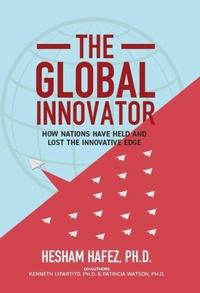
The Global Innovator
How Nations Have Held and Lost the Innovative Edge
Will be published approx. on 22. March 2022
Book
Hardback
175 pages
978-1-64687-074-5 (ISBN)
Description
What makes a society innovative?
Tracing the story of five great civilizations, from
ancient Egypt, Greece and Rome, to the Middle East, Europe, the United States
and China, this book will tell you. History offers us a model and lessons for
what can be done right, and it shows how once mighty and innovative societies
can fall. The story here departs from pundits who believe that the Western or
American-style political and legal system is uni-versally best for economic
success. At various times China, the Middle East and elsewhere were the great
engines of innovation; later leadership passed to Europe and the United States.
As some places rose to the top of science and technology, others fell away. And
some, like China, rose again.
The lessons of history are clear. Centers of innovation
learn from and borrow ideas, prac-tices and technologies from elsewhere. They
adapt ideas and practices to add new value. They activate strengths of their
population through education, cultural openness, and access to financial
resources. They build strong institutions that pursue new knowledge and reject
orthodoxy. At a time when the world seems to be closing doors to the talented
and pulling back from global engagement, when suspicion of the foreign is
running high, we may be losing the essential traits that make for innovation,
the most important of all assets for the future of the human race.
Tracing the story of five great civilizations, from
ancient Egypt, Greece and Rome, to the Middle East, Europe, the United States
and China, this book will tell you. History offers us a model and lessons for
what can be done right, and it shows how once mighty and innovative societies
can fall. The story here departs from pundits who believe that the Western or
American-style political and legal system is uni-versally best for economic
success. At various times China, the Middle East and elsewhere were the great
engines of innovation; later leadership passed to Europe and the United States.
As some places rose to the top of science and technology, others fell away. And
some, like China, rose again.
The lessons of history are clear. Centers of innovation
learn from and borrow ideas, prac-tices and technologies from elsewhere. They
adapt ideas and practices to add new value. They activate strengths of their
population through education, cultural openness, and access to financial
resources. They build strong institutions that pursue new knowledge and reject
orthodoxy. At a time when the world seems to be closing doors to the talented
and pulling back from global engagement, when suspicion of the foreign is
running high, we may be losing the essential traits that make for innovation,
the most important of all assets for the future of the human race.
Reviews / Votes
"The book acts as the guide into the rich history ofinnovation, spanning a massive 5,000 years; from the ancient Egyptians, to the
modern world. Having Dr. Hafez's own life story woven into the history adds a
very necessary touch of humanity and we understand that he embodies what it
means to be a successful innovator. Most notably we realize that contrary to
the societal narrative, religion is not always the enemy of innovation."
DR. MOHAMED REDA AWAD, Author of The Makers of the Islamic Civilization
Med
Professor, Faculty of Medicine, Al Azhar University Egypt
"This book provides
a historical perspective on the role of innovation in defining how
organizations survive-and thrive-in good times and bad. This perspective is
important for business leaders who are innovating through crises today."
LYNDA M. APPLEGATE, Baker
Foundation Professor, Harvard Business School
"This remarkable
blend of global business experience, history, and economic analysis gives us
new insights into the vital process of innovation. It should be required
reading for all students and scholars with an interest in the past, present,
and future of capitalism."
LOUIS GALAMBOS, Research Professor in Business and
Economic History, Johns Hopkins University
"Like The Rise
and Fall Of The Great Powers by Paul Kennedy and Sapiens by Yuval
Noah Harari, this well paced book got me thinking about what happens next, how
governments can help, how this informs public policy and how we can apply these
lessons at Dow Jones."
MARK RILEY, GM, Innovation & Corporate Ventures
at Dow Jones
"This book provides unique insights into innovation given the
authors' diverse back-grounds. Blended with Dr. Hafez's experience as an
entrepreneur working with people and businesses in a multicultural world, this
is a refreshing look at an important topic."
MUHAMMAD BIN IBRAHIM, the 8th Governor of the Central Bank of Malaysia and Adjunct
Professor at International Islamic University Malaysia
"A thoughtful look
at how leaders can build an innovation culture to keep business grow-ing, and
people motivated. The best thing about this book is the use of real life
examples of big players and how they lost their edge because of missing
innovation culture."
ENG. MOHAMMED AL MOWKLEY, Deputy Minister, Water Services, CEO,
National Water Company, Kingdom of Saudi Arabia
More details
Language
English
Place of publication
United States
Publishing group
Ideapress Publishing
Product notice
Cloth over boards
Illustrations
Illustrations
Dimensions
Height: 229 mm
Width: 153 mm
Thickness: 10 mm
Weight
590 gr
ISBN-13
978-1-64687-074-5 (9781646870745)
Copyright in bibliographic data and cover images is held by Nielsen Book Services Limited or by the publishers or by their respective licensors: all rights reserved.
Schweitzer Classification
Other editions
Additional editions
Hesham Hafez | Kenneth Lipartito | Patricia Watson
The Global Innovator
How Nations Have Held and Lost the Innovative Edge
E-Book
01/2022
Simon + Schuster LLC
€12.85
Available for download
Persons
HESHAM HAFEZ, PhD is a businessman and entrepreneur who has lived,
worked, and studied around the world in diverse societies ranging from Egypt to
Austria, Dubai, Malaysia, and China. A graduate of Harvard Business School's
Owner- President Management Program, he speaks to audiences of business and
political leaders in multiple countries.
KENNETH LIPARTITO, PhD is an author and editor of seven books,
is Professor of History at Florida International University in Miami and
president of The Business History Group (businesshistorygroup.com). His award-winning
writings include A History of the Kennedy Space Center and Corporate
Responsibility: The American Experience. He has lectured around the world and
is a member of the Innovation, Equity, and the Future of Prosperity team at the
Canadian Institute for Advanced Research (CIFAR).
PATRICIA WATSON, PhD is a historian with expertise in popular
history, medical history, family history, and oral history who works across
many different media platforms, including illustrated books, exhibits, videos,
and websites. Among her books are The Front Line in the War Against HIV/AIDS: Case
Studies from the African Comprehensive HIV/AIDS Partnerships; Henry Schein: A
History of Success; Building Values and Traditions: One Hundred Years of
Coopers & Lybrand; Crane: 150 Years Together.
worked, and studied around the world in diverse societies ranging from Egypt to
Austria, Dubai, Malaysia, and China. A graduate of Harvard Business School's
Owner- President Management Program, he speaks to audiences of business and
political leaders in multiple countries.
KENNETH LIPARTITO, PhD is an author and editor of seven books,
is Professor of History at Florida International University in Miami and
president of The Business History Group (businesshistorygroup.com). His award-winning
writings include A History of the Kennedy Space Center and Corporate
Responsibility: The American Experience. He has lectured around the world and
is a member of the Innovation, Equity, and the Future of Prosperity team at the
Canadian Institute for Advanced Research (CIFAR).
PATRICIA WATSON, PhD is a historian with expertise in popular
history, medical history, family history, and oral history who works across
many different media platforms, including illustrated books, exhibits, videos,
and websites. Among her books are The Front Line in the War Against HIV/AIDS: Case
Studies from the African Comprehensive HIV/AIDS Partnerships; Henry Schein: A
History of Success; Building Values and Traditions: One Hundred Years of
Coopers & Lybrand; Crane: 150 Years Together.