

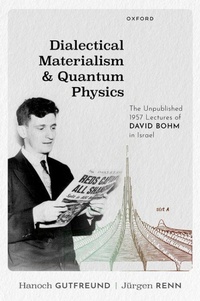
Dialectical Materialism and Quantum Physics
The Unpublished 1957 Lectures of David Bohm in Israel
Published on 4. November 2025
Book
Hardback
256 pages
978-0-19-894590-1 (ISBN)
Description
This is the story of David Bohm's hitherto unpublished notes, uncovered from a series of lectures given in Israel in 1957 to a group of Marxist physicists from the Hashomer Hatsair (young guard) movement. The notes explore quantum theory and dialectical materialism, as well as shedding light on the intellectual and emotional resources of his persistent rebellion against orthodoxies in science.
The discussion places his lectures notes in a wider historical, scientific, and philosophical context and traces Bohm's intellectual development from an early attempt to better understand the Copenhagen interpretation of quantum mechanics to his elaboration of an alternative causal interpretation based on the notion of "hidden variables."
As the lecture notes strikingly illustrate, dialectical materialism played a fundamental role for the further development of his understanding of quantum mechanics. Bohm placed the notions of infinity of nature and the unity of opposites in the center of his natural philosophy, drawing from the works of Hegel, Marx, Engels, and Lenin. The authors also examine Bohm's legacy in the history of quantum mechanics and his contribution to preparing the "second quantum revolution." Bohm's engagement with dialectical materialism and his role as a dissident to the orthodox interpretation of quantum mechanics were pivotal in bringing about the novel insights and technologies associated with this second quantum revolution. During the 1960s, Bohm developed a growing interest in the nature of consciousness and engaged with the philosopher Jiddu Krishnamurti. In spite of a seemingly fundamental break with earlier philosophical positions, this new phase in Bohm's intellectual odyssey was not completely unrelated to his fascination with and deep understanding of Hegel's philosophy, which the lecture notes amply document for the first time.
The discussion places his lectures notes in a wider historical, scientific, and philosophical context and traces Bohm's intellectual development from an early attempt to better understand the Copenhagen interpretation of quantum mechanics to his elaboration of an alternative causal interpretation based on the notion of "hidden variables."
As the lecture notes strikingly illustrate, dialectical materialism played a fundamental role for the further development of his understanding of quantum mechanics. Bohm placed the notions of infinity of nature and the unity of opposites in the center of his natural philosophy, drawing from the works of Hegel, Marx, Engels, and Lenin. The authors also examine Bohm's legacy in the history of quantum mechanics and his contribution to preparing the "second quantum revolution." Bohm's engagement with dialectical materialism and his role as a dissident to the orthodox interpretation of quantum mechanics were pivotal in bringing about the novel insights and technologies associated with this second quantum revolution. During the 1960s, Bohm developed a growing interest in the nature of consciousness and engaged with the philosopher Jiddu Krishnamurti. In spite of a seemingly fundamental break with earlier philosophical positions, this new phase in Bohm's intellectual odyssey was not completely unrelated to his fascination with and deep understanding of Hegel's philosophy, which the lecture notes amply document for the first time.
More details
Language
English
Place of publication
Oxford
United Kingdom
Target group
College/higher education
Product notice
sewn/stitched
Cloth over boards
Dimensions
Height: 237 mm
Width: 159 mm
Thickness: 24 mm
Weight
574 gr
ISBN-13
978-0-19-894590-1 (9780198945901)
Copyright in bibliographic data and cover images is held by Nielsen Book Services Limited or by the publishers or by their respective licensors: all rights reserved.
Schweitzer Classification
Persons
Hanoch Gutfreund has served as Head of the Institute of Physics, Head of the Institute of Advanced Studies, Rector, and President during his long association with The Hebrew University of Jerusalem. Currently, he is the academic head of the Einstein Archives. His research interests include theoretical solid-state physics, computational neuroscience, and the history and philosophy of science.
Juergen Renn is a Founding Director of the Max Planck Institute of Geoanthropology in Jena and a former Founding Director of Max Planck Institute for the History of Science in Berlin. His research interests include the history of modern physics, in particular of relativity and quantum theory, the history of the globalization of knowledge, and the history of the global change sciences that gave rise to the notion of the Anthropocene.
Juergen Renn is a Founding Director of the Max Planck Institute of Geoanthropology in Jena and a former Founding Director of Max Planck Institute for the History of Science in Berlin. His research interests include the history of modern physics, in particular of relativity and quantum theory, the history of the globalization of knowledge, and the history of the global change sciences that gave rise to the notion of the Anthropocene.
Content
Acknowledgments
Introduction
1: Setting the stage
2: Commentaries on Bohm's lectures: A framework of dialectical thinking
3: Lecture Notes (LN)
4: Bohm's legacy
References
Introduction
1: Setting the stage
2: Commentaries on Bohm's lectures: A framework of dialectical thinking
3: Lecture Notes (LN)
4: Bohm's legacy
References