

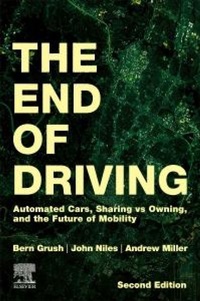
The End of Driving
Automated Cars, Sharing vs Owning, and the Future of Mobility
2nd Edition
Published on 29. September 2025
Book
Paperback/Softback
412 pages
978-0-443-22392-1 (ISBN)
Description
Vehicle automation is on dual paths of entrenching private car ownership while simultaneously enhancing transportation services that would make driving unnecessary. Future impacts are uncertain.
The End of Driving challenges the assumption that self-driving cars will by themselves reduce traffic congestion and crashes. Evolving vehicle automation will create safer, more convenient vehicles, yet continued reliance on private ownership will increase traffic volume. The authors explore psychological factors sustaining private vehicle use and the challenges of mixed-driver roads, examining why shared robotaxis face behavioral, political, and policy hurdles that will impede mass adoption, despite substantial public benefit.
This updated edition examines real-world deployments through 2025 and introduces concepts such as zero car-ownership communities, robotaxi pickup and drop-off orchestration, and urban spaces redesigned around greater mode choices for physical access rather than parking. The book compares privately owned automated cars against shared, on-demand driverless vehicles, using new data to show which model best serves cities.
Rather than predicting timelines, the authors use backcasting to map paths toward preferred mobility futures. They propose micro-subsidies, flexible transit integration, and regulatory frameworks to guide automation toward all three pillars of sustainability: ecology, economy, and equity. Shared, automated mobility is achievable and desirable but requires the deliberate actions described in this book.
The End of Driving challenges the assumption that self-driving cars will by themselves reduce traffic congestion and crashes. Evolving vehicle automation will create safer, more convenient vehicles, yet continued reliance on private ownership will increase traffic volume. The authors explore psychological factors sustaining private vehicle use and the challenges of mixed-driver roads, examining why shared robotaxis face behavioral, political, and policy hurdles that will impede mass adoption, despite substantial public benefit.
This updated edition examines real-world deployments through 2025 and introduces concepts such as zero car-ownership communities, robotaxi pickup and drop-off orchestration, and urban spaces redesigned around greater mode choices for physical access rather than parking. The book compares privately owned automated cars against shared, on-demand driverless vehicles, using new data to show which model best serves cities.
Rather than predicting timelines, the authors use backcasting to map paths toward preferred mobility futures. They propose micro-subsidies, flexible transit integration, and regulatory frameworks to guide automation toward all three pillars of sustainability: ecology, economy, and equity. Shared, automated mobility is achievable and desirable but requires the deliberate actions described in this book.
More details
Edition
2nd edition
Language
English
Place of publication
Philadelphia
United States
Target group
Professional and scholarly
Product notice
Paperback (trade)
Unsewn / adhesive bound
Dimensions
Height: 229 mm
Width: 152 mm
Thickness: 23 mm
Weight
717 gr
ISBN-13
978-0-443-22392-1 (9780443223921)
Copyright in bibliographic data and cover images is held by Nielsen Book Services Limited or by the publishers or by their respective licensors: all rights reserved.
Schweitzer Classification
Other editions
Additional editions
Bern Grush | John Niles | Andrew Miller
The End of Driving
Automated Cars, Sharing vs Owning, and the Future of Mobility
E-Book
10/2025
2nd Edition
Elsevier
€94.95
Available for download
Previous edition
Bern Grush | John Niles
The End of Driving
Transportation Systems and Public Policy Planning for Autonomous Vehicles
Book
06/2018
Elsevier
€118.99
Shipment within 15-20 days
Persons
Bern Grush is Executive Director of the Urban Robotics Foundation and project lead for ISO 4448, a technical standard for public-area mobile robots. With over four decades of experience in transportation innovation, he has founded several technology companies including Skymeter Corporation for road pricing systems and PCI Geomatics for satellite imaging analysis. His current work focuses on deployment standards and regulations for mobile robots in public spaces. He holds degrees in Human Factors Psychology from the University of Toronto and Systems Design Engineering from the University of Waterloo.
John S. Niles is Founder and President of Global Telematics, a Seattle-based research consultancy focused on improving transportation efficiency and effectiveness. As a Research Associate at San Jose State University's Mineta Transportation Institute, he has published studies on transit development, ride sharing, and vehicle automation. He advocates for sustainable personal mobility through non-profit organizations including the Ridesharing Institute and Puget Sound Smarter Transit. Life-long learning beyond his studies at MIT (S.B.) and Carnegie Mellon University (M.S.) have recently focused him on defining the strategic choices available for public transport agencies to expand personal mobility options for all citizens.
Andrew Miller, Ph.D., is Principal at Paladin Consulting, researching AI governance and mobility innovation. He has previously worked at Sidewalk Labs (Alphabet/Google), in private consulting, and in transport policy at all levels of government. He is the author of the Substack newsletter Changing Lanes on the future of transport, followed by more than 1,000 subscribers. He holds advanced degrees from Yale and Johns Hopkins Universities.
John S. Niles is Founder and President of Global Telematics, a Seattle-based research consultancy focused on improving transportation efficiency and effectiveness. As a Research Associate at San Jose State University's Mineta Transportation Institute, he has published studies on transit development, ride sharing, and vehicle automation. He advocates for sustainable personal mobility through non-profit organizations including the Ridesharing Institute and Puget Sound Smarter Transit. Life-long learning beyond his studies at MIT (S.B.) and Carnegie Mellon University (M.S.) have recently focused him on defining the strategic choices available for public transport agencies to expand personal mobility options for all citizens.
Andrew Miller, Ph.D., is Principal at Paladin Consulting, researching AI governance and mobility innovation. He has previously worked at Sidewalk Labs (Alphabet/Google), in private consulting, and in transport policy at all levels of government. He is the author of the Substack newsletter Changing Lanes on the future of transport, followed by more than 1,000 subscribers. He holds advanced degrees from Yale and Johns Hopkins Universities.
Content
Foreword by Dr. Susan Shaheen
Preface
Introduction
1. Language for automated driving
2. Hype, disillusionment, and reset
3. The broad context of change
4. Behavioral economics, automated driving, and vehicle ownership
5. A challenging transition: two competing markets
6. The road ahead wherever private ownership thrives
7. Barriers to shared use of vehicles
8. Matters of scale
9. Surviving mixed traffic
10. Backcasting: Steps to achieve desired futures
11. Microtransit rising
12. Nudging ride-buying with microsubsidies
13. Automated driving and transit-oriented development
14. The path to zero-car-ownership communities
15. Conclusion and recommendations
Glossary
References
Preface
Introduction
1. Language for automated driving
2. Hype, disillusionment, and reset
3. The broad context of change
4. Behavioral economics, automated driving, and vehicle ownership
5. A challenging transition: two competing markets
6. The road ahead wherever private ownership thrives
7. Barriers to shared use of vehicles
8. Matters of scale
9. Surviving mixed traffic
10. Backcasting: Steps to achieve desired futures
11. Microtransit rising
12. Nudging ride-buying with microsubsidies
13. Automated driving and transit-oriented development
14. The path to zero-car-ownership communities
15. Conclusion and recommendations
Glossary
References