

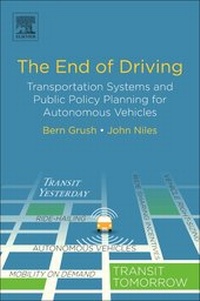
The End of Driving
Transportation Systems and Public Policy Planning for Autonomous Vehicles
Published on 14. June 2018
Book
Paperback/Softback
332 pages
978-0-12-815451-9 (ISBN)
Description
While many transportation and city planners, researchers, students, practitioners, and political leaders are familiar with the technical nature and promise of vehicle automation, consensus is not yet often seen on the impact that will result, or the policies and actions that those responsible for transportation systems should take.
The End of Driving: Transportation Systems and Public Policy Planning for Autonomous Vehicles explores both the potential of vehicle automation technology and the barriers it faces when considering coherent urban deployment. The book evaluates the case for deliberate development of automated public transportation and mobility-as-a-service as paths towards sustainable mobility, describing critical approaches to the planning and management of vehicle automation technology. It serves as a reference for understanding the full life cycle of the multi-year transportation systems planning processes, including novel regulation, planning, and acquisition tools for regional transportation.
Application-oriented, research-based, and solution-oriented rather than predict-and-warn, The End of Driving concludes with a detailed discussion of the systems design needed for accomplishing this shift.
From the Foreword by Susan Shaheen: The authors ... extend potential solutions through a set of open-ended exercises after each chapter. Their approach is both strategic and deliberate. They lead the reader from definitions and context setting to the transition toward automation, employing a range of creative strategies and policies. While our quest to understand how to deploy automated vehicles is just beginning, this book provides a thoughtful introduction to inform this evolution.
The End of Driving: Transportation Systems and Public Policy Planning for Autonomous Vehicles explores both the potential of vehicle automation technology and the barriers it faces when considering coherent urban deployment. The book evaluates the case for deliberate development of automated public transportation and mobility-as-a-service as paths towards sustainable mobility, describing critical approaches to the planning and management of vehicle automation technology. It serves as a reference for understanding the full life cycle of the multi-year transportation systems planning processes, including novel regulation, planning, and acquisition tools for regional transportation.
Application-oriented, research-based, and solution-oriented rather than predict-and-warn, The End of Driving concludes with a detailed discussion of the systems design needed for accomplishing this shift.
From the Foreword by Susan Shaheen: The authors ... extend potential solutions through a set of open-ended exercises after each chapter. Their approach is both strategic and deliberate. They lead the reader from definitions and context setting to the transition toward automation, employing a range of creative strategies and policies. While our quest to understand how to deploy automated vehicles is just beginning, this book provides a thoughtful introduction to inform this evolution.
More details
Language
English
Place of publication
United States
Target group
Professional and scholarly
Academic and commercial Transportation Planning researchers, practitioners, and policy makers
Dimensions
Height: 229 mm
Width: 152 mm
Weight
540 gr
ISBN-13
978-0-12-815451-9 (9780128154519)
Copyright in bibliographic data and cover images is held by Nielsen Book Services Limited or by the publishers or by their respective licensors: all rights reserved.
Schweitzer Classification
Other editions
New editions
Bern Grush | John Niles | Andrew Miller
The End of Driving
Automated Cars, Sharing vs Owning, and the Future of Mobility
Book
09/2025
2nd Edition
Elsevier
€93.50
Shipment within 15-20 days
Additional editions
Bern Grush | John Niles
The End of Driving
Transportation Systems and Public Policy Planning for Autonomous Vehicles
E-Book
06/2018
Elsevier
€109.00
Available for download
Persons
Bern Grush is Executive Director of the Urban Robotics Foundation and project lead for ISO 4448, a technical standard for public-area mobile robots. With over four decades of experience in transportation innovation, he has founded several technology companies including Skymeter Corporation for road pricing systems and PCI Geomatics for satellite imaging analysis. His current work focuses on deployment standards and regulations for mobile robots in public spaces. He holds degrees in Human Factors Psychology from the University of Toronto and Systems Design Engineering from the University of Waterloo.
John S. Niles is Founder and President of Global Telematics, a Seattle-based research consultancy focused on improving transportation efficiency and effectiveness. As a Research Associate at San Jose State University's Mineta Transportation Institute, he has published studies on transit development, ride sharing, and vehicle automation. He advocates for sustainable personal mobility through non-profit organizations including the Ridesharing Institute and Puget Sound Smarter Transit. Life-long learning beyond his studies at MIT (S.B.) and Carnegie Mellon University (M.S.) have recently focused him on defining the strategic choices available for public transport agencies to expand personal mobility options for all citizens.
John S. Niles is Founder and President of Global Telematics, a Seattle-based research consultancy focused on improving transportation efficiency and effectiveness. As a Research Associate at San Jose State University's Mineta Transportation Institute, he has published studies on transit development, ride sharing, and vehicle automation. He advocates for sustainable personal mobility through non-profit organizations including the Ridesharing Institute and Puget Sound Smarter Transit. Life-long learning beyond his studies at MIT (S.B.) and Carnegie Mellon University (M.S.) have recently focused him on defining the strategic choices available for public transport agencies to expand personal mobility options for all citizens.
Content
1. Critical Terminology and System Views2. Three Planning Contexts: Hype, Diffusion, and Governance
Part I: Contexts3. A Broad Context: The Contention of Change 4. Conflicting Narratives: Shared Understanding Will Be Difficult to Achieve
Part II: Problem5. A Challenging Transition: Two Competing Markets 6. Transitioning Through Multiple Automated Forms 7. How Privately Owned Vehicles Could Dominate the Next 30 Years8. A Note About Congestion 9. Barriers to Shared Use of Vehicles
Part III: Solutions10. Transit Leap in Theory 11. Transit Leap in Practice: City of SeaTac 12. Governing Fleets of Automated Vehicles 13. Harmonizing Competitive Fleets of Automated Common Carriers 14. The End of Driving and Transit-Oriented Development 15. How Behavioral Economics Can Help
Part I: Contexts3. A Broad Context: The Contention of Change 4. Conflicting Narratives: Shared Understanding Will Be Difficult to Achieve
Part II: Problem5. A Challenging Transition: Two Competing Markets 6. Transitioning Through Multiple Automated Forms 7. How Privately Owned Vehicles Could Dominate the Next 30 Years8. A Note About Congestion 9. Barriers to Shared Use of Vehicles
Part III: Solutions10. Transit Leap in Theory 11. Transit Leap in Practice: City of SeaTac 12. Governing Fleets of Automated Vehicles 13. Harmonizing Competitive Fleets of Automated Common Carriers 14. The End of Driving and Transit-Oriented Development 15. How Behavioral Economics Can Help