

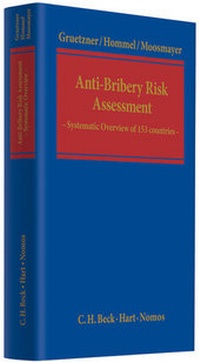
Anti-Bribery Risk Assessment
A Systematic Overview of 151 countries
1st Edition
Published on 22. December 2010
Book
Hardback
XXI, 473 pages
978-3-406-61006-6 (ISBN)
Description
"For the global economy, corruption is dangerous. The consequence is economic decay, not development. And that's why corruption demands a truly global response - one that knows no limits on collaboration." (so the US Attorney General Eric H. Holder at the OECD in May 2010).
The fight against corruption and bribery is backed by numerous global and regional agreements and conventions, supplemented by national legislation and practice, such as the Con-vention of the OECD on Combating Bribery of Foreign Public Officials in International Business Transactions (1997), the UN Convention against Corruption (2005), the Inter-American Convention against Cor-ruption ( 1997, the Criminal Law Convention on Corruption of the Council of Europe (2002), the Afri-can Union Convention on Prevent-ing and Combating Corruption (2006) and many more. Although most countries use their best en-deavours to reduce corruption within their jurisdiction, the effects of the measures taken still vary from country to country. This book undertakes the task of giving a compact overview on the legal framework and the practice of im-plementation in more than 150 countries worldwide, based on a uniform questionnaire. The reports of about 50 countries with the highest turnover in foreign trade are provided in print, a CD-ROM with the unprinted reports is included in the book.
Pros at a glance:
- Both compact and comprehensive
- Thanks to the uniform questionnaire the reports are easy to access and compare
- Focus is laid on practice
"Korruption gefährdet die globale Wirtschaft. Die Folge ist wirtschaftlicher Niedergang, nicht Fortschritt. Der Korruption kann nur durch eine weltweite, unbegrenzte Zusammenarbeit begegnet werden." (So US Attorney General Eric H. Holder vor der OECD im Mai 2010).
Dem Kampf gegen Korruption und Bestechung dienen zahlreiche internationale und regionale Abkommen und Verträge, ergänzt durch nationale Gesetzgebung und Verwaltungspraxis, wie das OECD-Übereinkommen über die Bekämpfung der Bestechung ausländischer Amtsträger im internationalen Geschäftsverkehr von 1997, die UN-Konvention gegen Korruption (UNCAC) von 2005, die Inter-American Convention against Corruption, 1997, das Strafrechtsübereinkommen über Korruption des Europarates, 2002, die African Union Convention on Preventing and Combating Corruption, 2006, und viele mehr. Obgleich sich die meisten Länder bemühen, die Korruption im Rahmen ihrer Möglichkeiten einzudämmen, sind die Erfolge je nach Land sehr verschieden.
Dieses Werk gibt auf der Grundlage eines einheitlichen Fragenkatalogs einen gleichermaßen knappen wie umfassenden Überblick über die rechtlichen Rahmen und die Umsetzungspraxis in 153 Ländern weltweit, wobei die Berichte über die 50 wichtigsten Handelsnationen abgedruckt, die restlichen auf einer CD diesem Werk beigelegt sind.
Vorteile auf einen Blick:
- sowohl knapp als auch umfassend
- dank eines einheitlichen Fragenkatalogs erleichterter Zugang zu und Vergleich der Länderberichte
- Fokus auf der Praxis
The fight against corruption and bribery is backed by numerous global and regional agreements and conventions, supplemented by national legislation and practice, such as the Con-vention of the OECD on Combating Bribery of Foreign Public Officials in International Business Transactions (1997), the UN Convention against Corruption (2005), the Inter-American Convention against Cor-ruption ( 1997, the Criminal Law Convention on Corruption of the Council of Europe (2002), the Afri-can Union Convention on Prevent-ing and Combating Corruption (2006) and many more. Although most countries use their best en-deavours to reduce corruption within their jurisdiction, the effects of the measures taken still vary from country to country. This book undertakes the task of giving a compact overview on the legal framework and the practice of im-plementation in more than 150 countries worldwide, based on a uniform questionnaire. The reports of about 50 countries with the highest turnover in foreign trade are provided in print, a CD-ROM with the unprinted reports is included in the book.
Pros at a glance:
- Both compact and comprehensive
- Thanks to the uniform questionnaire the reports are easy to access and compare
- Focus is laid on practice
"Korruption gefährdet die globale Wirtschaft. Die Folge ist wirtschaftlicher Niedergang, nicht Fortschritt. Der Korruption kann nur durch eine weltweite, unbegrenzte Zusammenarbeit begegnet werden." (So US Attorney General Eric H. Holder vor der OECD im Mai 2010).
Dem Kampf gegen Korruption und Bestechung dienen zahlreiche internationale und regionale Abkommen und Verträge, ergänzt durch nationale Gesetzgebung und Verwaltungspraxis, wie das OECD-Übereinkommen über die Bekämpfung der Bestechung ausländischer Amtsträger im internationalen Geschäftsverkehr von 1997, die UN-Konvention gegen Korruption (UNCAC) von 2005, die Inter-American Convention against Corruption, 1997, das Strafrechtsübereinkommen über Korruption des Europarates, 2002, die African Union Convention on Preventing and Combating Corruption, 2006, und viele mehr. Obgleich sich die meisten Länder bemühen, die Korruption im Rahmen ihrer Möglichkeiten einzudämmen, sind die Erfolge je nach Land sehr verschieden.
Dieses Werk gibt auf der Grundlage eines einheitlichen Fragenkatalogs einen gleichermaßen knappen wie umfassenden Überblick über die rechtlichen Rahmen und die Umsetzungspraxis in 153 Ländern weltweit, wobei die Berichte über die 50 wichtigsten Handelsnationen abgedruckt, die restlichen auf einer CD diesem Werk beigelegt sind.
Vorteile auf einen Blick:
- sowohl knapp als auch umfassend
- dank eines einheitlichen Fragenkatalogs erleichterter Zugang zu und Vergleich der Länderberichte
- Fokus auf der Praxis

More details
Product info
mit 1 CD-ROM
Edition
1. Auflage 2011
Language
English
Place of publication
München
Germany
Target group
Practising lawyers both in the field of commercial and criminal law, compliance officers and in-house counsels
Edition type
New edition
Product notice
Cloth
Illustrations
Including CD - Country Reports -
Dimensions
Height: 240 mm
Width: 160 mm
Thickness: 33 mm
Weight
943 gr
ISBN-13
978-3-406-61006-6 (9783406610066)
Schweitzer Classification
Other editions
Additional editions
Book
01/2011
1st Edition
Beck/Hart Publishing
€438.24
Article not available for order
Persons
Dr. Thomas Gruetzner ist Rechtsanwalt bei Baker & McKenzie in München, Dr. Ulf Hommel ist Justiziar und Dr. Klaus Moosmayer Chief Counsel Compliance in der Münchner Zentrale von Siemens. Die Autoren sind erfahrene Compliance-Experten in ihren jeweiligen Berichtsländern.
Content
The book and the CD-ROM cover 153 countries worldwide focussing on the following nine questions:
- What is the ceiling beyond which advantages granted to public officials in the context of contractual
negotiations become impermissible? What is commonly considered to be a socially acceptable and
legally unproblematic advantage?
- Who qualifies as a public official? Are government-controlled enterprises also included?
- Does culpability arise only in cases in which a public official breaches his official duties, or can there
be culpability also in cases in which a public official obtains any advantage in connection with a
permissible official act?
- What is the ceiling beyond which advantages granted to private sector business associates in the
con-text of contractual negotiations become impermissible? What is commonly considered to be a
socially acceptable and legally unproblematic advantage?
- How can differences between the answers to Question 1 and 4 (benefits obtained by public
officials/private sector business associates) be summarized?
- Many advantages be granted to a potential (in the absence of contractual negotiations) public or
private sector business associate? (So-called "priming the pump").
- Do corruption regulations apply solely to domestic businesses or also to foreign business entities
- Can legal entities be liable for prosecution? If not, what other possible sanctions might be imposed in
a business (forfeiture/monetary fine/confiscation of profits/barring of contract awards)?
- Can officials of a business also be held personally liable for criminal penalties or monetary fines?
- What is the ceiling beyond which advantages granted to public officials in the context of contractual
negotiations become impermissible? What is commonly considered to be a socially acceptable and
legally unproblematic advantage?
- Who qualifies as a public official? Are government-controlled enterprises also included?
- Does culpability arise only in cases in which a public official breaches his official duties, or can there
be culpability also in cases in which a public official obtains any advantage in connection with a
permissible official act?
- What is the ceiling beyond which advantages granted to private sector business associates in the
con-text of contractual negotiations become impermissible? What is commonly considered to be a
socially acceptable and legally unproblematic advantage?
- How can differences between the answers to Question 1 and 4 (benefits obtained by public
officials/private sector business associates) be summarized?
- Many advantages be granted to a potential (in the absence of contractual negotiations) public or
private sector business associate? (So-called "priming the pump").
- Do corruption regulations apply solely to domestic businesses or also to foreign business entities
- Can legal entities be liable for prosecution? If not, what other possible sanctions might be imposed in
a business (forfeiture/monetary fine/confiscation of profits/barring of contract awards)?
- Can officials of a business also be held personally liable for criminal penalties or monetary fines?