

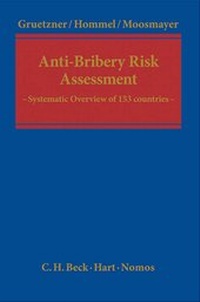
Anti-Bribery Risk Assessment
A Handbook
1st Edition
Published on 20. January 2011
Book
Hardback
500 pages
978-1-84946-129-0 (ISBN)
Description
For the global economy, corruption is dangerous. The consequence is economic decay, not development. And that's why corruption demands a truly global response, one that knows no limits on collaboration. (US Attorney General Eric H. Holder at the OECD in May 2010). The fight against corruption and bribery is backed by numerous global and regional agreements and conventions, supplemented by national legislation and practice, such as the Convention of the OECD on Combating Bribery of Foreign Public Officials in International Business Transactions (1997), the UN Convention against Corruption (2005), the Inter-American Convention against Corruption (1997), the Criminal Law Convention on Corruption of the Council of Europe (2002), the African Union Convention on Preventing and Combating Corruption (2006) and many more. Although most countries use their best endeavours to reduce corruption within their jurisdiction, the effects of the measures taken still vary from country to country. This book undertakes the task of giving a compact overview of the legal framework and practices of implementation in more than 150 countries worldwide, based on a uniform questionnaire. The reports of about 50 countries with the highest turnover in foreign trade are provided in print; a CD-ROM with the unprinted reports is included in the book.
·Both compact and comprehensive
·Thanks to the uniform questionnaire the reports are easy to access and compare
·Focus is laid on practice.
·Both compact and comprehensive
·Thanks to the uniform questionnaire the reports are easy to access and compare
·Focus is laid on practice.
More details
Other editions
Additional editions
Book
12/2010
1st Edition
C.H.BECK
€198.00
Article exhausted; check different version
Persons
Dr Thomas Gruetzner practises law with Baker & McKenzie in Munich.
Dr Ulf Hommel works as in-house counsel and Dr Klaus Moosmayer as Chief Counsel, Compliance, both with Siemens, Munich.
The authors are well-known experts in the field of compliance in the countries covered in this work.
Dr Ulf Hommel works as in-house counsel and Dr Klaus Moosmayer as Chief Counsel, Compliance, both with Siemens, Munich.
The authors are well-known experts in the field of compliance in the countries covered in this work.
Content
The book and the CD-ROM cover 153 countries worldwide focussing on the following nine questions:
1. What is the ceiling beyond which advantages granted to public officials in the context of contractual negotiations become impermissible? What is commonly considered to be a socially acceptable and legally unproblematic advantage?
2. Who qualifies as a public official? Are government-controlled enterprises also included?
3. Does culpability arise only in cases in which a public official breaches his official duties, or can there be culpability also in cases in which a public official obtains any advantage in connection with a permissible official act?
4. What is the ceiling beyond which advantages granted to private sector business associates in the context of contractual negotiations become impermissible? What is commonly considered to be a socially acceptable and legally unproblematic advantage?
5. How can differences between the answers to Question 1 and 4 (benefits obtained by public officials/private sector business associates) be summarized?
6. Many advantages be granted to a potential (in the absence of contractual negotiations) public or private sector business associate? (So-called "priming the pump").
7. Do corruption regulations apply solely to domestic businesses or also to foreign business entities?
8. Can legal entities be liable for prosecution? If not, what other possible sanctions might be imposed in a business (forfeiture/monetary fine/confiscation of profits/barring of contract awards)?
9. Can officials of a business also be held personally liable for criminal penalties or monetary fines?
1. What is the ceiling beyond which advantages granted to public officials in the context of contractual negotiations become impermissible? What is commonly considered to be a socially acceptable and legally unproblematic advantage?
2. Who qualifies as a public official? Are government-controlled enterprises also included?
3. Does culpability arise only in cases in which a public official breaches his official duties, or can there be culpability also in cases in which a public official obtains any advantage in connection with a permissible official act?
4. What is the ceiling beyond which advantages granted to private sector business associates in the context of contractual negotiations become impermissible? What is commonly considered to be a socially acceptable and legally unproblematic advantage?
5. How can differences between the answers to Question 1 and 4 (benefits obtained by public officials/private sector business associates) be summarized?
6. Many advantages be granted to a potential (in the absence of contractual negotiations) public or private sector business associate? (So-called "priming the pump").
7. Do corruption regulations apply solely to domestic businesses or also to foreign business entities?
8. Can legal entities be liable for prosecution? If not, what other possible sanctions might be imposed in a business (forfeiture/monetary fine/confiscation of profits/barring of contract awards)?
9. Can officials of a business also be held personally liable for criminal penalties or monetary fines?