

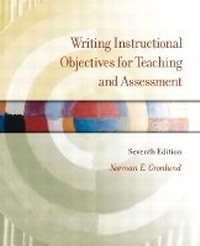
Writing Instructional Objectives for Teaching and Assessment
7th Edition
Published on 2. May 2003
Book
Paperback/Softback
144 pages
978-0-13-111737-2 (ISBN)
Description
For courses in Tests and Measurements; and as a supplement to elementary, middle-school, secondary, and K-12 general methods courses.
With a new title that reflects its broader focus, the seventh edition of this essential "how to" text again provides a step-by-step guide to writing instructional objectives as intended learning outcomes. The author describes how to state objectives in terms of the type of performance students must demonstrate in order to show that they have achieved the goals of the instruction-and illustrates his recommended methods with numerous examples. Gronlund describes a specific procedure for writing objectives-one that can be used to achieve all types of learning outcomes and is especially suited to teaching thinking, performance, and problem-solving skills. He stresses the important role of objectives in the teaching-learning assessment process and how they can be used to improve student learning.
With a new title that reflects its broader focus, the seventh edition of this essential "how to" text again provides a step-by-step guide to writing instructional objectives as intended learning outcomes. The author describes how to state objectives in terms of the type of performance students must demonstrate in order to show that they have achieved the goals of the instruction-and illustrates his recommended methods with numerous examples. Gronlund describes a specific procedure for writing objectives-one that can be used to achieve all types of learning outcomes and is especially suited to teaching thinking, performance, and problem-solving skills. He stresses the important role of objectives in the teaching-learning assessment process and how they can be used to improve student learning.
More details
Edition
7th edition
Language
English
Place of publication
United States
Publishing group
Pearson Education (US)
Target group
Professional and scholarly
Dimensions
Height: 233 mm
Width: 190 mm
Thickness: 6 mm
Weight
254 gr
ISBN-13
978-0-13-111737-2 (9780131117372)
Copyright in bibliographic data and cover images is held by Nielsen Book Services Limited or by the publishers or by their respective licensors: all rights reserved.
Schweitzer Classification
Other editions
New editions
Norman E. Gronlund | Susan M. Brookhart
Gronlund's Writing Instructional Objectives
Book
02/2008
8th Edition
Pearson
€50.12
Article is exhausted; no reprint
Previous edition
Norman E. Gronlund
How to Write and Use Instructional Objectives
Book
08/1999
6th Edition
Pearson
€14.84
Article exhausted; check for reprint
Content
I. PREPARING INSTRUCTIONAL OBJECTIVES.
1. Focusing on Intended Learning Outcomes.
2. Obtaining Clear Statements of Instructional Objectives.
3. Using Objectives in Planning for Instruction and Assessment.
4. Content Standards and Instructional Objectives.
5. Considerations in Preparing Instructional Objectives.
II. WRITING INSTRUCTIONAL OBJECTIVES FOR VARIOUS OUTCOMES.
6. Writing Objectives for Knowledge, Comprehension, and Application Outcomes.
7. Writing Objectives for Higher-Level Thinking Skills.
8. Writing Objectives for Affective Outcomes.
9. Writing Performance Objectives for Skills and Products.
10. Writing Performance Objectives for Problem-Solving Projects.
III. USING INSTRUCTIONAL OBJECTIVES IN ASSESSMENT.
11. Using Objectives in Achievement Testing.
12. Using Objectives in Performance and Affective Assessment.
APPENDIXES.
A. Checklist for Evaluating the Final List of Objectives.
B. Taxonomy of Educational Objectives.
C. Illustrative Verbs.
References.
Index.
1. Focusing on Intended Learning Outcomes.
2. Obtaining Clear Statements of Instructional Objectives.
3. Using Objectives in Planning for Instruction and Assessment.
4. Content Standards and Instructional Objectives.
5. Considerations in Preparing Instructional Objectives.
II. WRITING INSTRUCTIONAL OBJECTIVES FOR VARIOUS OUTCOMES.
6. Writing Objectives for Knowledge, Comprehension, and Application Outcomes.
7. Writing Objectives for Higher-Level Thinking Skills.
8. Writing Objectives for Affective Outcomes.
9. Writing Performance Objectives for Skills and Products.
10. Writing Performance Objectives for Problem-Solving Projects.
III. USING INSTRUCTIONAL OBJECTIVES IN ASSESSMENT.
11. Using Objectives in Achievement Testing.
12. Using Objectives in Performance and Affective Assessment.
APPENDIXES.
A. Checklist for Evaluating the Final List of Objectives.
B. Taxonomy of Educational Objectives.
C. Illustrative Verbs.
References.
Index.