

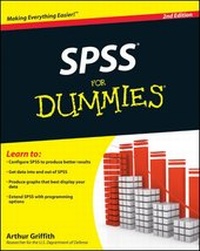
SPSS For Dummies
2nd Edition
Published on 12. January 2010
Book
Paperback/Softback
384 pages
978-0-470-48764-8 (ISBN)
Description
The fun and friendly guide to the world's leading statistical software
Predictive Analysis Software (PASW), formerly SPSS software, is the leading statistical software used by commerical, government, and academic organizations around the world to solve business and research problems. It allows you to quickly and easily discover new insights from data, test hypotheses, and build powerful predictive models.
PASW Statistics For Dummies covers everything you need to know to get up and running with this efficient and practical software.
* PASW Statistics is the leading statistical software used to analyze data and create predictive models; it is used by business, academic, and government entities worldwide
* This guide explains how to work with automatic codebook generation and customize the variable view
* Walks you through the rounding method that is used in all calculations and explains using predictive analysis
* Shows how to maximize your use of graph templates, and much more
Even if you have little or no statistical or mathematical background, PASW Statistics For Dummies will show you how to generate statistical support and decision-making information quickly and easily.
Note: CD-ROM/DVD and other supplementary materials are not included as part of eBook file.
Predictive Analysis Software (PASW), formerly SPSS software, is the leading statistical software used by commerical, government, and academic organizations around the world to solve business and research problems. It allows you to quickly and easily discover new insights from data, test hypotheses, and build powerful predictive models.
PASW Statistics For Dummies covers everything you need to know to get up and running with this efficient and practical software.
* PASW Statistics is the leading statistical software used to analyze data and create predictive models; it is used by business, academic, and government entities worldwide
* This guide explains how to work with automatic codebook generation and customize the variable view
* Walks you through the rounding method that is used in all calculations and explains using predictive analysis
* Shows how to maximize your use of graph templates, and much more
Even if you have little or no statistical or mathematical background, PASW Statistics For Dummies will show you how to generate statistical support and decision-making information quickly and easily.
Note: CD-ROM/DVD and other supplementary materials are not included as part of eBook file.
More details
Edition
2. Auflage
Language
English
Place of publication
Chichester
United Kingdom
Publishing group
John Wiley and Sons Ltd
Target group
Professional and scholarly
Edition type
Revised edition
Illustrations
Illustrations
Dimensions
Height: 23.3 cm
Width: 18.7 cm
Thickness: 2.1 cm
Weight
553 gr
ISBN-13
978-0-470-48764-8 (9780470487648)
Schweitzer Classification
Other editions
New editions
Keith McCormick | Jesus Salcedo | Aaron Poh
SPSS Statistics for Dummies
Book
07/2015
3rd Edition
Wiley
€32.90
Article exhausted; check for reprint
Person
Arthur Griffith is a former computer consultant for the U.S. Department of Defense. After working for 25 years as a programmer and software development project manager, he became a writer of computer books and has now written 14 of them.
Content
Introduction.
Part I: The Fundamental Mechanics of SPSS.
Chapter 1: Introducing IBM SPSS Statistics.
Chapter 2: Installing Software and Setting Options.
Chapter 3: A Simple Statistical Analysis Example.
Part II: Getting Data In and Out of SPSS.
Chapter 4: Entering Data from the Keyboard.
Chapter 5: Reading and Writing Files.
Chapter 6: Data and Data Types.
Chapter 7: Messing with the Data After It's in There.
Chapter 8: Getting Data Out of SPSS.
Part III: Graphing Data.
Chapter 9: Fundamentals of Graphing.
Chapter 10: Some Types of Graphs.
Chapter 11: More Types of Graphs.
Part IV: Analysis.
Chapter 12: Executing an Analysis.
Chapter 13: Some Analysis Examples.
Part V: Programming SPSS with Command Syntax.
Chapter 14: The Command Syntax Language.
Chapter 15: Command Syntax Language Examples.
Part VI: Programming SPSS with Python and Scripts.
Chapter 16: The Python Programming Language.
Chapter 17: Python inside SPSS.
Chapter 18: Scripts.
Part VII: The Part of Tens.
Chapter 19: Ten (or So) Modules You Can Add to SPSS.
Chapter 20: Ten Useful SPSS Things You Can Find on the Internet.
Glossary.
Index.
Part I: The Fundamental Mechanics of SPSS.
Chapter 1: Introducing IBM SPSS Statistics.
Chapter 2: Installing Software and Setting Options.
Chapter 3: A Simple Statistical Analysis Example.
Part II: Getting Data In and Out of SPSS.
Chapter 4: Entering Data from the Keyboard.
Chapter 5: Reading and Writing Files.
Chapter 6: Data and Data Types.
Chapter 7: Messing with the Data After It's in There.
Chapter 8: Getting Data Out of SPSS.
Part III: Graphing Data.
Chapter 9: Fundamentals of Graphing.
Chapter 10: Some Types of Graphs.
Chapter 11: More Types of Graphs.
Part IV: Analysis.
Chapter 12: Executing an Analysis.
Chapter 13: Some Analysis Examples.
Part V: Programming SPSS with Command Syntax.
Chapter 14: The Command Syntax Language.
Chapter 15: Command Syntax Language Examples.
Part VI: Programming SPSS with Python and Scripts.
Chapter 16: The Python Programming Language.
Chapter 17: Python inside SPSS.
Chapter 18: Scripts.
Part VII: The Part of Tens.
Chapter 19: Ten (or So) Modules You Can Add to SPSS.
Chapter 20: Ten Useful SPSS Things You Can Find on the Internet.
Glossary.
Index.