

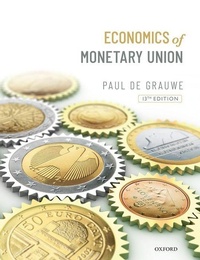
Economics of Monetary Union
13th Edition
Published on 1. April 2020
Book
Paperback/Softback
304 pages
978-0-19-884954-4 (ISBN)
Description
The thirteenth edition of this textbook provides an authoritative and concise analysis of the theories and policies relating to monetary union in which the author helps students to critically think about the sustainability of the Eurozone.
Part One examines the implications of adopting a common currency by analysing Europe's experience and the issues faced by the European Central Bank. Part Two of the book looks at the problems of running a monetary union by analysing Europe's experience and the issues faced by the European Central Bank.
Each chapter ends with a conclusion recapping the core issues, and a set of questions, which encourages students to test their knowledge and stretch their understanding further.
This book is accompanied by the following online resources:
For students:
- Links to data sources
- Essay questions
- Web links
- Paul De Grauwe on Twitter
For Lecturers:
- PowerPoint slides
- Instructor's manual
Part One examines the implications of adopting a common currency by analysing Europe's experience and the issues faced by the European Central Bank. Part Two of the book looks at the problems of running a monetary union by analysing Europe's experience and the issues faced by the European Central Bank.
Each chapter ends with a conclusion recapping the core issues, and a set of questions, which encourages students to test their knowledge and stretch their understanding further.
This book is accompanied by the following online resources:
For students:
- Links to data sources
- Essay questions
- Web links
- Paul De Grauwe on Twitter
For Lecturers:
- PowerPoint slides
- Instructor's manual
Reviews / Votes
An ideal book for students. The author strikes the perfect balance between the pedagogical needs of the students and thorough treatment of the concepts. Challenging topics and insightful analysis are introduced in a clear and coherent manner. * Dimitrios Syrrakos, Professor of Economics, Policy, and International Business, Manchester Metropolitan University * An excellent text that covers all major topics concerning monetary union and introduces students to all the key debates on the subject. * Johannes Schmidt, Professor of Economics, Karlsruhe University of Applied Sciences * Rigorous, original, and clear. The perfect textbook for both undergraduate and postgraduate students who want to understand the economic reasoning behind the monetary union in the Euro Area. * Miguel Angel Gavilan-Rubio, Lecturer in Economics, University of Essex *More details
Edition
13th Revised edition
Language
English
Place of publication
Oxford
United Kingdom
Target group
College/higher education
Edition type
Revised edition
Product notice
Paperback (trade)
Unsewn / adhesive bound
Dimensions
Height: 246 mm
Width: 192 mm
Thickness: 19 mm
Weight
522 gr
ISBN-13
978-0-19-884954-4 (9780198849544)
Copyright in bibliographic data and cover images is held by Nielsen Book Services Limited or by the publishers or by their respective licensors: all rights reserved.
Schweitzer Classification
Other editions
Previous edition
Paul De Grauwe
Economics of Monetary Union
Book
03/2018
12th Edition
Oxford University Press
€60.65
Article exhausted; check for reprint
Person
Paul De Grauwe, John Paulson Chair in European Political Economy, London School of Economics
Content
Part 1: Costs and Benefits of Monetary Union
1: The costs of a common currency
2: The theory of optimum currency areas: a critique
3: The benefits of a common currency
4: Costs and benefits compared
Part 2: Monetary Union
5: The fragility of incomplete monetary unions
6: The transition to a monetary union
7: How to complete a monetary union
8: Political economy of deconstructing the Eurozone
9: The European Central Bank
10: Monetary policy in the Eurozone
11: Fiscal policies in monetary unions
12: The euro and financial markets
1: The costs of a common currency
2: The theory of optimum currency areas: a critique
3: The benefits of a common currency
4: Costs and benefits compared
Part 2: Monetary Union
5: The fragility of incomplete monetary unions
6: The transition to a monetary union
7: How to complete a monetary union
8: Political economy of deconstructing the Eurozone
9: The European Central Bank
10: Monetary policy in the Eurozone
11: Fiscal policies in monetary unions
12: The euro and financial markets