

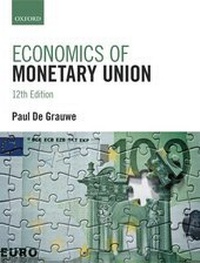
Economics of Monetary Union
12th Edition
Published on 22. March 2018
Book
Paperback/Softback
304 pages
978-0-19-880522-9 (ISBN)
Description
The twelfth edition of Economics of Monetary Union provides a concise analysis of the theories and policies relating to monetary union. The author addresses current issues surrounding the Eurozone, including; a critical discussion of the costs and benefits of possible exits by its member countries, an analysis of the role of the ECB as new single supervisor and detail on the sovereign debt crisis.
In Part One the author examines the implications of adopting a common currency, assessing the benefit to each country from being a member of the Eurozone, whilst also questioning whether other parts of the world would gain from monetary unification. Part Two of the book looks at the problems of running a monetary union by analysing Europe's experience and the issues faced by the European Central Bank.
The book is accompanied by online resources that feature:
For students:
r s1- Links to data sources
- Essay questions
- Web links
- Paul De Grauwe on Twitter
For Lecturers:
- PowerPoint slides
- Instructor's manual
In Part One the author examines the implications of adopting a common currency, assessing the benefit to each country from being a member of the Eurozone, whilst also questioning whether other parts of the world would gain from monetary unification. Part Two of the book looks at the problems of running a monetary union by analysing Europe's experience and the issues faced by the European Central Bank.
The book is accompanied by online resources that feature:
For students:
r s1- Links to data sources
- Essay questions
- Web links
- Paul De Grauwe on Twitter
For Lecturers:
- PowerPoint slides
- Instructor's manual
Reviews / Votes
The level and depth at which the text is written is excellent. It combines theoretical rigour with accessibility.The only book on the Economics of EMU worth buying, reading and recommending to students. * Robert Ackrill, Nottingham Trent University * The quality of the writing style is simply brilliant, and a major strength of the book: non technical though thorough, always relating concepts to the real world. Importantly, my students love it. * Jan Marc Berk, University of Groningen *
More details
Edition
12th Revised edition
Language
English
Place of publication
Oxford
United Kingdom
Target group
College/higher education
Edition type
Revised edition
Dimensions
Height: 247 mm
Width: 190 mm
Thickness: 15 mm
Weight
522 gr
ISBN-13
978-0-19-880522-9 (9780198805229)
Copyright in bibliographic data and cover images is held by Nielsen Book Services Limited or by the publishers or by their respective licensors: all rights reserved.
Schweitzer Classification
Other editions
New editions
Paul De Grauwe
Economics of Monetary Union
Book
04/2020
13th Edition
Oxford University Press
€61.00
Article is exhausted; no reprint
Person
Professor Paul De Grauwe is John Paulson Chair in European Political Economy at London School of Economics and Head of the European Institute. He was a member of the Belgian parliament from 1991 to 2003 and is honorary doctor of the University of Sankt Gallen (Switzerland), of the University of Turku (Finland), and the University of Genoa.
Content
Part One: Costs and Benefits of Monetary Union
1: The costs of common currency
2: The theory of optimum currency areas: a critique
3: The benefits of a common currency
4: Costs and benefits compared
Part Two: Monetary Union
5: The fragility of incomplete monetary union
6: Transition to a monetary union
7: How to complete a monetary union?
8: Leaving a monetary union
9: The European central bank
10: Monetary policy in the Eurozone
11: Fiscal policies in monetary unions
12: The euro and financial markets
1: The costs of common currency
2: The theory of optimum currency areas: a critique
3: The benefits of a common currency
4: Costs and benefits compared
Part Two: Monetary Union
5: The fragility of incomplete monetary union
6: Transition to a monetary union
7: How to complete a monetary union?
8: Leaving a monetary union
9: The European central bank
10: Monetary policy in the Eurozone
11: Fiscal policies in monetary unions
12: The euro and financial markets