

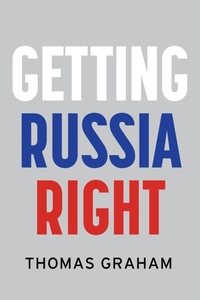
Getting Russia Right
1st Edition
Published on 24. November 2023
Book
Hardback
272 pages
978-1-5095-5689-2 (ISBN)
Description
As US-Russian relations scrape the depths of cold-war antagonism, the promise of partnership that beguiled American administrations during the first post-Soviet decades increasingly appears to be have been false from the start. Why did American leaders persist in pursuing it? Was there another path that would have produced more constructive relations or better prepared Washington to face the challenge Russia poses today?
With a practitioner's eye honed during decades of work on Russian affairs, Thomas Graham deftly traces the evolution of opposing ideas of national purpose that created an inherent tension in relations. Getting Russia Right identifies the blind spots that prevented Washington from seeing Russia as it really is and crafting a policy to advance American interests without provoking an aggressive Russian response. Distilling the Putin factor to reveal the contours of the Russia challenge facing the United States whenever he departs the scene, Graham lays out a compelling way to deal with it so that the United States can continue to advance its interests in a rapidly changing world.
As US-Russian relations scrape the depths of cold-war antagonism, the promise of partnership that beguiled American administrations during the first post-Soviet decades increasingly appears to be have been false from the start. Why did American leaders persist in pursuing it? Was there another path that would have produced more constructive relations or better prepared Washington to face the challenge Russia poses today?
With a practitioner's eye honed during decades of work on Russian affairs, Thomas Graham deftly traces the evolution of opposing ideas of national purpose that created an inherent tension in relations. <i>Getting Russia Right</i> identifies the blind spots that prevented Washington from seeing Russia as it really is and crafting a policy to advance American interests without provoking an aggressive Russian response. Distilling the Putin factor to reveal the contours of the Russia challenge facing the United States whenever he departs the scene, Graham lays out a compelling way to deal with it so that the United States can continue to advance its interests in a rapidly changing world.
With a practitioner's eye honed during decades of work on Russian affairs, Thomas Graham deftly traces the evolution of opposing ideas of national purpose that created an inherent tension in relations. Getting Russia Right identifies the blind spots that prevented Washington from seeing Russia as it really is and crafting a policy to advance American interests without provoking an aggressive Russian response. Distilling the Putin factor to reveal the contours of the Russia challenge facing the United States whenever he departs the scene, Graham lays out a compelling way to deal with it so that the United States can continue to advance its interests in a rapidly changing world.
As US-Russian relations scrape the depths of cold-war antagonism, the promise of partnership that beguiled American administrations during the first post-Soviet decades increasingly appears to be have been false from the start. Why did American leaders persist in pursuing it? Was there another path that would have produced more constructive relations or better prepared Washington to face the challenge Russia poses today?
With a practitioner's eye honed during decades of work on Russian affairs, Thomas Graham deftly traces the evolution of opposing ideas of national purpose that created an inherent tension in relations. <i>Getting Russia Right</i> identifies the blind spots that prevented Washington from seeing Russia as it really is and crafting a policy to advance American interests without provoking an aggressive Russian response. Distilling the Putin factor to reveal the contours of the Russia challenge facing the United States whenever he departs the scene, Graham lays out a compelling way to deal with it so that the United States can continue to advance its interests in a rapidly changing world.
More details
Language
English
Place of publication
Oxford
United Kingdom
Publishing group
John Wiley and Sons Ltd
Dimensions
Height: 236 mm
Width: 157 mm
Thickness: 24 mm
Weight
516 gr
ISBN-13
978-1-5095-5689-2 (9781509556892)
Copyright in bibliographic data and cover images is held by Nielsen Book Services Limited or by the publishers or by their respective licensors: all rights reserved.
Schweitzer Classification
Other editions
Additional editions
Thomas Graham
Getting Russia Right
Book
09/2025
1st Edition
Polity Press
€22.50
Shipment within 15-20 days
Thomas Graham
Getting Russia Right
E-Book
09/2023
1st Edition
Wiley-Blackwell
€16.99
Available for download
Person
Thomas Graham is a distinguished fellow at the Council on Foreign Relations. He has worked on Soviet and Russian affairs for the past 40 years in and out of government. He served as the senior director for Russia on the National Security Council staff during the George W. Bush administration and as a political officer at the American Embassy in Moscow for eight years just before and after the breakup of the Soviet Union. His writings on Russian domestic politics and foreign policy and US-Russian relations have appeared in Foreign Affairs, Foreign Policy, the New York Times, Financial Times, Washington Post, and Wall Street Journal, as well as in leading Russian news media.
<b>Thomas Graham</b> is a distinguished fellow at the Council on Foreign Relations. He has worked on Soviet and Russian affairs for the past 40 years in and out of government. He served as the senior director for Russia on the National Security Council staff during the George W. Bush administration and as a political officer at the American Embassy in Moscow for eight years just before and after the breakup of the Soviet Union. His writings on Russian domestic politics and foreign policy and US-Russian relations have appeared in <i>Foreign Affairs</i>, <i>Foreign Policy</i>, the <i>New York Times</i>, <i>Financial Times</i>, <i>Washington Post</i>, and <i>Wall Street Journal</i>, as well as in leading Russian news media.
<b>Thomas Graham</b> is a distinguished fellow at the Council on Foreign Relations. He has worked on Soviet and Russian affairs for the past 40 years in and out of government. He served as the senior director for Russia on the National Security Council staff during the George W. Bush administration and as a political officer at the American Embassy in Moscow for eight years just before and after the breakup of the Soviet Union. His writings on Russian domestic politics and foreign policy and US-Russian relations have appeared in <i>Foreign Affairs</i>, <i>Foreign Policy</i>, the <i>New York Times</i>, <i>Financial Times</i>, <i>Washington Post</i>, and <i>Wall Street Journal</i>, as well as in leading Russian news media.
Content
Acknowledgements
Preface
Introduction
1. The Foundations of America's Russia Policy
2. The Clash of Worldviews
3. The Paradox of Russian Power
4. Russian National Interests and Grand Strategy
5. The Putin Factor
6. Washington's Blind Spots and Missteps
7. What is to be Done?
Epilogue
Notes
Index
Preface
Introduction
1. The Foundations of America's Russia Policy
2. The Clash of Worldviews
3. The Paradox of Russian Power
4. Russian National Interests and Grand Strategy
5. The Putin Factor
6. Washington's Blind Spots and Missteps
7. What is to be Done?
Epilogue
Notes
Index