

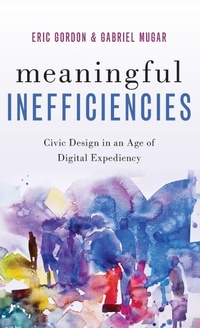
Meaningful Inefficiencies
Civic Design in an Age of Digital Expediency
Published on 26. March 2020
Book
Hardback
202 pages
978-0-19-087014-0 (ISBN)
Description
Public trust in the institutions that mediate civic life-from governing bodies to newsrooms-is low. In facing this challenge, many organizations assume that ensuring greater efficiency will build trust. As a result, these organizations are quick to adopt new technologies to enhance what they do, whether it's a new app or dashboard. However, efficiency, or charting a path to a goal with the least amount of friction, is not itself always built on a foundation of trust.
Meaningful Inefficiencies is about the practices undertaken by civic designers that challenge the normative applications of "smart technologies" in order to build or repair trust with publics. Based on over sixty interviews with change makers in public serving organizations throughout the United States, as well as detailed case studies, this book provides a practical and deeply philosophical picture of civic life in transition. The designers in this book are not professional designers, but practitioners embedded within organizations who have adopted an approach to public engagement Eric Gordon and Gabriel Mugar call "meaningful inefficiencies," or the deliberate design of less efficient over more efficient means of achieving some ends. This book illustrates how civic designers are creating meaningful inefficiencies within public serving organizations. It also encourages a rethinking of how innovation within these organizations is understood, applied, and sought after. Different than market innovation, civic innovation is not just about invention and novelty; it is concerned with building communities around novelty, and cultivating deep and persistent trust.
At its core, Meaningful Inefficiencies underlines that good civic innovation will never just involve one single public good, but must instead negotiate a plurality of publics. In doing so, it creates the conditions for those publics to play, resulting in people truly caring for the world. Meaningful Inefficiencies thus presents an emergent and vitally needed approach to creating civic life at a moment when smart and efficient are the dominant forces in social and organizational change.
Meaningful Inefficiencies is about the practices undertaken by civic designers that challenge the normative applications of "smart technologies" in order to build or repair trust with publics. Based on over sixty interviews with change makers in public serving organizations throughout the United States, as well as detailed case studies, this book provides a practical and deeply philosophical picture of civic life in transition. The designers in this book are not professional designers, but practitioners embedded within organizations who have adopted an approach to public engagement Eric Gordon and Gabriel Mugar call "meaningful inefficiencies," or the deliberate design of less efficient over more efficient means of achieving some ends. This book illustrates how civic designers are creating meaningful inefficiencies within public serving organizations. It also encourages a rethinking of how innovation within these organizations is understood, applied, and sought after. Different than market innovation, civic innovation is not just about invention and novelty; it is concerned with building communities around novelty, and cultivating deep and persistent trust.
At its core, Meaningful Inefficiencies underlines that good civic innovation will never just involve one single public good, but must instead negotiate a plurality of publics. In doing so, it creates the conditions for those publics to play, resulting in people truly caring for the world. Meaningful Inefficiencies thus presents an emergent and vitally needed approach to creating civic life at a moment when smart and efficient are the dominant forces in social and organizational change.
Reviews / Votes
Meaningful Inefficiencies is a valuable contribution to current debates and academic theory in the fields of communication and media studies. * Martijn de Waal, Amsterdam University of Applied Sciences * The concept of 'meaningful inefficiencies' is a productive addition to the field-it moves away from the utilitarian 'solutionist' view of smart tech and, instead, puts people at the forefront of the future. * Michiel de Lange, Utrecht University * This book is the perfect combination of radical and practical. What would the institutions that set the foundation for civic health look like if they operated through the lens of care? This simple question is profoundly consequential, and readers get to see that brighter and more functional future with the case studies provided herein. This book provides the spark for scholars, leaders, and workers in civic spaces to reorient around care, and I cant wait to see the positive change that follows. * Jennifer Brandel, Hearken *More details
Language
English
Place of publication
New York
United States
Target group
Professional and scholarly
Dimensions
Height: 222 mm
Width: 145 mm
Thickness: 14 mm
Weight
390 gr
ISBN-13
978-0-19-087014-0 (9780190870140)
Copyright in bibliographic data and cover images is held by Nielsen Book Services Limited or by the publishers or by their respective licensors: all rights reserved.
Schweitzer Classification
Other editions
Additional editions
Book
03/2020
Oxford University Press Inc
€47.20
Shipment within 15-20 days
E-Book
01/2020
OUP eBook
€19.99
Available for download
E-Book
01/2020
OUP eBook
€19.99
Available for download
Persons
Eric Gordon is a professor of civic media and the director of the Engagement Lab at Emerson College in Boston, Massachusetts. His research focuses on civic engagement and the transformation of public life and governance in digital culture. He has served as an expert advisor for local and national governments, as well as NGOs around the world, designing responsive processes that encourage play, delight, and deliberation. He is the author of two books about media and cities and, most recently, is the editor of Civic Media: Technology, Design, Practice (MIT Press, 2016) and Ludics: Play from Antiquity to Present (Palgrave, 2020).
Gabriel Mugar (Ph.D., Information Science and Technology, Syracuse University) is a design researcher at the global design consultancy, IDEO. He specializes in working with communities and organizations to design opportunities for learning, collaboration, and storytelling.
Gabriel Mugar (Ph.D., Information Science and Technology, Syracuse University) is a design researcher at the global design consultancy, IDEO. He specializes in working with communities and organizations to design opportunities for learning, collaboration, and storytelling.
Content
Acknowledgements
Introduction
Chapter 1: Innovation
Chapter 2: Publics
Chapter 3: Play
Chapter 4: Care
Chapter 5: Practice
References
Index
Introduction
Chapter 1: Innovation
Chapter 2: Publics
Chapter 3: Play
Chapter 4: Care
Chapter 5: Practice
References
Index