


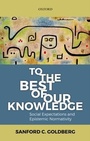
To the Best of Our Knowledge
Social Expectations and Epistemic Normativity
Published on 22. March 2018
Book
Hardback
294 pages
978-0-19-879367-0 (ISBN)
Description
Sanford C. Goldberg argues in this volume that epistemic normativity - the sort of normativity implicated in assessments of whether a belief amounts to knowledge - is grounded in the things we properly expect of one another as epistemic subjects. In developing this claim Goldberg argues that epistemic norms and standards themselves are generated by the expectations that arise out of our profound and ineliminable dependence on one another for what we know of the world. The expectations in question are those through which we hold each other accountable to standards of both (epistemic) reliability and (epistemic) responsibility. In arguing for this Goldberg aims to honor the insights of both internalist and externalist approaches to epistemic justification. The resulting theory has far-reaching implications not only for the theory of epistemic normativity, but also for the nature of epistemic assessment itself, as well as for our understanding of epistemic defeat, epistemic justification, epistemic responsibility, and the various social dimensions of knowledge.
More details
Language
English
Place of publication
Oxford
United Kingdom
Target group
College/higher education
Professional and scholarly
Dimensions
Height: 222 mm
Width: 145 mm
Thickness: 20 mm
Weight
516 gr
ISBN-13
978-0-19-879367-0 (9780198793670)
Copyright in bibliographic data and cover images is held by Nielsen Book Services Limited or by the publishers or by their respective licensors: all rights reserved.
Schweitzer Classification
Other editions
Additional editions
E-Book
03/2018
1st Edition
OUP eBook
€25.49
Available for download
E-Book
03/2018
1st Edition
OUP eBook
€32.99
Available for download
Person
Sanford C. Goldberg is Professor of Philosophy at Northwestern University. He works primarily in the areas of epistemology, philosophy of language, and philosophy of mind and is the author of dozens of articles in these areas, as well as four monographs, including Anti-Individualism: Mind and Language, Knowledge and Justification (Cambridge University Press, 2007), Relying on Others: An Essay in Epistemology (Oxford University Press, 2010), and Assertion: On the Philosophical Significance of Assertoric Speech (Oxford University Press, 2015). He is also the editor of the Oxford Handbook of Assertion (Oxford University Press, forthcoming).
Content
INTRODUCTION: The aim of this project
I Foundations of Epistemic Normativity
1: Epistemically Proper Belief: the very idea
2: Epistemic Assessment: Core Criteria and General Expectations
II Social Expectations, Epistemic Responsibility, and Epistemically Proper Belief
3: Core Criteria I: Permissions to rely on cognitive processes
4: Core Criteria II: Coherence-Infused Reliabilism (CIR)
5: General Expectations I: Entitlements to expect and Social Epistemic Responsibility
6: General Expectations II: Normative defeat and ultima facie epistemic propriety
7: Epistemic Responsibility in (Social) Context
I Foundations of Epistemic Normativity
1: Epistemically Proper Belief: the very idea
2: Epistemic Assessment: Core Criteria and General Expectations
II Social Expectations, Epistemic Responsibility, and Epistemically Proper Belief
3: Core Criteria I: Permissions to rely on cognitive processes
4: Core Criteria II: Coherence-Infused Reliabilism (CIR)
5: General Expectations I: Entitlements to expect and Social Epistemic Responsibility
6: General Expectations II: Normative defeat and ultima facie epistemic propriety
7: Epistemic Responsibility in (Social) Context