

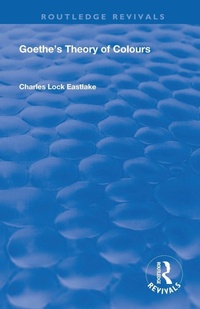
Goethe's Theory of Colours
1st Edition
Published on 19. February 2021
Book
Paperback/Softback
428 pages
978-0-367-02315-7 (ISBN)
Description
First published in German in 1810, this detailed volume was translated from the German by Charles Lock Eastlake and, in six parts, examines every aspect of Goethe's theory of colours, including psychological colours, chemical colours, the moral effect of colour, minerals, plants, insects, mammals and a multitude of further subjects.
More details
Series
Language
English
Place of publication
London
United Kingdom
Publishing group
Taylor & Francis Ltd
Target group
College/higher education
Dimensions
Height: 216 mm
Width: 140 mm
Thickness: 26 mm
Weight
616 gr
ISBN-13
978-0-367-02315-7 (9780367023157)
Copyright in bibliographic data and cover images is held by Nielsen Book Services Limited or by the publishers or by their respective licensors: all rights reserved.
Schweitzer Classification
Other editions
Additional editions
Johann Wolfgang Von Goethe
Goethe's Theory of Colours
E-Book
10/2019
1st Edition
Routledge
€48.49
Available for download
Johann Wolfgang Von Goethe
Goethe's Theory of Colours
E-Book
10/2019
1st Edition
Routledge
€48.49
Available for download
Johann Wolfgang Von Goethe
Goethe's Theory of Colours
Book
07/2019
1st Edition
Routledge
€187.20
Shipment within 15-20 days
Persons
Johann Wolfgang von Goethe was a German writer, poet, playwright, and philosopher, widely regarded as one of the most influential figures in Western literature. Born on August 28, 1749, in Frankfurt, Germany, he is best known for his works such as Faust, The Sorcerer's Apprentice, and Erlkönig. Goethe's works span a wide range of genres, including drama, poetry, and philosophy, and he was a central figure in the Sturm und Drang literary movement. His writing not only revolutionized German literature but also had a profound impact on political and philosophical thought. Throughout his career, Goethe was influenced by figures such as Friedrich Schiller and William Shakespeare, and his ideas on individuality and the human condition helped shape European intellectual history. Goethe was married to Christiane Vulpius from 1806 until her death in 1816. He spent much of his life in Weimar, Germany, where he died on March 22, 1832, at the age of 82. His legacy continues to influence writers, artists, and thinkers across the globe. His exploration of human nature and existential questions remains relevant in modern cultural and intellectual discussions.
Content
Part I. Physiological Colours. 1. Effects of Light and Darkness on the Eye. 2. Effects of Black and White Objects on the Eye. 3. Grey Surfaces and Objects. 4. Dazzling Colourless Objects. 5. Coloured Objects. 6. Coloured Shadows. 7. Faint Lights. 8. Subjective Halos. Part II. Physical Colours. 9. Dioptrical Colours. 10. Dioptrical Colours of the First Class. 11. Dioptrical Colours of the Second Class - Refraction. 12. Refraction without the Appearance of Colour. 13. Conditions of the Appearance of Colour. 14. Conditions under which the Appearance of Colour Increases. 15. Explanation of the Foregoing Phenomena. 16. Decrease of the Appearance of Colour. 17. Grey Objects Displaced by Refraction. 18. Coloured Objects Displaced by Refraction. 19. Achromatism and Hyperchromatism. 20. Advantages of Subjective Experiments - Transition to the Objective. 21. Refraction without the Appearance of Colour. 22. Conditions of the Appearance of Colour. 23. Conditions of the Increase of Colour. 24. Explanation of the Foregoing Phenomena. 25. Decrease of the Appearance of Colour. 26. Grey Objects. 27. Coloured Objects. 28. Achromatism and Hyperchromatism. 29. Combination of Subjective and Objective Experiments. 30. Transition. 31. Catoptrical Colours. 32. Paroptical Colours. 33. Epoptical Colours. Part III. Chemical Colours. 34. Chemical Contrast. 35. White. 36. Black. 37. First Excitation of Colour. 38. Augmentation of Colour. 39. Culmination. 40. Fluctuation. 41. Passage through the Whole Scale. 42. Inversion. 43. Fixation. 44. Intermixture, Real. 45. Intermixture, Apparent. 46. Communication, Actual. 47. Communication, Apparent. 48. Extraction. 49. Nomenclature. 50. Minerals. 51. Plants. 52. Worms, Insects, Fishes. 53. Birds. 54. Mammalia and Human Beings. 55. Physical and Chemical Effects of the Transmission of Light through Coloured Mediums. 56. Chemical Effect in Dioptrical Achromatism. Part IV. General Characteristics. Part V. Relation to Other Pursuits. Part VI. Effect of Colour with Reference to Moral Associations.