

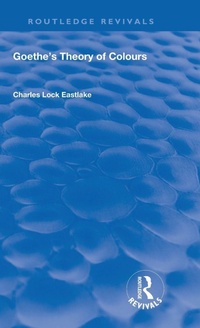
Goethe's Theory of Colours
1st Edition
Published on 5. July 2019
Book
Hardback
428 pages
978-0-367-02313-3 (ISBN)
Description
First published in German in 1810, this detailed volume was translated from the German by Charles Lock Eastlake and, in six parts, examines every aspect of Goethe's theory of colours, including psychological colours, chemical colours, the moral effect of colour, minerals, plants, insects, mammals and a multitude of further subjects.
More details
Series
Language
English
Place of publication
London
United Kingdom
Publishing group
Taylor & Francis Ltd
Target group
College/higher education
Dimensions
Height: 222 mm
Width: 145 mm
Thickness: 30 mm
Weight
747 gr
ISBN-13
978-0-367-02313-3 (9780367023133)
Copyright in bibliographic data and cover images is held by Nielsen Book Services Limited or by the publishers or by their respective licensors: all rights reserved.
Schweitzer Classification
Other editions
Additional editions
Johann Wolfgang Von Goethe
Goethe's Theory of Colours
Book
02/2021
1st Edition
Routledge
€59.20
Shipment within 15-20 days
Johann Wolfgang Von Goethe
Goethe's Theory of Colours
E-Book
10/2019
1st Edition
Routledge
€48.49
Available for download
Johann Wolfgang Von Goethe
Goethe's Theory of Colours
E-Book
10/2019
1st Edition
Routledge
€48.49
Available for download
Persons
Content
Part I. Physiological Colours. 1. Effects of Light and Darkness on the Eye. 2. Effects of Black and White Objects on the Eye. 3. Grey Surfaces and Objects. 4. Dazzling Colourless Objects. 5. Coloured Objects. 6. Coloured Shadows. 7. Faint Lights. 8. Subjective Halos. Part II. Physical Colours. 9. Dioptrical Colours. 10. Dioptrical Colours of the First Class. 11. Dioptrical Colours of the Second Class - Refraction. 12. Refraction without the Appearance of Colour. 13. Conditions of the Appearance of Colour. 14. Conditions under which the Appearance of Colour Increases. 15. Explanation of the Foregoing Phenomena. 16. Decrease of the Appearance of Colour. 17. Grey Objects Displaced by Refraction. 18. Coloured Objects Displaced by Refraction. 19. Achromatism and Hyperchromatism. 20. Advantages of Subjective Experiments - Transition to the Objective. 21. Refraction without the Appearance of Colour. 22. Conditions of the Appearance of Colour. 23. Conditions of the Increase of Colour. 24. Explanation of the Foregoing Phenomena. 25. Decrease of the Appearance of Colour. 26. Grey Objects. 27. Coloured Objects. 28. Achromatism and Hyperchromatism. 29. Combination of Subjective and Objective Experiments. 30. Transition. 31. Catoptrical Colours. 32. Paroptical Colours. 33. Epoptical Colours. Part III. Chemical Colours. 34. Chemical Contrast. 35. White. 36. Black. 37. First Excitation of Colour. 38. Augmentation of Colour. 39. Culmination. 40. Fluctuation. 41. Passage through the Whole Scale. 42. Inversion. 43. Fixation. 44. Intermixture, Real. 45. Intermixture, Apparent. 46. Communication, Actual. 47. Communication, Apparent. 48. Extraction. 49. Nomenclature. 50. Minerals. 51. Plants. 52. Worms, Insects, Fishes. 53. Birds. 54. Mammalia and Human Beings. 55. Physical and Chemical Effects of the Transmission of Light through Coloured Mediums. 56. Chemical Effect in Dioptrical Achromatism. Part IV. General Characteristics. Part V. Relation to Other Pursuits. Part VI. Effect of Colour with Reference to Moral Associations.