

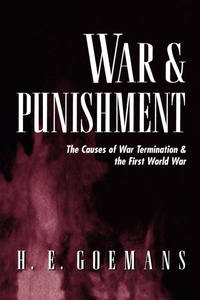
War and Punishment
The Causes of War Termination and the First World War
Published on 20. August 2000
Book
Paperback/Softback
368 pages
978-0-691-04944-1 (ISBN)
Description
What makes wars drag on and why do they end when they do? Here H. E. Goemans brings theoretical rigor and empirical depth to a long-standing question of securities studies. He explores how various government leaders assess the cost of war in terms of domestic politics and their own postwar fates. Goemans first develops the argument that two sides will wage war until both gain sufficient knowledge of the other's strengths and weaknesses so as to agree on the probable outcome of continued war. Yet the incentives that motivate leaders to then terminate war, Goemans maintains, can vary greatly depending on the type of government they represent. The author looks at democracies, dictatorships, and mixed regimes and compares the willingness among leaders to back out of wars or risk the costs of continued warfare. Democracies, according to Goemans, will prefer to withdraw quickly from a war they are not winning in order to appease the populace. Autocracies will do likewise so as not to be overthrown by their internal enemies.
Mixed regimes, which are made up of several competing groups and which exclude a substantial proportion of the people from access to power, will likely see little risk in continuing a losing war in the hope of turning the tide. Goemans explores the conditions and the reasoning behind this "gamble for resurrection" as well as other strategies, using rational choice theory, statistical analysis, and detailed case studies of Germany, Britain, France, and Russia during World War I. In so doing, he offers a new perspective of the Great War that integrates domestic politics, international politics, and battlefield developments.
Mixed regimes, which are made up of several competing groups and which exclude a substantial proportion of the people from access to power, will likely see little risk in continuing a losing war in the hope of turning the tide. Goemans explores the conditions and the reasoning behind this "gamble for resurrection" as well as other strategies, using rational choice theory, statistical analysis, and detailed case studies of Germany, Britain, France, and Russia during World War I. In so doing, he offers a new perspective of the Great War that integrates domestic politics, international politics, and battlefield developments.
Reviews / Votes
"Goemans makes a significant addition to our understanding of war termination. In addition, the book is so well written that it is a valuable source for readers at all levels."--Choice "One can disagree with particular interpretations of Goemans, or even question his overall thesis, but it is a thesis that must be taken seriously. Goemans is to be congratulated for producing a book of value to scholars and to policy-makers, given the obvious implications of his findings for strategy."--Richard Ned Lebow, International History Review "The greatest strength of this book is that it is eminently thought-provoking, and that is praise not lightly given."--Ralph Ashby, The HistorianMore details
Series
Language
English
Place of publication
New Jersey
United States
Target group
Professional and scholarly
College/higher education
Product notice
Paperback (trade)
Illustrations
2 line illus., 20 tables
Dimensions
Height: 229 mm
Width: 152 mm
Thickness: 22 mm
Weight
594 gr
ISBN-13
978-0-691-04944-1 (9780691049441)
Copyright in bibliographic data and cover images is held by Nielsen Book Services Limited or by the publishers or by their respective licensors: all rights reserved.
Schweitzer Classification
Other editions
Additional editions
E-Book
06/2015
1st Edition
Princeton University Press
€199.95
Available for download
Person
H. E. Goemans is Assistant Professor of Political Science at Duke University.
Content
List of Tables and Figures vii Acknowlegments ix Chapter One: Introduction 3 Chapter Two: A Theory of War Termination 19 Chapter Three: Large N: The Fate of Leaders and the Diration of War 53 Chapter Four: Germany 72 Chapter Five: Russia 122 Chapter Six: France 134 Chapter Seven: Great Britain 181 Chapter Eight: The Termination of the First World War, I: 1914-1917 232 Chapter Nine: The Termination of the First World War, II: 1918 270 Chapter Ten: Conclusion 310 Bibliography 325 Index 351