

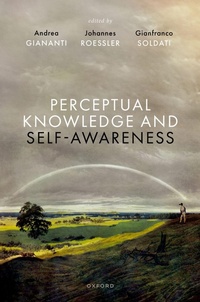
Perceptual Knowledge and Self-Awareness
Published on 26. December 2024
Book
Hardback
272 pages
978-0-19-286907-4 (ISBN)
Description
There is a tendency, in contemporary epistemology, to treat 'perceptual knowledge' and 'self-knowledge' as labels for different and largely unconnected sets of philosophical problems. The project of this volume is to bring out how much is to be gained from treating the two topics as, on the contrary, intimately connected. One set of questions that comes into view when we do concerns the sense in which perceptual knowledge, as understood from the first-person perspective, seem to be 'direct'. In a famous passage, Austin contrasted reliance on what we call 'evidence' with the way perceptual experience 'settles' questions. How should we understand the difference? In what sense is perceptual knowledge 'direct', in contradistinction to evidence-based, inferential knowledge? A connected set of issues has to do with the relationship between the epistemic authority of perception and self-consciousness. Is the way perceptual experience 'settles' questions inherently manifest to the perceiver? Is a perceiver's awareness of (e.g.) seeing that p to be explained by reference to the very capacities at work in seeing that p? Or does it reflect the operation of some kind of second-order perceptual capacity? Consideration of these matters, in turn, prompts questions about the nature of the first-person perspective. 'I can see that p' is a first-person self-ascription. But does it express the distinctively immediate kind of knowledge commonly labelled first-person self-knowledge? How would an affirmative answer to this question bear on a philosophical understanding of the 'first-person perspective'? These are rough indications of some of the ways in which reflection on the relationship between perceptual knowledge and self-awareness promises to shed valuable light on both topics.
More details
Language
English
Place of publication
Oxford
United Kingdom
Target group
College/higher education
Product notice
sewn/stitched
Cloth over boards
Dimensions
Height: 237 mm
Width: 164 mm
Thickness: 21 mm
Weight
590 gr
ISBN-13
978-0-19-286907-4 (9780192869074)
Copyright in bibliographic data and cover images is held by Nielsen Book Services Limited or by the publishers or by their respective licensors: all rights reserved.
Schweitzer Classification
Other editions
Additional editions
Persons
Andrea Giananti holds an MA from the University of Milan, an MLitt from the University of Glasgow, and a PhD from the University of Fribourg. His work lies at the intersection of epistemology and philosophy of mind, and he is particularly interested in issues in the philosophy of perception, self-knowledge, rationality, and action.
He has worked as a Lecturer at the University of Fribourg, and as Deputy Professor of epistemology at the University of Bayreuth. Currently, he is a Research Consultant at the University of Lausanne.
Johannes Roessler holds an MA from Tuebingen University and a DPhil from Oxford University. He was a Prize Fellow at Magdalen College and subsequently joined the Philosophy Department at Warwick University (initially as a research fellow in an interdisciplinary project on Consciousness and Self-Consciousness, directed by Naomi Eilan), where he is now a Professor. His main research interests are in epistemology and the philosophy of mind and action. He has published numerous articles on self-knowledge, perceptual knowledge, and reason-giving explanation, and he has co-authored a series of articles with Josef Perner on children's understanding of intentional actions. He is co-editor of three interdisciplinary volumes, published by OUP.
Gianfranco Soldati obtained his Licence es Lettres at the University of Geneva and his PhD at the University of Tuebingen. He has been doctoral assistant in Geneva and post-doctoral assistant in Tuebingen. He holds the chair for modern and contemporary philosophy at Fribourg University since 2000. He works on phenomenology, mind and knowledge. Among other things he is interested in problems related to perception, action, reason, self-knowledge, and in the philosophical analysis of experience.
He has worked as a Lecturer at the University of Fribourg, and as Deputy Professor of epistemology at the University of Bayreuth. Currently, he is a Research Consultant at the University of Lausanne.
Johannes Roessler holds an MA from Tuebingen University and a DPhil from Oxford University. He was a Prize Fellow at Magdalen College and subsequently joined the Philosophy Department at Warwick University (initially as a research fellow in an interdisciplinary project on Consciousness and Self-Consciousness, directed by Naomi Eilan), where he is now a Professor. His main research interests are in epistemology and the philosophy of mind and action. He has published numerous articles on self-knowledge, perceptual knowledge, and reason-giving explanation, and he has co-authored a series of articles with Josef Perner on children's understanding of intentional actions. He is co-editor of three interdisciplinary volumes, published by OUP.
Gianfranco Soldati obtained his Licence es Lettres at the University of Geneva and his PhD at the University of Tuebingen. He has been doctoral assistant in Geneva and post-doctoral assistant in Tuebingen. He holds the chair for modern and contemporary philosophy at Fribourg University since 2000. He works on phenomenology, mind and knowledge. Among other things he is interested in problems related to perception, action, reason, self-knowledge, and in the philosophical analysis of experience.
Content
1: Johannes Roessler and Andrea Giananti: Introduction: Perceptual Knowledge and Self-Awareness
2: Barry Stroud: The Possibility of Perceptual Knowledge
3: Barry Stroud: The Scope of Perception
4: Seeing and Thereby Knowing
5: Alan Millar: Recognitional Abilities and Knowing What One Sees
6: Appearances, Perceptual Knowledge, and Self-Knowledge
7: Perceptual Beliefs and Beliefs About Perception
8: Perception, Perceptual Knowledge, and Perceptual Self-Knowledge
9: Johannes Roessler: Perception, Knowledge, and Reflection
10: Andrea Giananti: Perception as a Rational Capacity
11: Guy Longworth: Unsettling Questions
12: Eylem Azaltun: Knowledge in Action and Knowledge of Perception
13: Hannah Ginsborg: Spontaneity Without Rationality: A Kantian Approach to Self-Consciousness and Perceptual Content
2: Barry Stroud: The Possibility of Perceptual Knowledge
3: Barry Stroud: The Scope of Perception
4: Seeing and Thereby Knowing
5: Alan Millar: Recognitional Abilities and Knowing What One Sees
6: Appearances, Perceptual Knowledge, and Self-Knowledge
7: Perceptual Beliefs and Beliefs About Perception
8: Perception, Perceptual Knowledge, and Perceptual Self-Knowledge
9: Johannes Roessler: Perception, Knowledge, and Reflection
10: Andrea Giananti: Perception as a Rational Capacity
11: Guy Longworth: Unsettling Questions
12: Eylem Azaltun: Knowledge in Action and Knowledge of Perception
13: Hannah Ginsborg: Spontaneity Without Rationality: A Kantian Approach to Self-Consciousness and Perceptual Content