

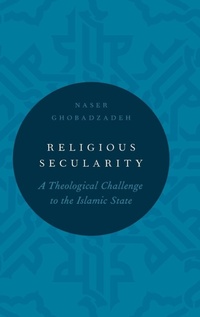
Religious Secularity
A Theological Challenge to the Islamic State
Published on 15. January 2015
Book
Hardback
288 pages
978-0-19-939117-2 (ISBN)
Description
"Fundamentalism" and "authoritarian secularism" are commonly perceived as the two mutually exclusive paradigms available to Muslim majority countries. Naser Ghobadzadeh highlights the recent political developments that have challenged this perception. He points to mainstream Islamist groups, such as the Muslim Brotherhood and Al-Nahda, that have adopted a distinctly secular-democratic approach to the state re-building process. Their success or failure in transitioning to democracy remains to be seen, but the political position these Islamic groups have carved out suggests the viability of a third way.
Ghobadzadeh examines the case of Iran, which has a unique history with respect to the relationship of religion and politics. The country has been subject to both authoritarian secularization and authoritarian Islamization over the last nine decades. While politico-religious discourse in Iran is articulated in response to the Islamic state, it also bears the scars of Iran's history of authoritarian secularizationthe legacy of the Pahlavi regime. Ghobadzadeh conceptualizes this politico-religious discourse as religious secularity. He uses this apparent oxymoron to describe the Islamic quest for a democratic secular state.
Offering a new reading of Shiite political theology, Ghobadzadeh argues that the Islamic state is detrimental to religion while a secular state can be compatible with it. Going further, he contends that maintaining a secular government is crucial to the cultivation of genuine religious conviction. This path-breaking analysis of Islamic history challenges existing scholarship, and gives voice to a unique, and optimistic Islamist perspective on what the future of Middle Eastern politics could be.
Ghobadzadeh examines the case of Iran, which has a unique history with respect to the relationship of religion and politics. The country has been subject to both authoritarian secularization and authoritarian Islamization over the last nine decades. While politico-religious discourse in Iran is articulated in response to the Islamic state, it also bears the scars of Iran's history of authoritarian secularizationthe legacy of the Pahlavi regime. Ghobadzadeh conceptualizes this politico-religious discourse as religious secularity. He uses this apparent oxymoron to describe the Islamic quest for a democratic secular state.
Offering a new reading of Shiite political theology, Ghobadzadeh argues that the Islamic state is detrimental to religion while a secular state can be compatible with it. Going further, he contends that maintaining a secular government is crucial to the cultivation of genuine religious conviction. This path-breaking analysis of Islamic history challenges existing scholarship, and gives voice to a unique, and optimistic Islamist perspective on what the future of Middle Eastern politics could be.
Reviews / Votes
Ghobadzadeh's book is a valuable addition to the current literature on Islam and secularism. His book will be useful to students and scholars interested in Iranian political history and thought and modern Muslim reformist thought more generally. Perhaps his greatest contribution is in writing a highly readable book that shows modern Muslims not as simply passive subjects of tyrannical regimes but as critical thinkers who are pushing the envelope of Islamic political thought into a more promising future. * Rushain Abbasi, Journal of Law andReligion * Ghobadzadeh's assessment of Middle Eastern politics is superb and concise. He adopts the Islamic state of Iran as a case study and in essence develops a strong argument for the liberation of religion through a democratic state founded upon a secularity with religious roots planted deep in the theological soil of Islamic teachings. * Ed Cook, Journal of Church & State * An authoritative and highly persuasive innovative Shia alternative to the clerical Islamic state. Ghobazadeh's systematic documentation of an authoritative critique of Khomeini's doctrine of Velayat-e-Faqih from within the Shia tradition can be inspiring and instructive for proponents of similar strategies in the Sunni Muslim world. * Abdullahi Ahmed An-Na'im, author of Islam and the Secular State: Negotiating the Future of Sharia * This is a path-breaking book that seeks a middle way between Islamism and assertive secularism. Ghobadzadeh reveals how several Iranian intellectuals and even influential members of the Shiite clergy have opposed the semi-theocratic regime in Iran. Such theological arguments about the necessity of an institutional separation between Islam and the state are hard to find in any other book. * Ahmet T. Kuru, the author of Secularism and State Policies toward Religion: The United States, France, and Turkey * This book is a valuable contribution to the global debate on Islam and democracy. By focusing on the concept of 'religious secularity,' Naser Ghobadzadeh deepens our understanding of how Islamic politics continues to evolve based on the lived experiences of Muslim societies, rather than on some medieval essence. Students and scholars interested in the intersection of religion and politics will benefit from the author's argument and ideas. * Nader Hashemi, Director, Center for Middle East Studies, University of Denver * The book is well written ... Scholars of Iran will find it interesting * G. M. Farr, CHOICE *More details
Series
Language
English
Place of publication
New York
United States
Target group
College/higher education
Professional and scholarly
Dimensions
Height: 240 mm
Width: 161 mm
Thickness: 21 mm
Weight
642 gr
ISBN-13
978-0-19-939117-2 (9780199391172)
Copyright in bibliographic data and cover images is held by Nielsen Book Services Limited or by the publishers or by their respective licensors: all rights reserved.
Schweitzer Classification
Other editions
Additional editions
Book
02/2017
Oxford University Press Inc
€45.00
Shipment within 15-20 days
E-Book
11/2014
1st Edition
OUP eBook
€17.49
Available for download
Person
Naser Ghobadzadeh is a Research Fellow at the Institute for Social Justice, the Australian Catholic University (ACU). Researching the intersection of religion and politics, his interests lie in the study of Islamic political theology, secularism, state-religion-society relations, and Middle East and Iranian politics.
Content
Acknowledgments ; Introduction ; Chapter One: Shiite Discourses on Sovereignty ; Chapter Two: Seeding Secularity The Rise of a Jurisprudential State ; Chapter Three: Religious Rationale for Separation ; Chapter Four: Political Construction of Clericalism ; Chapter Five: Clerics against Clericalism ; Chapter Six: Clerical Hegemony Contradictions and Paradoxes ; Conclusion ; Bibliography ; Notes