

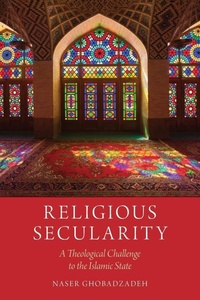
Religious Secularity
A Theological Challenge to the Islamic State
Published on 9. February 2017
Book
Paperback/Softback
288 pages
978-0-19-066489-3 (ISBN)
Description
Renewed authoritarianism, national disintegration, sectarian violence, and the increasing radicalization of Jihadi-Salafism since the Arab uprisings have significantly blurred visions for constructive religion-state-society relations in the MENA region. The dissolution of the 'Arab Spring' seems to have revived the questionable notion of Islamic exceptionalism. In sharp contrast, this book seeks to invalidate the supposed incompatibility of Islam and secular democracy. It outlines a complex Islamic political theology that undermines the religious basis of the unification of religion and state, offering religious justification for their separation.
Naser Ghobadzadeh coins the seemingly oxymoronic notion 'religious secularity' to encapsulate the Islamic quest to emancipate religion from state. In simultaneous opposition to both the politicisation of Islam and authoritarian secularism, religious secularity employs Islamic sources such as the Quran and Hadiths to articulate a robust religious rationale for state secularism. Whereas mainstream literature frequently presents being secular as 'antithetical to being religious', religious secularity blurs the boundaries between the 'religious' and the 'secular'. This book suggests that the rift between the religious and the secular is no more pronounced than the relationship between the two understood in dualistic terms, as evinced by Islamic history. Thus, religious secularity supports a theoretical shift away from the religious-secular dichotomy.
Naser Ghobadzadeh coins the seemingly oxymoronic notion 'religious secularity' to encapsulate the Islamic quest to emancipate religion from state. In simultaneous opposition to both the politicisation of Islam and authoritarian secularism, religious secularity employs Islamic sources such as the Quran and Hadiths to articulate a robust religious rationale for state secularism. Whereas mainstream literature frequently presents being secular as 'antithetical to being religious', religious secularity blurs the boundaries between the 'religious' and the 'secular'. This book suggests that the rift between the religious and the secular is no more pronounced than the relationship between the two understood in dualistic terms, as evinced by Islamic history. Thus, religious secularity supports a theoretical shift away from the religious-secular dichotomy.
Reviews / Votes
Ghobadzadeh's book is a valuable addition to the current literature on Islam and secularism. His book will be useful to students and scholars interested in Iranian political history and thought and modern Muslim reformist thought more generally. Perhaps his greatest contribution is in writing a highly readable book that shows modern Muslims not as simply passive subjects of tyrannical regimes but as critical thinkers who are pushing the envelope of Islamic political thought into a more promising future. * Rushain Abbasi, Journal of Law andReligion *More details
Series
Language
English
Place of publication
New York
United States
Target group
Professional and scholarly
Dimensions
Height: 234 mm
Width: 156 mm
Thickness: 17 mm
Weight
484 gr
ISBN-13
978-0-19-066489-3 (9780190664893)
Copyright in bibliographic data and cover images is held by Nielsen Book Services Limited or by the publishers or by their respective licensors: all rights reserved.
Schweitzer Classification
Other editions
Additional editions
Book
01/2015
Oxford University Press Inc
€145.00
Shipment within 15-20 days
E-Book
11/2014
1st Edition
OUP eBook
€17.49
Available for download
Person
Naser Ghobadzadeh is a Research Fellow at the Institute for Social Justice, the Australian Catholic University (ACU). He holds a Ph.D. (University of Sydney, 2012) and an M.A. in Political Science (Shahid Beheshti University, Iran, 2001). Naser has authored two books in the Persian language, including A Study of People's Divergence from the Ruling System (2002) and The Caspian Sea: Legal Regime, Neighboring Countries and US Policies (2005). His articles have been published in top-ranked international journals such as Third World Quarterly, Democratization, Philosophy and Social Criticism, Contemporary Politics, Commonwealth & Comparative Politics and Discourse.
Content
Acknowledgments
Introduction
Chapter One: Shiite Discourses on Sovereignty
Chapter Two: Seeding Secularity The Rise of a Jurisprudential State
Chapter Three: Religious Rationale for Separation
Chapter Four: Political Construction of Clericalism
Chapter Five: Clerics against Clericalism
Chapter Six: Clerical Hegemony Contradictions and Paradoxes
Conclusion
Bibliography
Notes
Introduction
Chapter One: Shiite Discourses on Sovereignty
Chapter Two: Seeding Secularity The Rise of a Jurisprudential State
Chapter Three: Religious Rationale for Separation
Chapter Four: Political Construction of Clericalism
Chapter Five: Clerics against Clericalism
Chapter Six: Clerical Hegemony Contradictions and Paradoxes
Conclusion
Bibliography
Notes