

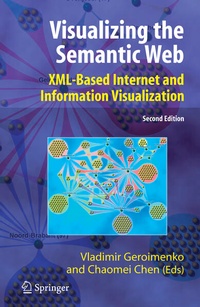
Visualizing the Semantic Web
XML-based Internet and Information Visualization
2nd Edition
Published on 11. October 2005
Book
Hardback
XIV, 248 pages
978-1-85233-976-0 (ISBN)
Description
The Semantic Web is a vision that has sparked a wide-ranging enthusiasm for a new generation of the Web. The Semantic Web is happening. The central idea of that vision is to make the Web more understandable to computer programs so that people can make more use of this gigantic asset. The use of metadata (data about data) can clearly indicate the meaning of data on the Web so as to provide computers enough information to handle such data. On the future Web, many additional layers will be required if we want computer programs to handle the semantics (the meaning of data) properly without human - tervention. Such layers should deal with the hierarchical relationships between me- ings, their similarities and differences, logical rules for making new inferences from the existing data and metadata, and so on. Dozens of new technologies have emerged recently to implement these ideas. XML (eXtensible Markup Language) forms the foundation of the future Web, RDF (Resource Description Framework), OWL (Web Ontology Language) and many other technologies help to erect a "multistory" bui- ing of the Semantic Web layer by layer by adding new features and new types of metadata. According to Tim Berners-Lee, the inventor of the current Web and the Semantic Web, it may take up to ten years to complete the building. The new Web will be much more complex than the current one and will contain enormous amounts of metadata as well as data.
Reviews / Votes
From the reviews of the second edition:
"Extensible Markup Language (XML) is the basis of the semantic Web's metadata. . The production quality of the book is quite high, featuring high-gloss paper and containing numerous intriguing color screen shots of visualization outputs . . the book does a good job of providing an understanding of the semantic web, presenting its vision and an overview of research into its visualization." (A. E. Salwin, Computing Reviews, December, 2006)
More details
Edition
2nd ed. 2006
Language
English
Place of publication
London
United Kingdom
Target group
Professional and scholarly
Research
Edition type
Revised edition
Illustrations
38 s/w Abbildungen, 70 farbige Abbildungen
XIV, 248 p. 108 illus., 70 illus. in color.
Dimensions
Height: 241 mm
Width: 160 mm
Thickness: 21 mm
Weight
613 gr
ISBN-13
978-1-85233-976-0 (9781852339760)
DOI
10.1007/1-84628-290-X
Schweitzer Classification
Other editions
Additional editions
Vladimir Geroimenko | Chaomei Chen
Visualizing the Semantic Web
XML-based Internet and Information Visualization
Book
03/2011
2nd Edition
Springer
€106.99
Shipment within 15-20 days
Vladimir Geroimenko | Chaomei Chen
Visualizing the Semantic Web
XML-based Internet and Information Visualization
E-Book
07/2006
2nd Edition
Springer
€96.29
Available for download
Previous edition
Vladimir Geroimenko | Chaomei Chen
Visualizing the Semantic Web
XML-based Internet and Information Visualization
Book
10/2004
Springer
€85.59
Article exhausted; check for reprint
Content
Semantic, Visual, and Technological Facets of the Second-Generation Web.- The Concept and Architecture of the Semantic Web.- Information Visualization and the Semantic Web.- Ontology-Based Information Visualization: Toward Semantic Web Applications.- Topic Maps, RDF Graphs, and Ontologies Visualization.- Web Services: Description, Interfaces, and Ontology.- Recommender Systems for the Web.- SVG and X3D: New XML Technologies for 2D and 3D Visualization.- Visual Techniques and Applications for the Semantic Web.- Using Graphically Represented Ontologies for Searching Content on the Semantic Web.- Adapting Graph Visualization Techniques for the Visualization of RDF Data.- Spring-Embedded Graphs for Semantic Visualization.- Semantic Association Networks: Using Semantic Web Technology to Improve Scholarly Knowledge and Expertise Management.- Interactive Interfaces for Mapping E-Commerce Ontologies.- Back Pain Data Collection Using Scalable Vector Graphics and Geographical Information Systems.- Social Network Analysis on the Semantic Web: Techniques and Challenges for Visualizing FOAF.- Concluding Remarks: Today's Vision of Envisioning the Semantic Future.