

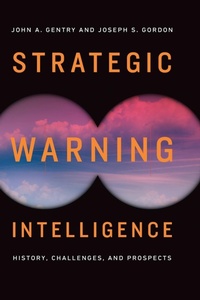
Strategic Warning Intelligence
History, Challenges, and Prospects
Published on 1. March 2019
Book
Hardback
296 pages
978-1-62616-654-7 (ISBN)
Description
John A. Gentry and Joseph S. Gordon update our understanding of strategic warning intelligence analysis for the twenty-first century. Strategic warning-the process of long-range analysis to alert senior leaders to trending threats and opportunities that require action-is a critical intelligence function. It also is frequently misunderstood and underappreciated. Gentry and Gordon draw on both their practitioner and academic backgrounds to present a history of the strategic warning function in the US intelligence community. In doing so, they outline the capabilities of analytic methods, explain why strategic warning analysis is so hard, and discuss the special challenges strategic warning encounters from senior decision-makers. They also compare how strategic warning functions in other countries, evaluate why the United States has in recent years emphasized current intelligence instead of strategic warning, and recommend warning-related structural and procedural improvements in the US intelligence community. The authors examine historical case studies, including postmortems of warning failures, to provide examples of the analytic points they make. Strategic Warning Intelligence will interest scholars and practitioners and will be an ideal teaching text for intermediate and advanced students.
Reviews / Votes
Students and practitioners of intelligence will gain invaluable insight into a discrete analytic function that is regularly overlooked or misunderstood [from this book]. * International Journal of Intelligence and CounterIntelligence * With "Strategic Warning Intelligence: History, Challenges, and Prospects" Professors John A. Gentry and Joseph S. Gordon significantly update our understanding of strategic warning intelligence analysis for the twenty-first century. Exceptionally well written, organized and presented, "Strategic Warning Intelligence" will prove to be of special and enduring interest scholars and practitioners - and will be an ideal teaching text for both intermediate and advanced students. * Midwest Book Review * All told, Gentry and Gordon present an important and valuable work. The analysis, conclusions, and recommendations they provide are well supported by personal experience and rigorous research. Students of intelligence, strategic warning, military and diplomatic decision making, and the history of all three would do well to include this volume in their library. * Air & Space Power Journal (ASPJ) * This book's discussion of strategic warning issues, especially how these apply to countering terrorism, make it an important resource for understanding the role of the intelligence community and its analytic methods in effectively addressing the terrorism challenges facing governments. * Perspectives on Terrorism *More details
Language
English
Place of publication
Washington, DC
United States
Target group
Professional and scholarly
US School Grade: College Graduate Student and over
Illustrations
Not illustrated
Dimensions
Height: 254 mm
Width: 178 mm
Weight
721 gr
ISBN-13
978-1-62616-654-7 (9781626166547)
Copyright in bibliographic data and cover images is held by Nielsen Book Services Limited or by the publishers or by their respective licensors: all rights reserved.
Schweitzer Classification
Other editions
Additional editions
E-Book
03/2019
Georgetown University Press
€37.99
Available for download
Persons
John A. Gentry is an adjunct professor in the Security Studies Program at the Edmund A. Walsh School of Foreign Service, Georgetown University and at Columbia University's School of International and Public Affairs.
Joseph S. Gordon is the Colin Powell Chair for Intelligence Analysis at National Intelligence University, president emeritus of the International Association for Intelligence Education, and was formerly an analyst at the Defense Intelligence Agency.
Joseph S. Gordon is the Colin Powell Chair for Intelligence Analysis at National Intelligence University, president emeritus of the International Association for Intelligence Education, and was formerly an analyst at the Defense Intelligence Agency.
Content
Contents
Preface
Abbreviations
Introduction
1. Concepts of Strategic Warning Intelligence
2. Four Classic Warning Cases
3. Types of Government Warning Institutions
4. The Evolution of U.S., British, Dutch, and NATO Warning Institutions
5. Warning Methodological Issues
6. The "Indications and Warning" Analytic Method
7. Other Warning Analytic Techniques
8. Cognitive, Psychological, and Character Issues
9. Producers of Warning Intelligence beyond Formal Intelligence Communities
10. Dealing with Senior Intelligence Consumers
11. Institutional Issues
12. The Future of Strategic Warning Intelligence
Bibliography
Index
About the Authors
Preface
Abbreviations
Introduction
1. Concepts of Strategic Warning Intelligence
2. Four Classic Warning Cases
3. Types of Government Warning Institutions
4. The Evolution of U.S., British, Dutch, and NATO Warning Institutions
5. Warning Methodological Issues
6. The "Indications and Warning" Analytic Method
7. Other Warning Analytic Techniques
8. Cognitive, Psychological, and Character Issues
9. Producers of Warning Intelligence beyond Formal Intelligence Communities
10. Dealing with Senior Intelligence Consumers
11. Institutional Issues
12. The Future of Strategic Warning Intelligence
Bibliography
Index
About the Authors