

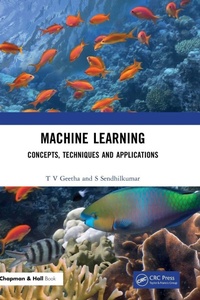
Machine Learning
Concepts, Techniques and Applications
1st Edition
Published on 17. May 2023
Book
Hardback
456 pages
978-1-032-26828-6 (ISBN)
Description
Machine Learning: Concepts, Techniques and Applications starts at basic conceptual level of explaining machine learning and goes on to explain the basis of machine learning algorithms. The mathematical foundations required are outlined along with their associations to machine learning. The book then goes on to describe important machine learning algorithms along with appropriate use cases. This approach enables the readers to explore the applicability of each algorithm by understanding the differences between them. A comprehensive account of various aspects of ethical machine learning has been discussed. An outline of deep learning models is also included. The use cases, self-assessments, exercises, activities, numerical problems, and projects associated with each chapter aims to concretize the understanding.
Features
Concepts of Machine learning from basics to algorithms to implementation
Comparison of Different Machine Learning Algorithms - When to use them & Why - for Application developers and Researchers
Machine Learning from an Application Perspective - General & Machine learning for Healthcare, Education, Business, Engineering Applications
Ethics of machine learning including Bias, Fairness, Trust, Responsibility
Basics of Deep learning, important deep learning models and applications
Plenty of objective questions, Use Cases, Activity and Project based Learning Exercises
The book aims to make the thinking of applications and problems in terms of machine learning possible for graduate students, researchers and professionals so that they can formulate the problems, prepare data, decide features, select appropriate machine learning algorithms and do appropriate performance evaluation.
Features
Concepts of Machine learning from basics to algorithms to implementation
Comparison of Different Machine Learning Algorithms - When to use them & Why - for Application developers and Researchers
Machine Learning from an Application Perspective - General & Machine learning for Healthcare, Education, Business, Engineering Applications
Ethics of machine learning including Bias, Fairness, Trust, Responsibility
Basics of Deep learning, important deep learning models and applications
Plenty of objective questions, Use Cases, Activity and Project based Learning Exercises
The book aims to make the thinking of applications and problems in terms of machine learning possible for graduate students, researchers and professionals so that they can formulate the problems, prepare data, decide features, select appropriate machine learning algorithms and do appropriate performance evaluation.
More details
Language
English
Place of publication
United Kingdom
Publishing group
Taylor & Francis Ltd
Target group
College/higher education
Professional and scholarly
Postgraduate, Professional, and Undergraduate Advanced
Illustrations
273 s/w Abbildungen, 273 s/w Photographien bzw. Rasterbilder, 22 s/w Tabellen
22 Tables, black and white; 273 Halftones, black and white; 273 Illustrations, black and white
Dimensions
Height: 260 mm
Width: 183 mm
Thickness: 30 mm
Weight
1090 gr
ISBN-13
978-1-032-26828-6 (9781032268286)
Copyright in bibliographic data and cover images is held by Nielsen Book Services Limited or by the publishers or by their respective licensors: all rights reserved.
Schweitzer Classification
Other editions
Additional editions
Book
06/2025
1st Edition
Chapman & Hall/CRC
€101.20
Shipment within 10-20 days
E-Book
05/2023
1st Edition
Chapman & Hall/CRC
€94.99
Available for download
E-Book
05/2023
1st Edition
Chapman & Hall/CRC
€94.99
Available for download
Persons
T V Geetha is a retired Senior Professor of Computer Science and Engineering with over 35 years of teaching experience in the areas of Artificial Intelligence, Machine Learning, Natural Language Processing and Information Retrieval. Her research interests include semantic, personalized and deep web search, semi-supervised learning for Indian languages, application of Indian philosophy to knowledge representation and reasoning, machine learning for adaptive e-learning, and application of machine learning and deep learning to biological literature mining and drug discovery. She is a recipient of the Young Women Scientist Award from the Government of Tamilnadu and Women of Excellence Award from Rotract Club of Chennai. She is a receipt of BSR Faculty Fellowship for Superannuated Faculty from University Grants Commission, Government of India for 2020-2023.
S Sendhilkumar is working as Associate Professor in Department of Information Science and Technology, CEG, Anna University with 18 years of teaching experience in the areas of Data Mining, Machine Learning, Data Science and Social Network Analytics. His research interests include personalized information retrieval, Bibliometrics and social network mining. He is recipient of CTS Best Faculty Award for the year 2018 and awarded with Visvesvaraya Young Faculty Research Fellowship by Ministry of Electronics and Information Technology (MeitY), Government of India for 2019-2021.
S Sendhilkumar is working as Associate Professor in Department of Information Science and Technology, CEG, Anna University with 18 years of teaching experience in the areas of Data Mining, Machine Learning, Data Science and Social Network Analytics. His research interests include personalized information retrieval, Bibliometrics and social network mining. He is recipient of CTS Best Faculty Award for the year 2018 and awarded with Visvesvaraya Young Faculty Research Fellowship by Ministry of Electronics and Information Technology (MeitY), Government of India for 2019-2021.
Content
1. Introduction. 2. Understanding Machine Learning. 3. Mathematiccal Foundations and Machine Learning. 4. Foundations and categoris of Machine Learning Techniques. 5. Machine Learning: Tool and Software 6. Classification Algorithms. 7. Probabilistic and Regression based approaches. 8. Performance Evaluation & Ensemble Methods. 9. Unsupervised Learning. 10. Sequence Models. 11. Reinforcement Learning. 12. Machine Learning Applications - Approaches. 13. Domain based Machine Learning Applications. 14. Ethical Aspects of Machine Learning. 15. Introduction to Deep Learning and Convolutional Neural Networks. 16. Other Models of Deep Learning and Applications of Deep Learning.