

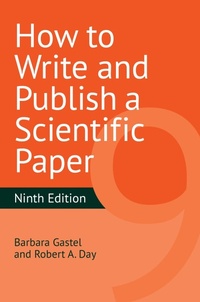
How to Write and Publish a Scientific Paper
9th Edition
Published on 30. June 2022
Book
Hardback
376 pages
978-1-4408-7882-4 (ISBN)
Description
Thoroughly updated throughout, this classic, practical text on how to write and publish a scientific paper takes its own advice to be "as clear and simple as possible."
"The purpose of scientific writing," according to Barbara Gastel and Robert A. Day, "is to communicate new scientific findings. Science is simply too important to be communicated in anything other than words of certain meaning."
This clear, beautifully written, and often funny text is a must-have for anyone who needs to communicate scientific information, whether they're writing for a professor, other scientists, or the general public. The thoughtfully revised 9th edition retains the most important material-including preparing text and graphics, publishing papers and other types of writing, and plenty of information on writing style-while adding up-to-date advice on copyright, presenting online, identifying authors, creating visual abstracts, and writing in English as a non-native language.
A set of valuable appendixes provide ready reference, including words and expressions to avoid, SI prefixes, a list of helpful websites, and a glossary. Students and working scientists will want to keep How to Write and Publish a Scientific Paper at their desks and refer to it at every stage of writing and publication.
"The purpose of scientific writing," according to Barbara Gastel and Robert A. Day, "is to communicate new scientific findings. Science is simply too important to be communicated in anything other than words of certain meaning."
This clear, beautifully written, and often funny text is a must-have for anyone who needs to communicate scientific information, whether they're writing for a professor, other scientists, or the general public. The thoughtfully revised 9th edition retains the most important material-including preparing text and graphics, publishing papers and other types of writing, and plenty of information on writing style-while adding up-to-date advice on copyright, presenting online, identifying authors, creating visual abstracts, and writing in English as a non-native language.
A set of valuable appendixes provide ready reference, including words and expressions to avoid, SI prefixes, a list of helpful websites, and a glossary. Students and working scientists will want to keep How to Write and Publish a Scientific Paper at their desks and refer to it at every stage of writing and publication.
Reviews / Votes
I have been using and recommending How to Write and Publish a Scientific Paper throughout my career, starting with the earliest editions. Not only is this book thorough, instructive, and fun to read, it was a critical guide in helping me to prepare manuscripts and grant applications and to hone my ability to write clear, meaningful, and easy-to-understand text. I promote this book in the many grantsmanship presentations I give each year, and I have given copies to my many trainees and to the graduate students in the PhD training program I direct. * William C. Parks, PhD, Professor of Medicine and Associate Dean for Graduate Research Education, Cedars-Sinai Medical Center, Los Angeles, CA * For almost four decades, first as a student and then a supervisor, How to Write and Publish has been my go-to resource for scientific writing. It is both informative and a joy to read; students-and academics-engage with it. It is comprehensive, and, critically, it has evolved through new editions, adapting to the ever-changing world of scientific communication. The 9th edition is no exception (for instance, it includes additions on e-publishing and the ethics of applying publication metrics). If your shelf has room for only one book on scientific writing, this should be it. * David JS Montagnes, PhD, Department of Evolution, Ecology, and Behaviour, University Liverpool, UK * Implausibly thorough, clear, funny-everything you would want in a book on scientific writing! Follow its advice or beware the consequences... * Tara Gray, Author, Publish & Flourish: Become a Prolific Scholar and Associate Provost for Faculty Development, New Mexico State University * How to Write and Publish a Scientific Paper is a highly desirable, up-to-date, and effective source for all the basic forms of scientific communication, essential to writing-in-the disciplines or scientific/professional writing courses and writing centers. As much for faculty as for students, it guides the reader through the whys as well as presenting the how-tos, all in readable, accessible prose. The book casts the writer in the role of decision maker-for example, not relying formulaically on IMRAD but explaining that it is one of many possible options for organization. Perhaps best of all, it promotes the basic truth that writing is essential to doing science. * Valerie M. Balester, Assistant Provost, Undergraduate Studies and Professor of English, Texas A&M University *More details
Edition
9th edition
Language
English
Place of publication
United States
Publishing group
Bloomsbury Publishing Plc
Target group
Professional and scholarly
College/higher education
Interest Age: From 7 to 17 years
Illustrations
50 bw illus
Dimensions
Height: 240 mm
Width: 161 mm
Thickness: 25 mm
Weight
725 gr
ISBN-13
978-1-4408-7882-4 (9781440878824)
Copyright in bibliographic data and cover images is held by Nielsen Book Services Limited or by the publishers or by their respective licensors: all rights reserved.
Schweitzer Classification
Other editions
Additional editions
Barbara Gastel | Robert A. Day
How to Write and Publish a Scientific Paper
E-Book
06/2022
9th Edition
Greenwood Press
€36.99
Available for download
Barbara Gastel | Robert A. Day
How to Write and Publish a Scientific Paper
E-Book
06/2022
9th Edition
Greenwood Press
€36.99
Available for download
Persons
Barbara Gastel, MD, is professor of integrative biosciences and of medical humanities at Texas A&M University, College Station, where she coordinates the graduate program in science communication.
Robert A. Day was professor emeritus of English at the University of Delaware, Newark.
Robert A. Day was professor emeritus of English at the University of Delaware, Newark.