

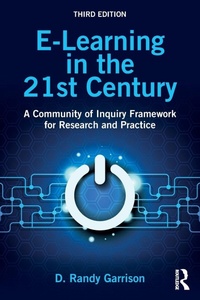
E-Learning in the 21st Century
A Community of Inquiry Framework for Research and Practice
3rd Edition
Published on 6. October 2016
Book
Paperback/Softback
202 pages
978-1-138-95356-7 (ISBN)
Description
The third edition of E-Learning in the 21st Century provides a coherent, comprehensive, and empirically-based framework for understanding e-learning in higher education. Garrison draws on his decades of experience and extensive research in the field to explore technological, pedagogical, and organizational implications. The third edition has been fully updated throughout and includes new material on learning technologies, MOOCs, blended learning, leadership, and the importance and role of social connections in thinking and learning, highlighting the transformative and disruptive impact that e-learning has recently had on education.
Reviews / Votes
"The latest edition of E-Learning in the 21st Century examines e-learning from the perspectives of advancing research, instructional practice, and institutional readiness. D. Randy Garrison, perhaps the prominent scholar and thought leader on e-learning, provides thought-provoking perspectives for scholars, educators, and administrators. I was highly impressed with his ability to direct practical suggestions to each of these constituencies."--Ben Arbaugh, Department Chair, Management and Human Resources, the University of Wisconsin Oshkosh, USA
"In the third edition of E-Learning in the 21st Century, D. Randy Garrison focuses more sharply on the Community of Inquiry framework and the ways in which it can inform research and practice in e-learning. As always, Garrison's insights are grounded in thoughtful and thought-provoking research findings. Newcomers to online learning and longtime fans of the Community of Inquiry framework alike will find much to value in this volume."
--Karen Swan, Stukel Professor of Educational Leadership, University of Illinois Springfield, USA
More details
Edition
3rd edition
Language
English
Place of publication
London
United Kingdom
Publishing group
Taylor & Francis Ltd
Target group
College/higher education
Professional and scholarly
Postgraduate and Professional
Illustrations
13 s/w Abbildungen
13 Illustrations, black and white
Dimensions
Height: 229 mm
Width: 152 mm
Thickness: 12 mm
Weight
329 gr
ISBN-13
978-1-138-95356-7 (9781138953567)
Copyright in bibliographic data and cover images is held by Nielsen Book Services Limited or by the publishers or by their respective licensors: all rights reserved.
Schweitzer Classification
Other editions
Additional editions
D. Randy Garrison
E-Learning in the 21st Century
A Community of Inquiry Framework for Research and Practice
Book
10/2016
3rd Edition
Routledge
€231.20
Shipment within 10-20 days
D. Randy Garrison
E-Learning in the 21st Century
A Community of Inquiry Framework for Research and Practice
E-Book
10/2016
3rd Edition
Routledge
€52.49
Available for download
D. Randy Garrison
E-Learning in the 21st Century
A Community of Inquiry Framework for Research and Practice
E-Book
10/2016
3rd Edition
Routledge
€52.49
Available for download
Previous edition
Book
03/2011
2nd Edition
Routledge
€57.13
Article exhausted; check for reprint
Person
D. Randy Garrison is Professor Emeritus at the University of Calgary, Canada.
Content
List of Figures
Preface
Acknowledgements
1 Introduction
SECTION I: The Conceptual Framework
2 Theoretical Foundations
3 Community of Inquiry
4 Social Presence
5 Cognitive Presence
6 Teaching Presence
SECTION II: Applying the CoI Framework
7 Learning Technologies
8 Blended Learning
9 Guidelines for Practice
10 Assessment and Evaluation
11 Organizational Issues
12 Future Directions
Appendices
About the Author
References
Index
Preface
Acknowledgements
1 Introduction
SECTION I: The Conceptual Framework
2 Theoretical Foundations
3 Community of Inquiry
4 Social Presence
5 Cognitive Presence
6 Teaching Presence
SECTION II: Applying the CoI Framework
7 Learning Technologies
8 Blended Learning
9 Guidelines for Practice
10 Assessment and Evaluation
11 Organizational Issues
12 Future Directions
Appendices
About the Author
References
Index