

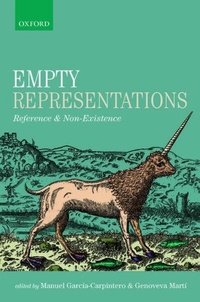
Empty Representations
Reference and Non-Existence
Published on 14. August 2014
Book
Hardback
368 pages
978-0-19-964705-7 (ISBN)
Description
It is the linguistic job of singular terms to pick out the objects that we think or talk about. But what about singular terms that seem to fail to designate anything, because the objects they refer to don't exist? We can employ these terms in meaningful thought and talk, which suggests that they are succeeding in fulfilling their representational task. A team of leading experts presents new essays on the much-debated problem of empty reference and thought.
In the 1960s and 1970s Keith Donnellan, David Kaplan, Saul Kripke and Hilary Putnam initiated a revolution in the then standard conception of reference--a concept at the core of philosophical inquiry. The repercussions of the revolution, particularly felt in metaphysics and epistemology, were soon refined by other influential writers such as Tyler Burge, Gareth Evans, and John Perry. They argued that some linguistic and mental representations have contents individuated by what they are about--by ordinary referents of expressions such as proper names, indexicals, definite descriptions and common nouns, i.e. by planets, people or natural kinds. The view was at odds with a central philosophical presumption at that time: that cognitive and linguistic access to objective reality is indirect and accidental, mediated by general descriptive characterizations, the only constitutive semantic feature of the expressions; hence its ontological and epistemological repercussions. A turning-point in the debate about how linguistic and mental representation reach external contents concerned the nature of empty mental and linguistic representations, framed by means of the very same expressions crucially invoked in the Donnellan-Kaplan-Kripke-Putnam arguments. The papers in this volume address different aspects of reference and thought about the (apparently) non-existent.
In the 1960s and 1970s Keith Donnellan, David Kaplan, Saul Kripke and Hilary Putnam initiated a revolution in the then standard conception of reference--a concept at the core of philosophical inquiry. The repercussions of the revolution, particularly felt in metaphysics and epistemology, were soon refined by other influential writers such as Tyler Burge, Gareth Evans, and John Perry. They argued that some linguistic and mental representations have contents individuated by what they are about--by ordinary referents of expressions such as proper names, indexicals, definite descriptions and common nouns, i.e. by planets, people or natural kinds. The view was at odds with a central philosophical presumption at that time: that cognitive and linguistic access to objective reality is indirect and accidental, mediated by general descriptive characterizations, the only constitutive semantic feature of the expressions; hence its ontological and epistemological repercussions. A turning-point in the debate about how linguistic and mental representation reach external contents concerned the nature of empty mental and linguistic representations, framed by means of the very same expressions crucially invoked in the Donnellan-Kaplan-Kripke-Putnam arguments. The papers in this volume address different aspects of reference and thought about the (apparently) non-existent.
Reviews / Votes
Garcia-Carpintero and Marti have curated some of the latest and best work on the topic, in one convenient and well-edited format. The volume accordingly stands as an excellent sample of the most cutting-edge thinking on these issues. * T Parent, Analysis *More details
Language
English
Place of publication
Oxford
United Kingdom
Target group
College/higher education
Product notice
sewn/stitched
Cloth over boards
With dust jacket
Dimensions
Height: 236 mm
Width: 165 mm
Thickness: 28 mm
Weight
703 gr
ISBN-13
978-0-19-964705-7 (9780199647057)
Copyright in bibliographic data and cover images is held by Nielsen Book Services Limited or by the publishers or by their respective licensors: all rights reserved.
Schweitzer Classification
Other editions
Additional editions
E-Book
08/2014
1st Edition
OUP eBook
€50.49
Available for download
E-Book
08/2014
1st Edition
OUP eBook
€50.49
Available for download
Persons
Manuel Garcia-Carpintero was awarded a 'Distincio de Recerca' for senior researchers by the Catalan Government between 2002 and 2008, and in 2009 the prize 'ICREA Academia' for excellence in research, also funded by the Generalitat de Catalunya, to work on a book on the nature of assertion and reference (2009-2013).
; Genoveva Marti is a member elect of the Academia Europaea, since 2009. She was the first academic director of the Academia Europaea--Barcelona Knowledge Hub. In 2012 she received the Narcis Monturiol medal for scientific merit, awarded by the Generalitat de Catalunya.
; Genoveva Marti is a member elect of the Academia Europaea, since 2009. She was the first academic director of the Academia Europaea--Barcelona Knowledge Hub. In 2012 she received the Narcis Monturiol medal for scientific merit, awarded by the Generalitat de Catalunya.
Content
Introduction ; 1. Transparency and the Context-Sensitivity of Attitude Reports ; 2. Two Dogmas of Russellianism ; 3. Intersubjective Intentional Identity ; 4. Vulcan Might Have Existed, and Neptune Not: On the Semantics of Empty Names ; 5. Content Relativism and the Problem of Empty Names ; 6. Empty Singular Terms in the Mental File Framework ; 7. The Things We Do With Empty Names: Objectual Representations, Non-Veridical Language Games, and Truth Similitude ; 8. A Practical Solution to the Problem of Empty Singular Thought ; 9. What is Existence? ; 10. The Problem of Negative Existentials Inadvertently Solved ; 11. Fictional Worlds and Fiction Operators ; 12. Many, but almost Holmes? ; 13. Notions of Nothing ; 14. Fictional Realism and Negative Existentials