

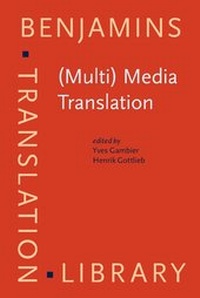
(Multi) Media Translation
Concepts, practices, and research
Published on 6. September 2001
Book
Hardback
298 pages
978-90-272-1639-7 (ISBN)
Description
The globalisation of communication networks has increased the domains of translation and is challenging ever more the translator's role. This volume is a collection of contributions from two different conferences (Misano, 1997 and Berlin, 1998). (Multi)Media translation, especially screen translation (TV, cinema, video), has made more explicit the complexities of any communication and has led us to take a fresh look at the translator's strategies and behaviours.Several papers ponder the concepts of media and multimedia, the necessity of interdisciplinarity, the polysemiotic dimension of audiovisual media. Quite a few discuss the current transformations in audiovisual media policy. A great many deal with practices, mainly in subtitling but also in interpreting for TV and surtitling: what are the quality parameters and the conditions to meet audience's expectations?
Finally some show the cultural and linguistic implications of screen translation. Digitalisation is changing production and broadcasting and speeding up convergence between media, telecommunications and information and communication technology.
Is (multi)media translation a new field of study or an umbrella framework for scholars from various disciplines? Is it a trick to overcome the absence of prestige in Translation Studies? Or is it just a buzz word which gives rise to confusion? These questions remain open: the 26 contributions are partial answers.
Finally some show the cultural and linguistic implications of screen translation. Digitalisation is changing production and broadcasting and speeding up convergence between media, telecommunications and information and communication technology.
Is (multi)media translation a new field of study or an umbrella framework for scholars from various disciplines? Is it a trick to overcome the absence of prestige in Translation Studies? Or is it just a buzz word which gives rise to confusion? These questions remain open: the 26 contributions are partial answers.
Reviews / Votes
Translation in the context of multimedia and technology will continue to evolve and take shape. The articles in this book give an excellent overview of this innovative area of study, and open the door to further research. -- Sabine Lauffer, Glendon College, York UniversityMore details
Series
Language
English
Place of publication
Amsterdam
Netherlands
Target group
College/higher education
Professional and scholarly
Dimensions
Height: 245 mm
Width: 164 mm
Weight
550 gr
ISBN-13
978-90-272-1639-7 (9789027216397)
Copyright in bibliographic data and cover images is held by Nielsen Book Services Limited or by the publishers or by their respective licensors: all rights reserved.
Schweitzer Classification
Other editions
Additional editions
E-Book
09/2001
1st Edition
John Benjamins Publishing Company
€136.99
Available for download
Persons
Content
1. Multimedia, Multilingua: Multiple Challenges (by Gambier, Yves); 2. Part I: Concepts; 3. Multimedia & Translation: Methodological Considerations (by Cattrysse, Patrick); 4. Some Thoughts on the Study of Multimodal and Multimedia Translation (by Remael, Aline); 5. Simultaneous Interpreting for Television and Other Media: Translation Doubly Constrained (by Viaggio, Sergio); 6. Hypertext and Cyberspace: New Challenges to Translation Studies (by Martinez, Domingo Sanchez-Mesa); 7. Images of Translation (by Goethals, Gregor); 8. Text and Context in Multimedia Translation (by Werner, J. Ritter); 9. About Remakes, Dubbing and Morphing: Some Comments on Visual Transformation Processes and their Relevance for Translation Theory (by Wehn, Karin); 10. Part II: Policies and Practices; 11. Shooting in English? Myth or Necessity? (by Jackel, Anne); 12. The Position of Foreign Languages in the Flemish Media (by Meylaerts, Reine); 13. Disentangling Audiovisual Translation into Catalan from the Spanish Media Mesh (by Zabalbeascoa, Patrick); 14. Interpreter-Mediated TV Live Interviews (by Alexieva, Bistra); 15. Conference Interpreters on the Air: Live Simultaneous Interpreting on Italian Television (by Mack, Gabriele); 16. Translation Quality. An Organizational Viewpoint (by Gummerus, Eivor); 17. Quality Down Under (by Muller, Felicity); 18. Quality Control of Subtitles: Review or Preview? (by James, Heulwen); 19. Subtitling for Channel 4 Television (by Morgan, Hazel R.); 20. Live Interlingual Subtitling (by Boer, Corien M. den); 21. Punctuating Subtitles: Typographical Conventions and their Evolution (by Ceron, Clara); 22. Surtitling Operas. With Examples of Translations from German into French and Dutch (by Dewolf, Linda); 23. Part III: Empirical Research; 24. The Choice to Subtitle Children's TV Programmes in Greece: Conforming to Superior Norms (by Karamitroglou, Fotios); 25. Striving for Quality in Subtitling: the Role of a Good Dialogue List (by Diaz Cintas, Jorge); 26. Features of Oral and Written Communication in Subtitling (by Assis Rosa, Alexandra); 27. The Subtitling of la Haine: A Case Study (by Jackel, Anne); 28. Transfert des references culturelles dans les sous-titres filmiques (by Tomaszkiewicz, Teresa); 29. Anglicisms and TV Subtitles in an Anglified World (by Gottlieb, Henrik); 30. Incidental Foreign-Language Acquisition by Children Watching Subtitled Television Programs (by Van de Poel, Marijke); 31. Epilogue; 32. Four Remarks on Translation Research and Multimedia (by Pym, Anthony); 33. References; 34. Subject Index; 35. List of Films and TV Programmes Cited