

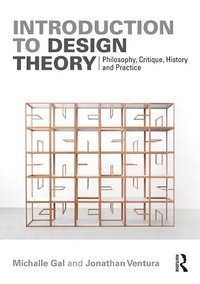
Introduction to Design Theory
Philosophy, Critique, History and Practice
1st Edition
Published on 31. July 2023
Book
Paperback/Softback
274 pages
978-1-032-10618-2 (ISBN)
Description
Introduction to Design Theory introduces a comprehensive, systematic, and didactic outline of the discourse of design. Designed both as a course book and a source for research, this textbook methodically covers the central concepts of design theory, definitions of design, its historical milestones, and its relations to culture, industry, body, ecology, language, society, gender and ideology.
Demonstrated by a shift towards the importance of the sociocultural context in which products are manufactured and embedded, this book showcases design theory as an emerging sub-discipline of design, unique in its practice-based approach and its broad perception of design. It offers an in-depth understanding of the central concepts, such as "form" and "function", "theory" and "practice", through a discussion of key case studies and historical examples, such as the advent of the view of design in antiquity, the introduction of mass production to modernist design or the ideological shifts in design in the mid-twentieth century, as well as analytical tools for further dissection and learning in practice. With a focus on a combination of several theoretical knowledge foundations - aesthetics and philosophy, critical theories, cultural studies, design history and design anthropology - the reader is enabled to approach design as a central pivot around which contemporary culture revolves, reflecting, reaffirming or challenging social and cultural structures.
Aimed towards undergraduate and postgraduate students, as well as teachers and scholars, from across the design disciplines, Introduction to Design Theory invites readers to engage with design from an interdisciplinary perspective, departing from the traditional academic compartmentalisation of practice, history and philosophy.
Demonstrated by a shift towards the importance of the sociocultural context in which products are manufactured and embedded, this book showcases design theory as an emerging sub-discipline of design, unique in its practice-based approach and its broad perception of design. It offers an in-depth understanding of the central concepts, such as "form" and "function", "theory" and "practice", through a discussion of key case studies and historical examples, such as the advent of the view of design in antiquity, the introduction of mass production to modernist design or the ideological shifts in design in the mid-twentieth century, as well as analytical tools for further dissection and learning in practice. With a focus on a combination of several theoretical knowledge foundations - aesthetics and philosophy, critical theories, cultural studies, design history and design anthropology - the reader is enabled to approach design as a central pivot around which contemporary culture revolves, reflecting, reaffirming or challenging social and cultural structures.
Aimed towards undergraduate and postgraduate students, as well as teachers and scholars, from across the design disciplines, Introduction to Design Theory invites readers to engage with design from an interdisciplinary perspective, departing from the traditional academic compartmentalisation of practice, history and philosophy.
Reviews / Votes
"Michalle Gal and Jonathan Ventura have produced a fascinating historical tour of the complexities of design theory with all its contradictions and reversals. The stumbles and contradictions are important, for they show that the answer to what appears to be a simple question, 'what is design?', changes every time new findings and evidence appears. The book should appeal to students and advanced scholars, showing that this confusion is proper and appropriate. Their summary is apt: design is a bricolage of methods and approaches. We should not ask 'what is design?' but instead ask 'what can design achieve?'"Don Norman, Distinguished Professor Emeritus, University of California, San Diego, USA; and author of "Design for a Better World".
"Michalle Gal and Jonathan Ventura provide a wide-ranging and engaging survey of the many facets of Design. Touching on perennial theoretical questions as well as contemporary examples and issues, An Introduction to Design Theory will appeal to theorists and practitioners alike."
Glenn Parsons, Professor, Toronto Metropolitan University, Canada.
More details
Language
English
Place of publication
London
United Kingdom
Publishing group
Taylor & Francis Ltd
Target group
College/higher education
Postgraduate and Undergraduate Advanced
Illustrations
98 s/w Abbildungen, 95 s/w Photographien bzw. Rasterbilder, 3 s/w Zeichnungen
3 Line drawings, black and white; 100 Halftones, black and white; 103 Illustrations, black and white
Dimensions
Height: 243 mm
Width: 172 mm
Thickness: 18 mm
Weight
560 gr
ISBN-13
978-1-032-10618-2 (9781032106182)
Copyright in bibliographic data and cover images is held by Nielsen Book Services Limited or by the publishers or by their respective licensors: all rights reserved.
Schweitzer Classification
Other editions
Additional editions
Michalle Gal | Jonathan Ventura
Introduction to Design Theory
Philosophy, Critique, History and Practice
E-Book
07/2023
1st Edition
Routledge
€51.49
Available for download
Michalle Gal | Jonathan Ventura
Introduction to Design Theory
Philosophy, Critique, History and Practice
E-Book
07/2023
1st Edition
Routledge
€51.49
Available for download

Michalle Gal | Jonathan Ventura
Introduction to Design Theory
Philosophy, Critique, History and Practice
Book
07/2023
1st Edition
Routledge
€200.54
Shipment within 10-20 days
Persons
Michalle Gal is a Professor of Philosophy at the Unit of History and Philosophy of Art and Design and the Interdisciplinary Design Graduate Program, Shenkar College, Israel. Gal is the author of Visual Metaphors and Aesthetics: A Formalist Theory of Metaphor (2022) and Aestheticism: Deep Formalism and the Emergence of Modernist Aesthetics (2015), and the co-editor of the special issues Art and Gesture (2014), Visual Hybrids (2023, Poetics Today) and Design and its Relations (2023, Journal of Comparative Literature and Aesthetics).
Jonathan Ventura is a Professor of Design Theory and Research and the Director of the Unit for History and Philosophy of Art and Design at Shenkar College, Israel; Ventura is also a visiting scholar at the Helen Hamlyn Centre for Design, Royal College of Art, UK, and an international instructor at the PhD School at MOME University in Budapest Hungary. He is the co-founder and co-director of the international Social Design Network (https://www.socialdesignnetwork.org/).
Jonathan Ventura is a Professor of Design Theory and Research and the Director of the Unit for History and Philosophy of Art and Design at Shenkar College, Israel; Ventura is also a visiting scholar at the Helen Hamlyn Centre for Design, Royal College of Art, UK, and an international instructor at the PhD School at MOME University in Budapest Hungary. He is the co-founder and co-director of the international Social Design Network (https://www.socialdesignnetwork.org/).
Content
Introduction 1. Definitions of Design 2. Form and Function 3. Design and (or as) Language 4. Design Between Theory and Practice: Applied Theories of Design 5 Design, Culture, and Social Institutions 6. Design and Industry 7. Design, Ecologies and the Body 8. Design and Ideology