

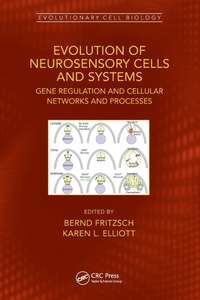
Evolution of Neurosensory Cells and Systems
Gene regulation and cellular networks and processes
1st Edition
Published on 27. May 2024
Book
Paperback/Softback
308 pages
978-0-367-55287-9 (ISBN)
Description
This book is an overview of primary sensory maps of vertebrates, characterized by continuous and discrete properties. The eight primary sensory maps of vertebrates have unique features and use distinct molecular cues, cell cycle exit, and activity combinations during development, regeneration, and plasticity. As an introduction and overview, the book provides a short overview for all eight sensory senses and presents through evolution and gene regulatory networks, the molecular cues needed for sensory processing. Independent contributions are included for olfactory, vision, trigeminal, taste, vestibular, auditory, lateral line, and electroreception.
More details
Series
Language
English
Place of publication
London
United Kingdom
Publishing group
Taylor & Francis Ltd
Target group
College/higher education
Professional and scholarly
Postgraduate, Professional, and Undergraduate Advanced
Illustrations
15 s/w Abbildungen, 55 farbige Abbildungen, 8 s/w Photographien bzw. Rasterbilder, 10 Farbfotos bzw. farbige Rasterbilder, 7 s/w Zeichnungen, 45 farbige Zeichnungen, 3 s/w Tabellen
3 Tables, black and white; 45 Line drawings, color; 7 Line drawings, black and white; 10 Halftones, color; 8 Halftones, black and white; 55 Illustrations, color; 15 Illustrations, black and white
Dimensions
Height: 234 mm
Width: 156 mm
Thickness: 17 mm
Weight
474 gr
ISBN-13
978-0-367-55287-9 (9780367552879)
Copyright in bibliographic data and cover images is held by Nielsen Book Services Limited or by the publishers or by their respective licensors: all rights reserved.
Schweitzer Classification
Other editions
Additional editions
Bernd Fritzsch | Karen Elliott
Evolution of Neurosensory Cells and Systems
Gene regulation and cellular networks and processes
Book
05/2022
1st Edition
CRC Press
€229.80
Shipment within 15-20 days
Bernd Fritzsch | Karen Elliott
Evolution of Neurosensory Cells and Systems
Gene regulation and cellular networks and processes
E-Book
05/2022
1st Edition
CRC Press
€72.49
Available for download
Bernd Fritzsch | Karen Elliott
Evolution of Neurosensory Cells and Systems
Gene regulation and cellular networks and processes
E-Book
05/2022
1st Edition
CRC Press
€72.49
Available for download
Persons
Bernd Fritzsch Ph.D., is the Associate Director of the Aging Mind and Brain Initiative. He is Professor and Chair of the Department of Biology, holds an Endowed Entrepreneurial Professor title and is a Fellow of the AAAS. He holds secondary appointments in the Department of Otolaryngology, is a member of the DELTA center and is core co-director of the recently awarded P30 in auditory research. He received his PhD from the University of Darmstadt, was awarded the prestigious Heisenberg Fellowship and has published over 250 papers and reviews. Prior to becoming the Chair in the Department of Biology he served as Assistant Dean for Research in the College of Medicine at Creighton University. He is on the editorial board of three journals, serves currently on an NIH study section, has been ad hoc reviewer for multiple journals and funding agencies across the globe and has organized multiple national and international meetings some resulting in either a book or special journal volume publications. His research focuses on the early development of the inner ears neurosensory system that is prone to be lost with age, isolating seniors from their normal social interactions. While cochlear implants serve as remarkably functional substitutes, a cure would require regeneration of the hearing organ. To this end he is manipulating gene cascades during mouse development to assess their possible use for the reconstitution of a normal hearing organ in the elderly.
Karen Louise Elliot Thompson is an Assistant Research Scientist in the Fritzsch lab. She recently received the D.C. Spriestersbach Dissertation Prize in the biological and life sciences. Thompson received her doctorate in biology in 2013.
Karen Louise Elliot Thompson is an Assistant Research Scientist in the Fritzsch lab. She recently received the D.C. Spriestersbach Dissertation Prize in the biological and life sciences. Thompson received her doctorate in biology in 2013.
Content
Introduction and overview; from the molecular basis of a given sense and diversified the various senses to expand and contracts in different species.
Olfactory development and evolution: from sensing to cortical information processing.
Vision and retina information processing: going from opsins to the visual cortex.
Trigeminal and related spinal projections: how to cross or not the multisensory projections.
Taste buds explained: from taste sending to taste processing in the forbrain.
Vestibular processing: from mechanosensation to the cortex underlies a broad input.
Auditory as derived 'vestibular' sensory input: keeping the same molecular transduction in a different way to hear.
Lateral line input to 'almost' all vertebrates is a common organization with different distinct connections. Electroreception: a novel hair cell derived sense of some but not all vertebrates.
Integrated perspective of common and differences across variable sensory receptors and their central and distinct forebrain inputs
Olfactory development and evolution: from sensing to cortical information processing.
Vision and retina information processing: going from opsins to the visual cortex.
Trigeminal and related spinal projections: how to cross or not the multisensory projections.
Taste buds explained: from taste sending to taste processing in the forbrain.
Vestibular processing: from mechanosensation to the cortex underlies a broad input.
Auditory as derived 'vestibular' sensory input: keeping the same molecular transduction in a different way to hear.
Lateral line input to 'almost' all vertebrates is a common organization with different distinct connections. Electroreception: a novel hair cell derived sense of some but not all vertebrates.
Integrated perspective of common and differences across variable sensory receptors and their central and distinct forebrain inputs