

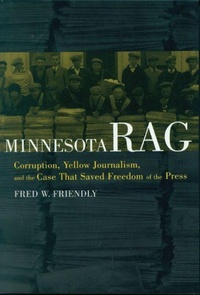
Minnesota Rag
Corruption, Yellow Journalism, and the Case That Saved Freedom of the Press
Will be published approx. on 6. May 2003
Book
Paperback/Softback
256 pages
978-0-8166-4161-1 (ISBN)
Description
The fascinating behind-the-scenes story of this landmark First Amendment case
Minnesota Rag takes the reader on an exhilarating tour of the seamy underside of a dark period in Minnesota's past, one rife with crooked public officials, vengeful gangsters, and yellow journalists. Featuring notorious characters such as Jay M. Near, racist and antilabor publisher of Minneapolis's Saturday Press, pioneering newsman Fred W. Friendly weaves the tale of a court case that molded our understanding of freedom of the press and set a precedent for the publication of the Pentagon Papers.
Minnesota Rag takes the reader on an exhilarating tour of the seamy underside of a dark period in Minnesota's past, one rife with crooked public officials, vengeful gangsters, and yellow journalists. Featuring notorious characters such as Jay M. Near, racist and antilabor publisher of Minneapolis's Saturday Press, pioneering newsman Fred W. Friendly weaves the tale of a court case that molded our understanding of freedom of the press and set a precedent for the publication of the Pentagon Papers.
More details
Language
English
Place of publication
Minnesota
United States
Target group
College/higher education
Professional and scholarly
Product notice
Paperback (trade)
Unsewn / adhesive bound
Dimensions
Height: 206 mm
Width: 142 mm
Thickness: 14 mm
Weight
290 gr
ISBN-13
978-0-8166-4161-1 (9780816641611)
Copyright in bibliographic data and cover images is held by Nielsen Book Services Limited or by the publishers or by their respective licensors: all rights reserved.
Schweitzer Classification
Person
Fred W. Friendly (1915-1998) spent virtually his entire life in journalism. With his partner Edward R. Murrow, he was responsible for many of television's most distinguished moments, including See It Now and CBS Reports. After serving as president of CBS News, he was named professor of journalism at Columbia University.