

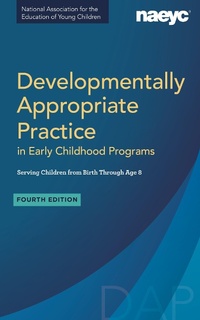
Developmentally Appropriate Practice in Early Childhood Programs Serving Children from Birth Through Age 8, Fourth Edition (Fully Revised and Updated)
4th Edition
Will be published approx. on 13. January 2022
Book
Paperback/Softback
368 pages
978-1-938113-95-6 (ISBN)
Description
The long-awaited new edition of NAEYC's Developmentally Appropriate Practice in Early Childhood Programs is here, fully revised and updated! Since the first edition in 1987,this book has been an essential resource for the early childhood education field. Early childhood educators have a professional responsibility to plan and implement intentional, developmentally appropriate learning experiences that promote the social and emotional development, physical development and health, cognitive development, and general learning competencies of each child served.
But what is developmentally appropriate practice (DAP)? DAP is a framework designed to promote young children's optimal learning and development through a strengths-based approach to joyful, engaged learning. As educators make decisions to support each child's learning and development, they consider what they know about (1) commonality in children's development and learning, (2) each child as an individual (within the context of their family and community), and (3) everything discernible about the social and cultural contexts for each child, each educator, and the program as a whole.
This latest edition of the book is fully revised to underscore the critical role social and cultural contexts play in child development and learning, including new research about implicit bias and teachers' own context and consideration of advances in neuroscience. Educators implement developmentally appropriate practice by recognizing the many assets all young children bring to the early learning program as individuals and as members of families and communities. They also develop an awareness of their own context. Building on each child's strengths, educators design and implement learning settings to help each child achieve their full potential across all domains of development and across all content areas.
But what is developmentally appropriate practice (DAP)? DAP is a framework designed to promote young children's optimal learning and development through a strengths-based approach to joyful, engaged learning. As educators make decisions to support each child's learning and development, they consider what they know about (1) commonality in children's development and learning, (2) each child as an individual (within the context of their family and community), and (3) everything discernible about the social and cultural contexts for each child, each educator, and the program as a whole.
This latest edition of the book is fully revised to underscore the critical role social and cultural contexts play in child development and learning, including new research about implicit bias and teachers' own context and consideration of advances in neuroscience. Educators implement developmentally appropriate practice by recognizing the many assets all young children bring to the early learning program as individuals and as members of families and communities. They also develop an awareness of their own context. Building on each child's strengths, educators design and implement learning settings to help each child achieve their full potential across all domains of development and across all content areas.
Reviews / Votes
Continuing its path-breaking tradition, the fourth edition of Developmentally Appropriate Practice is fresh and remarkably resonant with contemporary issues; it is ethically provocative and practically useful. Elevating the importance of cultural, social, and educational contexts, this edition beckons intentional reflection on the role and transcendence of bias in inhibiting the creation of just learning opportunities and a just society. To advance this hard and necessary work, this edition also offers practical guideposts, including rich examples and probing discussion questions. Its elegant nine principles of development and learning render it an unparalleled gift to the profession.-Sharon Lynn Kagan, Marx Professor of Early Childhood and Family Policy, Teachers College, Columbia University
This work fully supports our practice in the field of early learning and care. Educators of children from birth to age 8 will use this information to learn applicable skills for teaching through developmentally appropriate practices that build brains during the critical first five years of life.
-Barbara J. Cooper, Secretary, Alabama Department of Early Childhood Education
This newest edition provides a wealth of information for both new and experienced teachers. From emphasizing a both/and approach to incorporating strengths-based intentional teaching, this book guides early childhood professionals to refine and reflect on the decisions they make every day that impact young children.
-Debbie Pischke, Early Childhood Director, Peoria Unified School District
Yet again, NAEYC has struck the perfect balance between what practitioners in the field need and what researchers and administrators will use to apply developmentally appropriate practice. The timeliness of the updates toward equity allows us all to deliver on the sacred promise to make early childhood matter most.
-Edward J. Manuszak II, Superintendent, Dundee Community Schools, and Early Learning Cohort Co-Chair, The School Superintendents Association (AASA)
The authors of this book wisely remind us of three foundational pillars: Children have universal needs, even as each child yearns be seen and heard; teaching practices are fruitful when planted in relationships; and we learn and grow best in a reciprocal partnership among educators, families, and communities.
-Junlei Li, Saul Zaentz Senior Lecturer in Early Childhood Education and Co-Chair of the Human Development and Education Program, Harvard Graduate School of Education
If educators intentionally meet children where they are and implement NAEYC's updated guidelines and recommendations for developmentally appropriate practice, there is no question that children will have meaningful opportunities to thrive in joyful learning environments where inclusive, research-based, high-quality early education is the norm and not the exception. This must be the goal of all early childhood education programs, but it requires unwavering support from funders, policymakers, administrators, teaching practitioners, and the private sector.
-Maria-Isabel Ballivian, Executive Director, Annandale Christian Community for Action Child Development Center
I really appreciate the organization and layout of the book, with learning objectives and thought questions at the beginning of each chapter and opportunities to reflect at the end. Overall, I am pleased to see the evolution of Developmentally Appropriate Practice and its inclusive move from an either/or to a both/and way of looking at how early childhood professionals can better serve children and families. I am looking forward to using this book in the classes I teach.
-Benita Flores-Munoz, Professor of Child Development, Del Mar College
Schools are complex organizations and young children are complex human beings. Ensuring that organizations are designed for the children they serve is at the heart of developmentally appropriate practice. All administrators should read this book and consider the appropriateness and effectiveness of their approach.
-Vincent J. Costanza, Principal, Metuchen Public Schools
This volume uses research and teaching experience to describe the balance needed in today's programs for young children. The avoidance of either/or positions in pedagogy, culture and language, and family involvement make it perfect for teachers and students.
-Barbara T. Bowman, Irving B. Harris Professor of Child Development, Erikson Institute
Aristotle once said, "Educating the mind without educating the heart is no education at all." The revised edition of Developmentally Appropriate Practice invites educators to discover the whys of their decision making, emphasizing the importance of understanding the social contexts in which relationships and learning are built.
-Margarita Marichal-Lugo, Associate Professor of Early Childhood Education, Inter American University of Puerto Rico
As a long-time consumer of NAEYC resources, especially content related to developmentally appropriate practice, it is encouraging to see the evolution of thought from "best practices" to a model that recognizes the complex needs and inherent strengths of each and every child and family.
-Dina Walker-DeVose, Associate Professor of Child and Family Development, Georgia Southern University
Intentionality-this is the word that best describes the focus of the latest edition of this foundational text. Early childhood educators have a pedagogical tool that recognizes the strength of both/and approach to teaching and learning.
-Meghan Gowin, Primary Teacher, Uplift Ascend Primary, and Doctoral Candidate, Texas A&M University-Commerce
More details
Edition
4th New edition
Language
English
Place of publication
Washington DC
United States
Target group
Professional and scholarly
Edition type
New edition
Product notice
Paperback (trade)
Illustrations
Figures and tables
Dimensions
Height: 277 mm
Width: 216 mm
Thickness: 20 mm
Weight
1069 gr
ISBN-13
978-1-938113-95-6 (9781938113956)
Copyright in bibliographic data and cover images is held by Nielsen Book Services Limited or by the publishers or by their respective licensors: all rights reserved.
Schweitzer Classification
Other editions
Additional editions
Naeyc | Susan Friedman | Brian L. Wright
Developmentally Appropriate Practice in Early Childhood Programs Serving Children from Birth Through Age 8, Fourth Edition (Fully Revised and Updated)
E-Book
12/2021
4th Edition
The National Association for the Education of Young Children
€68.49
Available for download
Previous edition
Carol Copple | Sue Bredekamp
Developmentally Appropriate Practice in Early Childhood Programs
Serving Children From Birth Through Age 8
Book
01/2009
3rd Edition
National Association for the Education of Young Children
€63.32
Article exhausted; check for reprint
Persons
A range of early childhood experts will be key contributors including the following:
NAEYC Volume Editor:
Susan Friedman is senior director of publishing and content development at NAEYC. In this role, she leads the content development work of NAEYC's books and periodicals teams. Ms.
Friedman is coeditor of Each and Every Child: Teaching Preschool with an Equity Lens. She has extensive prior experience creating content on play, developmentally appropriate uses of media, and other topics for educators and families. She began her career as a preschool teacher at City and Country School in New York City. She holds degrees from Vassar College and the Harvard Graduate School of Education.
Volume Editors and Contributing Editors:
Sue Bredekamp, PhD, is an early childhood education consultant on developmentally appropriate practice, curriculum, teaching, and professional development. She coedited NAEYC's 1986, 1997, and 2009 editions of Developmentally Appropriate Practice, and she developed and directed NAEYC's accreditation system for early childhood programs. Dr. Bredekamp is the author of an introductory teacher education textbook, Effective Practices in Early Childhood Education: Building a Foundation, Third Edition (Pearson, 2016).
Marie Masterson, PhD, is director of quality assessment at the McCormick Center for Early Childhood Leadership. She is a licensed teacher, national speaker, and author of many books and articles that address research-based, practical skills for high-quality teaching, children's development and behavior in cultural contexts, family engagement, and family child care. Dr. Masterson provides content expertise and consultation to organizations and systems involved in quality improvement and leadership development.
Barbara Willer, PhD, retired from NAEYC after 35 years of service and leadership. During her tenure, Dr. Willer led many substantive projects to further NAEYC's mission. The capstone efforts of her contributions to NAEYC and the field were leading the development of the position statements "Advancing Equity in Early Childhood Education" (2019) and "Developmentally Appropriate Practice" (2020).
Brian L. Wright, PhD, is associate professor and coordinator of the early childhood education program as well as coordinator of the middle school cohort of the African American Male Academy at the University of Memphis. Dr. Wright is author of The Brilliance of Black Boys: Cultivating School Success in the Early Grades, with contributions by Shelly L. Counsell, which won the National Association for Multicultural Education's 2018 Phillip C. Chinn Book Award.
NAEYC Volume Editor:
Susan Friedman is senior director of publishing and content development at NAEYC. In this role, she leads the content development work of NAEYC's books and periodicals teams. Ms.
Friedman is coeditor of Each and Every Child: Teaching Preschool with an Equity Lens. She has extensive prior experience creating content on play, developmentally appropriate uses of media, and other topics for educators and families. She began her career as a preschool teacher at City and Country School in New York City. She holds degrees from Vassar College and the Harvard Graduate School of Education.
Volume Editors and Contributing Editors:
Sue Bredekamp, PhD, is an early childhood education consultant on developmentally appropriate practice, curriculum, teaching, and professional development. She coedited NAEYC's 1986, 1997, and 2009 editions of Developmentally Appropriate Practice, and she developed and directed NAEYC's accreditation system for early childhood programs. Dr. Bredekamp is the author of an introductory teacher education textbook, Effective Practices in Early Childhood Education: Building a Foundation, Third Edition (Pearson, 2016).
Marie Masterson, PhD, is director of quality assessment at the McCormick Center for Early Childhood Leadership. She is a licensed teacher, national speaker, and author of many books and articles that address research-based, practical skills for high-quality teaching, children's development and behavior in cultural contexts, family engagement, and family child care. Dr. Masterson provides content expertise and consultation to organizations and systems involved in quality improvement and leadership development.
Barbara Willer, PhD, retired from NAEYC after 35 years of service and leadership. During her tenure, Dr. Willer led many substantive projects to further NAEYC's mission. The capstone efforts of her contributions to NAEYC and the field were leading the development of the position statements "Advancing Equity in Early Childhood Education" (2019) and "Developmentally Appropriate Practice" (2020).
Brian L. Wright, PhD, is associate professor and coordinator of the early childhood education program as well as coordinator of the middle school cohort of the African American Male Academy at the University of Memphis. Dr. Wright is author of The Brilliance of Black Boys: Cultivating School Success in the Early Grades, with contributions by Shelly L. Counsell, which won the National Association for Multicultural Education's 2018 Phillip C. Chinn Book Award.
Content
List of Vignettes
Acknowledgments
Susan Friedman
Editors, Authors, and Contributors
Foreword
Tammy Mann
Preface
Susan Friedman
About this Book
Position Statement
Part 1: Developmentally
Appropriate Practice in Context
Chapter 1: Intentional Teaching: Complex Decision Making
and the Core Considerations
Sue Bredekamp and Barbara Willer
Chapter 2: The Principles in Practice: Understanding
Child Development and Learning in Context
Iheoma U. Iruka
Chapter 3: Context Matters: Reframing Teaching in
Early Childhood Education
Susan Friedman, Marie Masterson, and Brian L.
Wright
Chapter 3 Appendix: Theoretical Frameworks for
Understanding Child Development and Context
Brian L. Wright
Chapter 4: Teaching Content in Early Childhood Education
Douglas H. Clements and Tanya S. Wright
Chapter 5: The Power of Playful Learning in the Early
Childhood Setting
Jennifer M. Zosh, Caroline Gaudreau, Roberta
Michnick Golinkoff, and Kathy Hirsh-Pasek
Part 2: Developmentally
Appropriate Practice in Action
Chapter 6: Creating a Caring, Equitable
Community of Learners
Brian L. Wright
Chapter 7: Engaging in Reciprocal Partnerships with Families and Fostering Community
Connections
Lorena Mancilla and Patricia Blanco
Chapter 8: Observing, Documenting, and Assessing
Children's Development and Learning
Catherine Scott-Little, with Kathy L.
Reschke
Chapter 9: Teaching to Enhance Each Child's
Development and Learning
Marie Masterson
Chapter 10: Planning and
Implementing an Engaging Curriculum to Achieve Meaningful Goals
Marie Masterson
Chapter 11: Demonstrating Professionalism as an Early
Childhood Educator
Losmeiya Huang, Sim Loh, and Ashley Simpson, with Lauren
Hogan, Lucy Recio, and Mary Harrill
Appendices
Appendix A: Developmentally Appropriate Practice in
Action: Educator Snapshots and Reflections
Appendix B: Digging Deeper into Knowledge
Appendix C: Changes to the Position Statement, Changes to
the Book: Resources and Strategies for Faculty
Camille Catlett, Eva Horn, and Florianna J. Thompson
Appendix D: Creating and Implementing Developmentally
Appropriate Curriculum: A Guide for Public School Audiences
Jason Sachs and Chris Bucco
Appendix E: Developmentally Appropriate Practice in the
Early Learning Setting: Tips and Resources for Early Childhood Educators
Glossary
References
Index
Acknowledgments
Susan Friedman
Editors, Authors, and Contributors
Foreword
Tammy Mann
Preface
Susan Friedman
About this Book
Position Statement
Part 1: Developmentally
Appropriate Practice in Context
Chapter 1: Intentional Teaching: Complex Decision Making
and the Core Considerations
Sue Bredekamp and Barbara Willer
Chapter 2: The Principles in Practice: Understanding
Child Development and Learning in Context
Iheoma U. Iruka
Chapter 3: Context Matters: Reframing Teaching in
Early Childhood Education
Susan Friedman, Marie Masterson, and Brian L.
Wright
Chapter 3 Appendix: Theoretical Frameworks for
Understanding Child Development and Context
Brian L. Wright
Chapter 4: Teaching Content in Early Childhood Education
Douglas H. Clements and Tanya S. Wright
Chapter 5: The Power of Playful Learning in the Early
Childhood Setting
Jennifer M. Zosh, Caroline Gaudreau, Roberta
Michnick Golinkoff, and Kathy Hirsh-Pasek
Part 2: Developmentally
Appropriate Practice in Action
Chapter 6: Creating a Caring, Equitable
Community of Learners
Brian L. Wright
Chapter 7: Engaging in Reciprocal Partnerships with Families and Fostering Community
Connections
Lorena Mancilla and Patricia Blanco
Chapter 8: Observing, Documenting, and Assessing
Children's Development and Learning
Catherine Scott-Little, with Kathy L.
Reschke
Chapter 9: Teaching to Enhance Each Child's
Development and Learning
Marie Masterson
Chapter 10: Planning and
Implementing an Engaging Curriculum to Achieve Meaningful Goals
Marie Masterson
Chapter 11: Demonstrating Professionalism as an Early
Childhood Educator
Losmeiya Huang, Sim Loh, and Ashley Simpson, with Lauren
Hogan, Lucy Recio, and Mary Harrill
Appendices
Appendix A: Developmentally Appropriate Practice in
Action: Educator Snapshots and Reflections
Appendix B: Digging Deeper into Knowledge
Appendix C: Changes to the Position Statement, Changes to
the Book: Resources and Strategies for Faculty
Camille Catlett, Eva Horn, and Florianna J. Thompson
Appendix D: Creating and Implementing Developmentally
Appropriate Curriculum: A Guide for Public School Audiences
Jason Sachs and Chris Bucco
Appendix E: Developmentally Appropriate Practice in the
Early Learning Setting: Tips and Resources for Early Childhood Educators
Glossary
References
Index